Sentinel is governed AI infrastructure installed inside your company. People work with their AI assistant, your systems stay where they are, and in between there's a boundary that decides who can read what and who can write where. Every action goes in the log, and everything published can be undone.
Sentinel is part of the Custom plan.
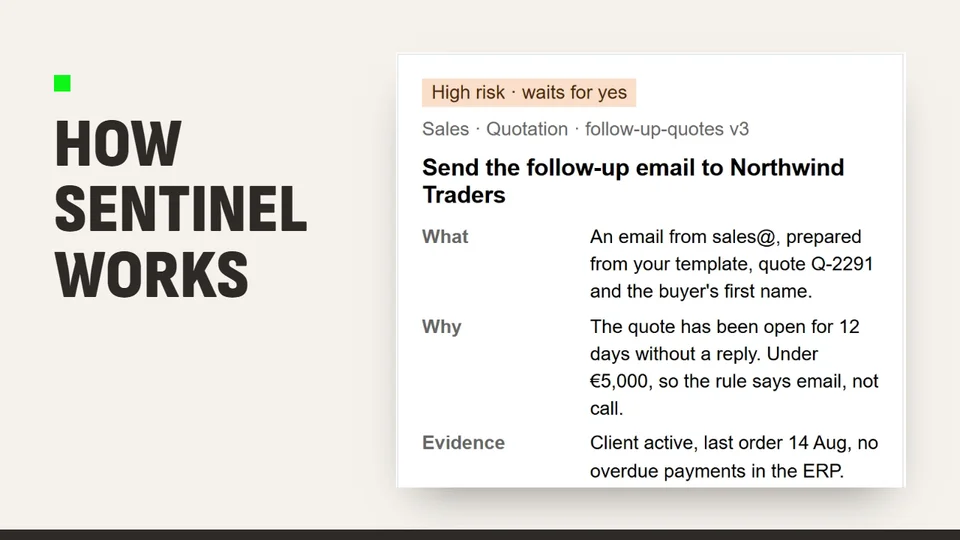
High risk · waits for your yes
Send the reminder for quote Q-2291
- What
- An email from your template, with the quote and the customer's name.
- Why
- The quote has been open for 12 days without a reply. Below the threshold, the rule says email, not a call.
- Evidence
- Active customer, last order in August, no overdue payments in your management software.
- What happens
- When you press Yes the email goes out. It can't be undone, and the log says so.
Yes, send itRedo with a noteUndo
| Time | Who | Procedure | Model | Cost | Outcome |
|---|---|---|---|---|---|
| 09:58 | orchestrator | weekly-report v2 | — | €0.00 | queued |
| 09:52 | sales rep | quote-follow-up v3 | model A | €0.02 | running, step 3 of 6 |
| 09:38 | orchestrator | quote-follow-up v3 | model A | €0.09 | done, 1 card opened |
| 09:20 | orchestrator | quote-follow-up v3 | — | €0.01 | failed, the CRM refused |
| 08:04 | orchestrator | weekly-report v2 | model A | €0.05 | published |
 Coming soon
An AI agent today can write a reminder, fill in a record, prepare the Monday report. What no owner or IT manager wants to do is hand it the credentials to the CRM, the management software and the company email. With Sentinel the AI decides what should happen, but it never holds the keys.
-
An entrance that knows who you are
Every request arrives with an identity, a role and a department. A sales rep sees their own customers, not their colleagues'. Anyone not authorised gets a no, not half an answer.
-
Jobs become procedures
Every job is a written procedure, with an owner, a risk level and a way to undo it. When you change one, the others stay consistent.
-
An exit with three risk levels
Agents never write into your systems, only fixed steps do. Low risk, the action runs and goes in the log. Medium, it runs with an Undo button. High, it waits for your yes and you see exactly what will go out. An email to the outside world is always high risk, and no level ever lowers itself.
-
A log that can't be erased
Every run records who asked, which AI model did the work, what it read, what went out and what it cost.
-
The AI model changes, the memory stays yours
Sentinel uses providers' AI models without tying itself to any of them. The model is chosen on a test bench with your real tasks, thresholds written beforehand, and changed when a better one comes out. The yardstick is the cost per completed task.
How much has Northwind Traders ordered this quarter?
12 orders, €18,400. From your management software, read-only.
Show me the customers in the south region.
Not authorised. Those customers aren't part of your role.
- Every Monday it reads quotes open for more than 7 dayslast Monday 22
- Overdue payments? Hands over to accounts and stops3 passed on
- Call or email? A rule decides by amount and customer4 calls, 13 emails
- Writes the reminder from your template13 drafts
- You press send, one email at a time13 yes
- Logs the action on the quote in your management software22 logged
- the machine does it
- a rule decides
- a text is written
- you press
Low riskIt runs and goes in the log.
Medium riskIt runs and leaves a record with an Undo button.
High riskIt waits for your yes, and you see the exact email that will go out.
High risk · waits for your yes
Send the reminder for quote Q-2291
- What
- An email from your template, with the quote and the customer's name.
- Why
- The quote has been open for 12 days without a reply. Below the threshold, the rule says email, not a call.
- Evidence
- Active customer, last order in August, no overdue payments in your management software.
- What happens
- When you press Yes the email goes out. It can't be undone, and the log says so.
Yes, send itRedo with a noteUndo
| Time | Who | Procedure | Model | Cost | Outcome |
|---|---|---|---|---|---|
| 09:58 | orchestrator | weekly-report v2 | — | €0.00 | queued |
| 09:52 | sales rep | quote-follow-up v3 | model A | €0.02 | running, step 3 of 6 |
| 09:38 | orchestrator | quote-follow-up v3 | model A | €0.09 | done, 1 card opened |
| 09:20 | orchestrator | quote-follow-up v3 | — | €0.01 | failed, the CRM refused |
| 08:04 | orchestrator | weekly-report v2 | model A | €0.05 | published |
- Model A · current
- Model B
- Model C
-
Live sales figures
Reps ask in Teams how much a customer has ordered, and the answer comes read-only from your management software. Each sees only their own customers.
-
Reminders that don't depend on memory
After 7 days a reminder to the rep, after 14 an alert to the manager. The email to the customer only goes out after a person says yes.
-
One discontinued product, five departments
Five actions at once, each with its owner and deadline. Sentinel follows up on whoever is late and closes the case.
-
Follow-up with sensitive data kept out
CRM, accounting and email connected. Sensitive data stays outside the boundary, and the log proves it.
-
The Monday report
Low risk. It goes out at 7 with figures from your management software and a comparison with the week before.
-
Choosing the AI model with numbers
The same procedures run on two models, including cases designed to trip up the agent. The decision comes with a table.
Who it's for
Structured companies with a team and clear rules on who approves what. With work that repeats across CRM, management software, email and Teams, and an owner or IT manager who wants control before automation.
Who it isn't for
It isn't a chatbot. It isn't switch-on-and-forget. It doesn't replace your tools. And it doesn't tie you to a single AI model, which is chosen on the test bench and changed when a better one comes out.
Every company has its own installation, never shared, in the country it chooses. You start with one department and, once it works, extend to the others. At first everything is high risk, and you lower the levels yourself, procedure by procedure.
-
Phase 1, assisted
People work with their assistant, and every action waits for their yes.
-
Phase 2, orchestrated
Procedures start on their own when needed, at the risk level you've set.
-
Phase 3, shared
Several departments work on the same system. It's the frontier, and here we don't promise dates.
The fee is monthly, with a pool of hours. Rule changes are included, and every quarter the test bench is rerun on the models.
Which work would you take off your team's plate?
Tell Maia how your company works, out loud or in writing. She'll help you see which department to start with on Sentinel. The consultation is free.
Questions
Who decides what the AI can do?
You do. Every procedure has a risk level. No level lowers itself, you lower it, procedure by procedure, with a signature.
Which AI model does it use?
The one that wins the test bench on your real tasks. Sentinel uses providers' models without tying itself to any of them, and the model changes when a better one comes out.
Where is the data?
In an installation that's yours alone, never shared, in the country you choose.
Can we keep some data out?
Yes. The data you choose stays outside the boundary, and the log proves no one read it.
Which plan is it in?
The Custom plan.