
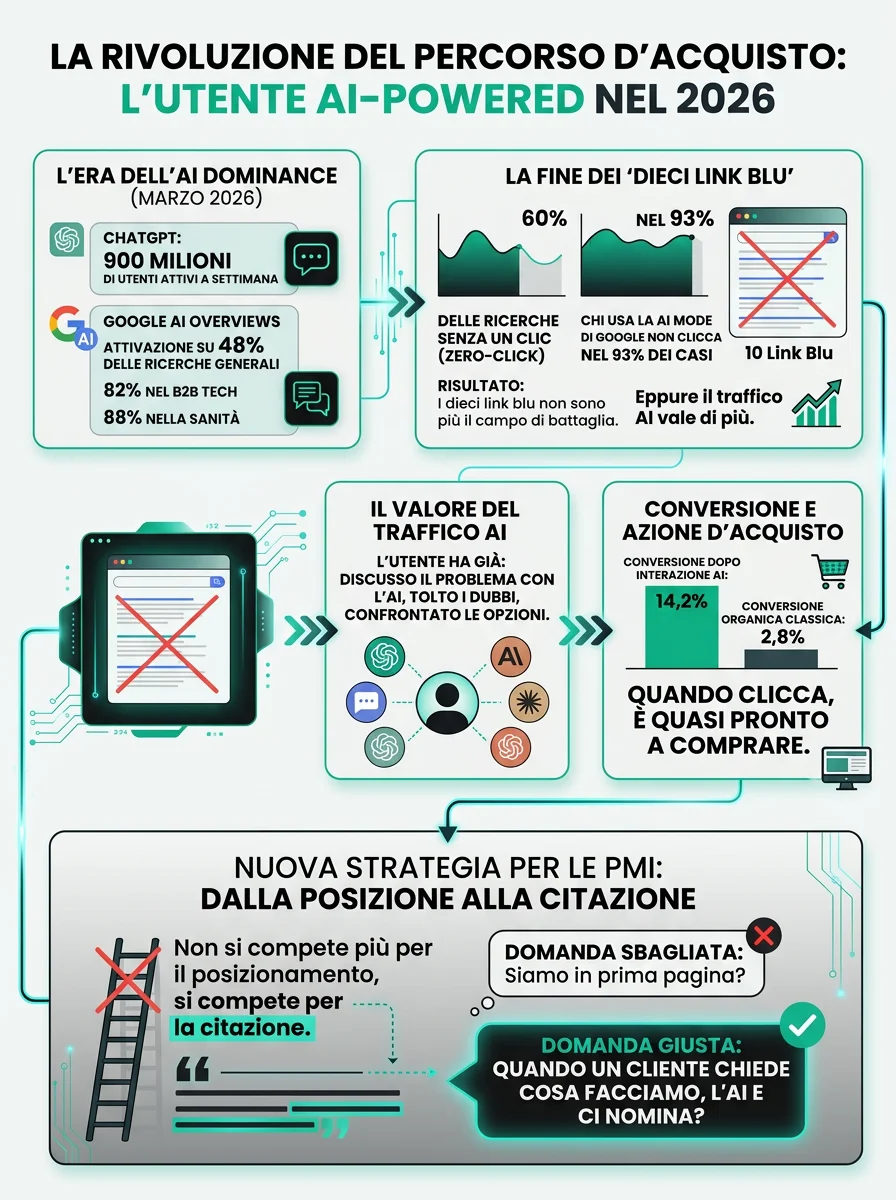
As of March 2026, ChatGPT has 900 million weekly active users. Google's AI Overviews show up on 48% of searches, on 82% in B2B tech and on 88% in healthcare.
60% of searches end without a click. People using Google's AI Mode don't click in 93% of cases. The ten blue links on page one are no longer where the fight happens.
And yet the little traffic that does come from AI is worth a lot more. Visitors who land on a site after talking to ChatGPT or Claude convert at 14.2%, compared with 2.8% for classic organic traffic. They've already talked the problem through with the AI, cleared up their doubts and compared their options. By the time they click, they're nearly ready to buy.
You're no longer competing for a ranking. You're competing for a citation. The right question isn't "are we on page one?" but "when a customer asks about what we do, does the AI mention us?".
GEO SEO: what it is and how it differs from classic SEO
GEO SEO is optimization done for generative engines instead of the results page. The acronym stands for Generative Engine Optimization. It doesn't replace SEO, it moves the target. SEO aims to put you near the top of a list of links. GEO aims to get you inside the answer that ChatGPT, Perplexity or AI Overviews write for the user.
SEO vs GEO, point by point:
| Comparison point | Classic SEO | GEO SEO |
|---|---|---|
| Goal | Move the page up the ten blue links | Get named inside the answer the model writes |
| Unit of measure | Average position and clicks | How often the brand shows up and gets cited in answers |
| Content format | A page built around one keyword | Atomic and verifiable answers to each sub-question |
| How you check the result | Search Console and rank trackers | Ask the models the same question again and count the citations |
The difference that matters is the last row. With SEO, you read the result in Search Console: position, impressions, clicks. With GEO, that number doesn't exist. The only way to check is to ask the models the same question several times, on different days, and count how often they name you. The answers aren't deterministic, so a single test proves nothing.
That's why SEO vs GEO isn't a choice between two paths. SEO still matters, because models read pages that have to stay reachable and indexable. GEO decides what happens next: whether those pages, once read, get cited.
Rankings and AI citations no longer go together
Until mid-2025, if you were in Google's Top 10, AI cited you too in 76% of cases. Good SEO was enough.
Since January 2026, with Gemini 3 in AI Overviews, that correlation has collapsed.
| Organic position | AI citations (mid-2025) | AI citations (early 2026) |
|---|---|---|
| Top 10 | ~76% | 17-38% |
| Position 11-100 | ~15% | 26-31% |
| Beyond 100 | ~9% | 31-37% |
A niche blog nobody finds on Google can end up in ChatGPT's answer. A site ranking first for the main keyword can be ignored because it doesn't answer the follow-up questions.
Query Fan-Out
When you ask an AI model something complex, the system doesn't run one search. It runs ten in parallel, each on a different angle.
If your site only answers the general question and says nothing about pricing, the AI will pull pricing from a competitor. And cite them instead.
Optimizing for a single keyword isn't enough anymore. You need to cover the whole range of sub-questions the AI will generate from the original query.
Example. You ask "what's the best management software for a small Italian manufacturer with fewer than 50 employees?". The AI fires off four different searches in parallel.
- ERP for manufacturing in Italy 2026
- Pricing and implementation costs for SMBs
- Real user reviews
- Cloud alternatives to traditional ERPs
How do you know if AI knows you?
Ask the models directly
Open ChatGPT, Perplexity, Gemini, Claude. Type a prompt like "Recommend a plumber in Verona to replace my boiler". See what comes back.
Don't just look for your name. Look at who gets suggested instead of you, which sources the AI pulls from, and whether the information about your business is accurate. If you don't show up, your brand doesn't exist in the models' Knowledge Graphs.
Heads up: every AI pulls from different sources. You might show up on Perplexity thanks to an article on a local news site and not exist at all on ChatGPT.
The status quo. Compare your page with what AI knows
Give ChatGPT or Gemini the URL of your services page and ask "what's missing compared with the state of the art in this industry in 2026?". You get a map of the gaps.
AI models favor pages with numbers and verifiable facts. If yours describes your services with adjectives and slogans ("industry leader", "top-quality service"), the AI skips it. A price list with real figures beats any persuasive copy.
At this point you'll want to know "what do the others have that I don't?" It sounds like self-pity, but it's really self-awareness. Here's how to find out
How to write so AI pulls from you
Atomic answers
Every section of the page should open with a 40-60 word sentence that sums up the point. That sentence has to make sense on its own, even if someone copies it and pastes it somewhere else.
AI systems scan millions of pages in fractions of a second. They prefer to pull these dense blocks, especially when they sit in the first third of the page.
Phrases like "the average cost is", "the first step is" or "the most common mistake" give models clear signals about where to look.
FAQs built on your customers' real questions
The question-and-answer format is the one AI extracts best. But the questions have to come from real conversations with customers, not from an office brainstorm.
Each answer starts with a fact, backs it with a number and a source, then grounds it in practice. No beating around the bush.
Your "About us" page should read like a company profile
This is the page where AI gets your company's ID card. Exact legal name, year founded, headquarters, number of employees, specialties, certifications, service area. All in one paragraph, all verifiable.
A paragraph packed with this data ends up in the models' Knowledge Graphs and gets used as a direct answer when someone asks about the brand.
Your business details (name, address, phone) have to match everywhere: website, Google Business Profile, LinkedIn, the business registry. If the AI finds discrepancies, it lowers its trust score and suggests a competitor with cleaner data.
Authority gets built off your site
85% of brand mentions in AI answers come from external sources, not from the company website. Models are designed not to trust anyone who sings their own praises.
Digital PR and independent mentions
Articles in local outlets, guest spots on industry podcasts, interviews with proprietary data. Every independent mention is a signal the AI adds up when it decides whether to recommend you.
Reviews that actually say something
A 5-star Google review that says "Great service, recommended" is useless to AI models. There's nothing to extract.
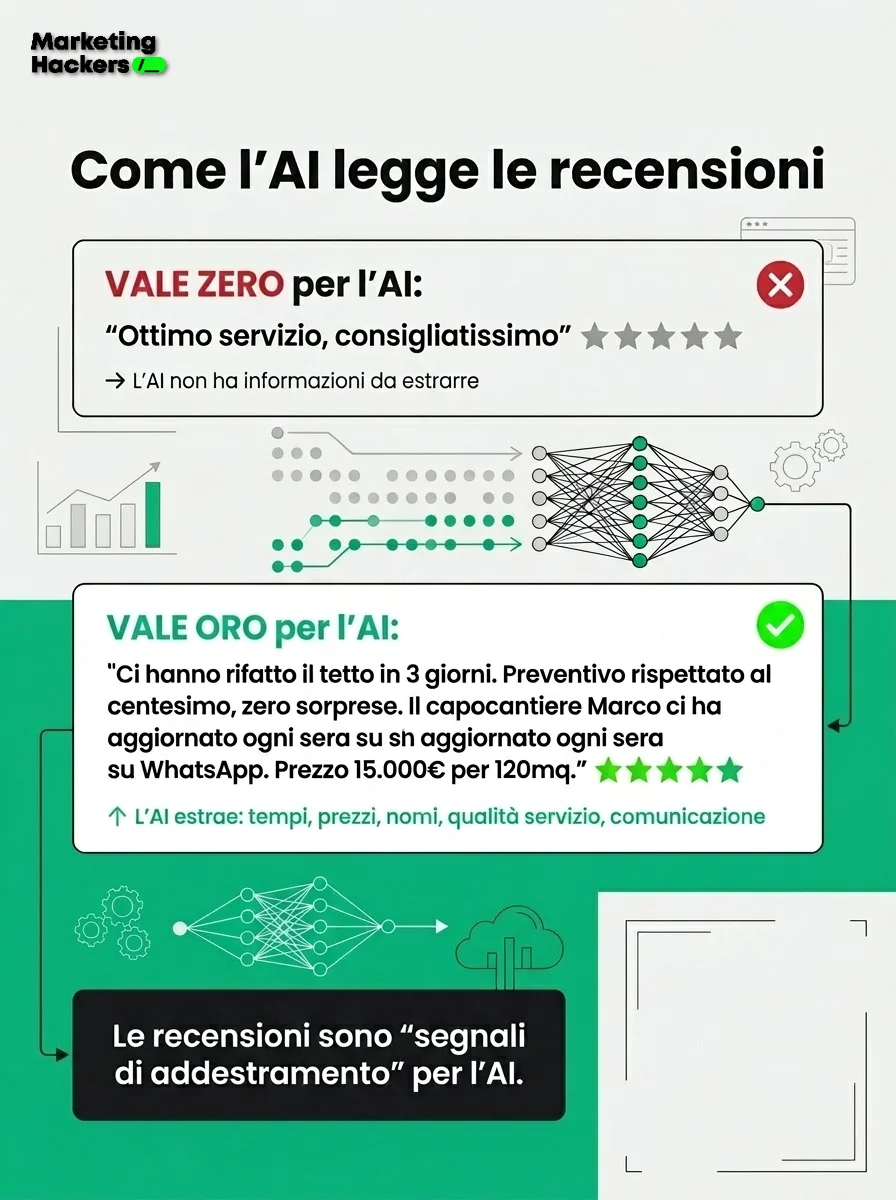
A review that says "Had Rossi Impianti replace our Vaillant boiler, they stuck to the €3,200 quote, the job was done in two days, and Marco the technician showed up on time" gives the AI concrete data. When someone asks for a "plumber in Verona who sticks to the quote", that kind of review gets picked up and cited.
It's worth building a template for asking happy customers for reviews. Specific questions that steer them toward useful details: service purchased, price, timing, the technician's name.
LinkedIn as a source for AI
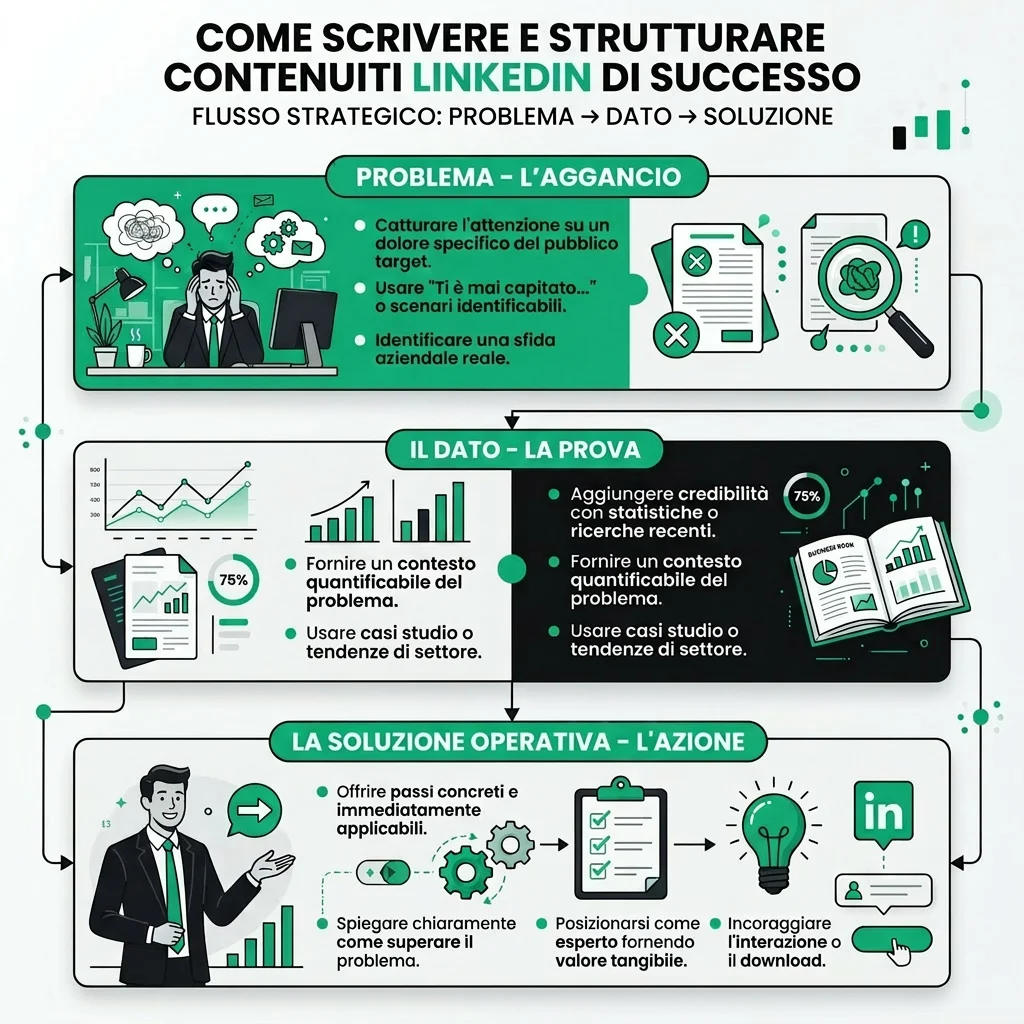
Business-focused models pull heavily from LinkedIn. A post that follows the "problem → data point → practical fix" pattern and carries the name of an identifiable professional is far more likely to get cited than motivational content or generic reshares.
Consistency over time counts. If you post regularly on the same topic, AI links you to that niche.
Technical markup: Schema.org and JSON-LD
Structured data isn't enough on its own, but without it AI has a harder time reading your pages.
In 2026 you need five schemas, ideally nested in the same JSON-LD block (the practice is called Schema Stacking).
- Organization or LocalBusiness to pin the business to precise geographic coordinates
- Article with datePublished and dateModified — models prefer recently updated content
- FAQPage to flag ready-made answers
- ItemList to make list structures readable with no ambiguity
- sameAs to connect every place you exist online (LinkedIn, Google Business Profile, industry directories)
Add a visible "Last updated: March 2026" line at the top or bottom of your articles. AI models have a strong bias toward fresh content, especially on regulations, pricing and technology.
The llms.txt file
The robots.txt file tells crawlers what they can and can't visit. The sitemap lists every page. Neither one tells AI which pages matter most and why.
The llms.txt file, placed in the root of your domain, fixes that. Written in Markdown, it lists only your most valuable resources, each with a short contextual summary. No menus, no ads, no scripts. Just the content that counts.
So far there's no evidence or official statement suggesting that AI reads this file or that it brings any benefit. But there's a strong grassroots push to get big tech to adopt it, so there's a good chance it will happen. Either way, having one doesn't hurt, and it still helps models find information more easily.
Practical rules
Keep it under 3,000 tokens (~50KB of text)
Open with a block that describes the company in 2-3 sentences
List the main pages with one line of context for each
Point to .md versions of the pages when you can, so the AI doesn't have to parse HTML
If the site has a lot of documentation, add an llms-full.txt file with the full text of every guide
Example for a small business
```markdown
# Rossi Impianti SRL — Verona
> F-GAS certified company, 12 specialized technicians. Installation,
> maintenance and repair of condensing boilers, heat pumps and
> air conditioning for homes and businesses. Provinces of Verona,
> Vicenza and Mantova. Founded in 2005.
## Services
- [Condensing boiler installation](https://www.rossiimpianti.it/caldaie.md)
Costs, brands we work with, 2026 certification procedures.
- [Heat pump maintenance](https://www.rossiimpianti.it/pompe-calore.md)
Standard service contracts, efficiency checks, Veneto regulations.
- [24/7 emergency service](https://www.rossiimpianti.it/emergenze.md)
Burst pipes and boiler lockouts, Verona and surrounding province.
## Prices and quotes
- [Price list and tax incentives](https://www.rossiimpianti.it/prezzi.md)
Average costs, system replacement estimates, Bonus Ristrutturazioni 50%, Conto Termico.
## FAQ
- [Frequently asked questions](https://www.rossiimpianti.it/faq.md)
Energy efficiency, common faults, response times.
## Contact
Office: Via Industria 42, 37135 Verona
Emergency line: +39 045 XXX XXXX
Email for quotes: info@rossiimpianti.it
Hours: Mon-Fri 8:00-18:00, Sat 8:00-12:00
```
The opening quote block (with >) gives the AI the big-picture context. The links go straight to the relevant content. The note under each section tells it what it will find on each page.
Video. Only the text counts.
YouTube is the single most cited domain in Google's AI Overviews. It accounts for 18.2% of citations from pages outside the organic Top 100. But AI doesn't watch the video. It reads the transcripts, captions and metadata. Production quality does nothing for your AI visibility.
What to do with every video
Rewrite the captions by hand. Auto-generated ones lack punctuation, get technical terms wrong and produce walls of text the AI can't use. Split the transcript into logical paragraphs. Add notes in square brackets to describe visual events the text doesn't capture (e.g. [on-screen chart shows +15% thermal efficiency after the job]). Put the speaker's name at the start of each section — it strengthens the video's E-E-A-T signals.
Turn your chapters into questions. Not "Introduction", "Explanation", "Conclusion". Instead, "02:15 — How much does a heat pump use in winter compared with a boiler?". That way the AI can pull the answer from the exact timestamp.
On-screen text that OCR can read. Sans-serif fonts (Helvetica, Arial), a 21:1 contrast ratio — white on pure black is the standard for reliable OCR. Multimodal models like Gemini read the text in video frames; if it's illegible, they ignore it.
Embed the video in a page on your site with a companion article that includes tables, lists and VideoObject + FAQPage markup. A standalone video on YouTube is worth less than the same video embedded in a page on your site with supporting content.
How to measure whether it's working
Classic metrics (rankings, organic traffic, CTR) can't see zero-click interactions. You need to measure visibility inside AI answers.
Three levels of visibility
| Level | What it means | Does it drive traffic? |
|---|---|---|
| Mention | The brand is named in the text of the AI answer | No |
| Citation | The brand shows up in the sources at the bottom | A little |
| Link | A clickable URL leads to the site | Yes |
Tracking them separately lets you diagnose problems precisely. Lots of mentions but zero citations? Your outside reputation is fine, but AI can't read your site (client-side JavaScript, a robots.txt that blocks crawlers, content that can't be extracted).
Monitoring and optimization tools (2026)
Google Search Console doesn't currently separate out impressions in AI Overviews. You need dedicated tools.
| Platform | Who it's for | What it does | link |
|---|---|---|---|
| AEO/GEO Analyzer | SEO and content managers | Queries AI engines to calculate a GEO Score and gives you a gap analysis to optimize your content plus ideas you can put to work right away | https://www.marketinghackers.it/tools/aeo-geo-analyzer |
| Frizerly | Local small businesses | Share of Voice for geo-targeted queries and tracking of nearby competitors | https://www.frizerly.com/ |
| Omnia | Small businesses with lean teams | Turns AI visibility data into ready-to-use editorial briefs | https://www.useomnia.com/ |
| Keyword.com | Analysts | Citation tracking on Perplexity and mention history with third-party sources | https://keyword.com/ai-search-visibility/ |
| SE Visible | Brand managers | AI Visibility Score and tracking down to the single prompt | https://visible.seranking.com/ |
Sentiment matters
Unlike traditional rankings, AI models understand the tone of content. If your brand gets associated with complaints on forums and bad reviews, AI won't recommend it. It might even tell people to avoid it.
Replying publicly to negative feedback, professionally and with facts, gives models the context to file the problems as isolated incidents that got resolved.
Where to start on Monday morning
Five concrete actions, in order of priority:
1. Ask AI models about your brand. Open ChatGPT, Perplexity, Gemini. Ask for recommendations in your industry and your area. See whether you show up and what they say about you.
2. Rewrite your "About us" page as a company profile. Exact name, year, headquarters, employees, specialties, certifications, service area. One paragraph. No storytelling.
3. Create an llms.txt file in the root of your site. A 2-3 sentence company description + links to your main pages with one line of context each.
4. Add an atomic answer at the top of every services page. 40-60 words that sum up the point, with a hard number. The sentence has to make sense on its own.
5. Ask customers for specific reviews. Not "leave us a review". Instead, "tell us which service you used, how much you spent and how it went". That information is gold for AI models.
Bonus
More prompts you can use to get even more ideas and spot opportunities
LinkedIn post
"About us" page
FAQ page
Analysis
Cosa ottieni iscrivendoti:
- Accesso a tutti gli episodi della newsletter
- Guide e corsi completi sull'AI per marketer
- Strumenti AI professionali (BrandPix, Short Video Suite)
- Crediti gratuiti per iniziare subito