MOFU Content Examples: Webinars, Case Studies and Comparisons
MOFU content helps prospects who already know you pick the right type of solution. How small businesses can use webinars, case studies and comparisons.

A lead downloads your guide, opens two of your emails, has a look at your services page, then goes quiet. Three months later you run into them at a trade show and they tell you they’ve already signed with someone else. All that time they had a very practical question, something like “should I hire someone or bring in an agency?”, and nothing on your website answered it.
MOFU content fills that gap. It helps people who already know you work out which kind of solution fits their situation. In the TOFU, MOFU and BOFU funnel it sits in the middle, after they’ve spotted the problem and before they pick a supplier. Below are three core assets (webinars, case studies and comparisons) and two supporting ones, plus the order to make them in when marketing is a one-person job.
The reader’s question decides the stage
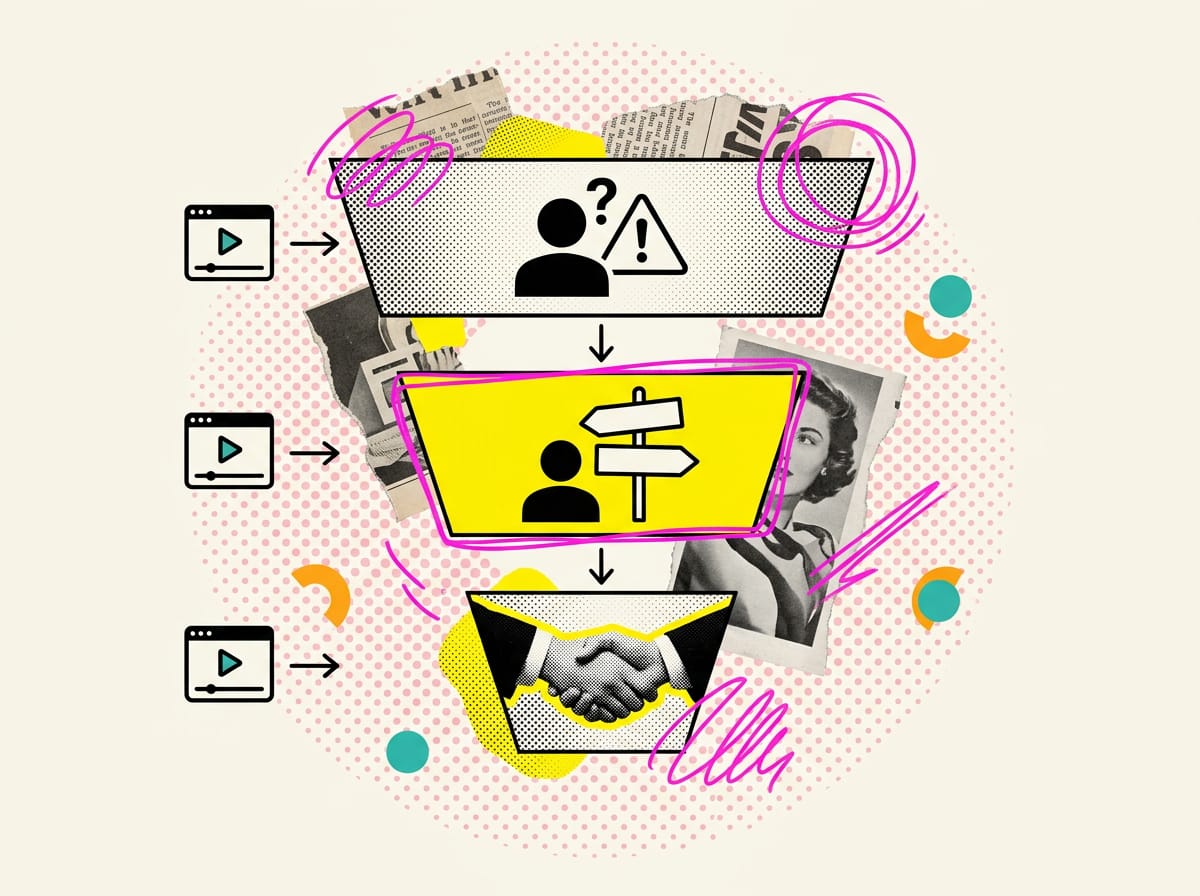
Take a webinar about handling quotes. If it explains why so many quote requests never get a reply, it’s TOFU. If it compares three ways of organising your replies, it’s MOFU. If it shows your service applied to the viewer’s own business, it’s BOFU. The format is identical every time. What shifts is the question the viewer walks in with.
| Stage | Reader’s question | Example webinar |
|---|---|---|
| TOFU | ”Do I actually have this problem?” | Why your quotes go unanswered |
| MOFU | ”What kind of solution suits me?” | In-house hire, agency or software for following up quotes |
| BOFU | ”Should I pick you? What’s the risk?” | Our method applied to your sales process |
Before you make anything, write the question it answers at the top of the document. If your company name is in it, you’re in BOFU. If only the problem is in it, you’re in TOFU. If it names at least two possible routes, you’re in the right place.
An academic case study shows how planning content as a set works in practice. It follows Terra Solar, a start-up bringing a DIY home solar kit to market. The authors use the funnel-bucket model to plan content genres and give technical buyers a coordinated set of information, both informative and persuasive, across several media.1 The practical takeaway for a small business: start with the whole set, and give every piece a job before you write a word of it.
A prompt to sort the content you already have
List the titles and opening lines of your existing content, then paste the lot into ChatGPT or Claude with this request.
Below are the titles and introductions of some of my company's content.
For each one:
1. Write the reader's question it answers, in one sentence.
2. Label it TOFU if the question is about the problem, MOFU if it
   compares types of solution, BOFU if it's about choosing a supplier.
3. Quote the sentence from the text that justifies your label.
If the text isn't enough to decide, write "can't classify".
At the end, list the MOFU questions that have no content yet.
The quoted sentence is there for you. Read it, and overrule the label whenever it doesn’t convince you.
A consideration webinar compares several routes
Picture an engineering firm that designs systems for machine shops. A webinar called “Introducing our services” speaks to people who’ve already made up their minds. “How to decide whether to replace your system, upgrade it or hold off” speaks to people still weighing it up, and gives them a reason to stay to the end.
Let your sales team pick the topic. Ask which alternatives prospects bring up on the first call and go with the one you hear most. The speaker should be the person who has actually seen those situations first-hand, even if they’re less polished on camera than your marketing lead.
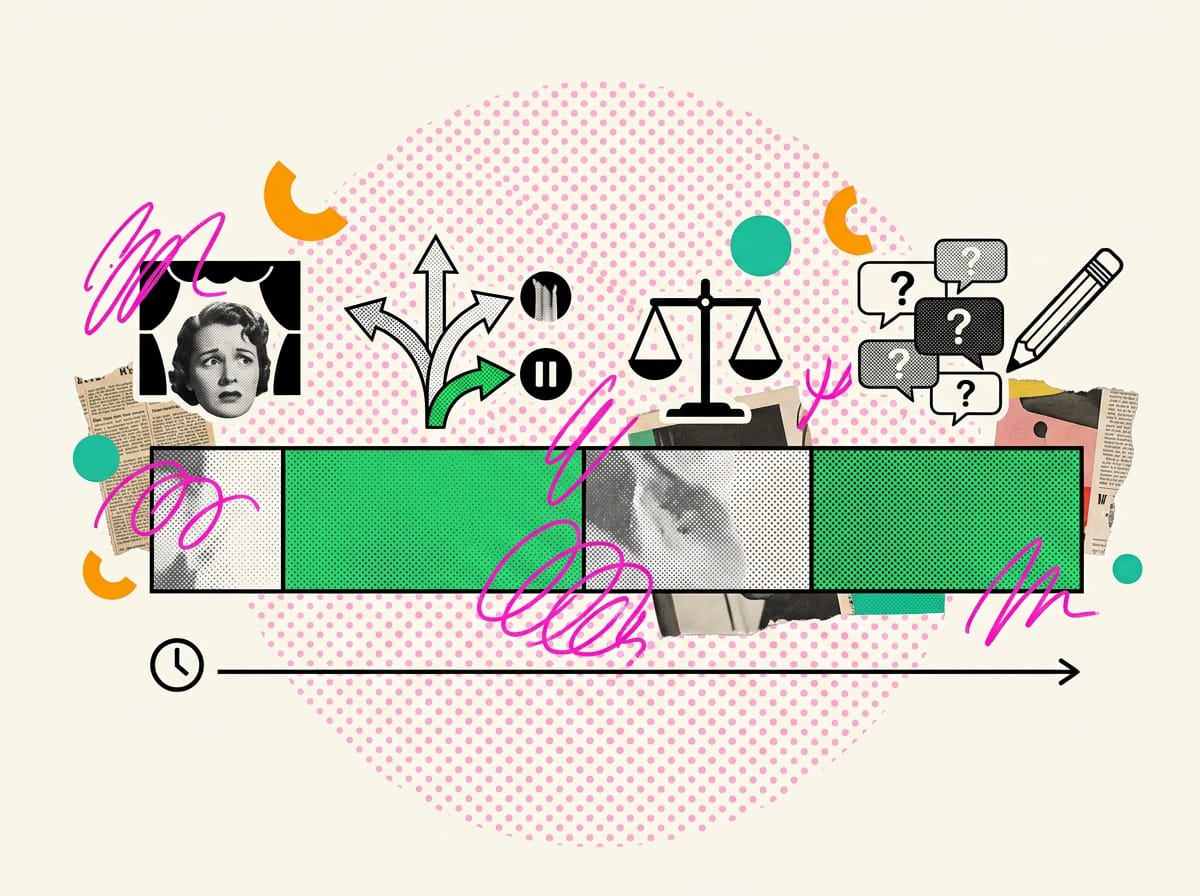
Here’s a starting running order that fits into 45 minutes. Adjust it to your audience.
- The problem in one scene (5 minutes). A concrete situation, told the way the customer would tell it.
- The possible routes (15 minutes). At least three, including doing nothing. For each, explain when it works and when it causes trouble.
- How to choose (10 minutes). The questions viewers need to ask themselves to reach their own answer.
- Audience Q&A (15 minutes). Someone on the team writes down every question in the attendees’ exact words.
Your company gets one line at the very end, with an invitation to bring their own case.
Live or recorded?
Go live while the topic is new, because you need the questions. Switch to a recording once the questions start repeating and your answers have settled. The engineering firm might run two live sessions, fold the doubts that came up into the talk, and publish the third as a video split into chapters.
How do you write a MOFU case study?
A MOFU case study tells the story of how a customer reasoned their way to a type of solution. It covers where they started, the routes they considered, the ones they ruled out and why, and the doubts that never quite went away. Readers should recognise their own problem and borrow the decision criteria, even if they end up buying elsewhere.
That’s where it parts ways with the case study that backs the final decision, the one built on verified, approved numbers, which belongs with BOFU content. At the consideration stage, the outcome can take up two lines. The space goes to the decision.
Here’s an example made up for illustration. A window and door manufacturer gets enquiries through its website, but almost all of them come from outside its service area. The owner weighs three options: rebuild the site, spend more on ads, or create a page for each area they cover. They rule out the first because the enquiries are already coming in. They rule out the second because it would bring in more enquiries of the same kind. They go with the third, and admit that if the site had been getting little traffic, they’d have chosen differently. That last sentence is the most useful one in the piece, because it tells readers when the same choice would be the wrong one.
All you need to gather the material is an interview with five questions.
- What was happening in the business when you started looking for a solution?
- Which alternatives did you consider, including leaving things as they were?
- Why did you rule out each of the others?
- What worried you about the route you chose?
- What would have made you change your mind?
Ask for permission before the interview and get the final text signed off. If the customer would rather stay anonymous, describe the industry and the situation without details that would give them away.
A prompt to turn the interview into a draft
Transcribe the conversation, strip out anything confidential, and use Claude or ChatGPT for the first draft.
This is the transcript of an interview with one of our customers.
Write a draft case study for readers who are still working out
what type of solution to go for.
Use this order: starting situation, routes considered, why each
one was ruled out, decision criteria, conditions under which
the choice would have been different.
Use only information that appears in the transcript.
Wherever a step is missing, write [TO ASK] and phrase the question.
Don't add numbers, praise or quotes.
The placeholders become your outline for the follow-up call. AI speeds up the writing. The quality still comes down to the questions you asked.
A comparison weighs different approaches
“Do I get my niece to do it, find a freelancer, call an agency or use a tool?” That’s how a business owner thinks when they need to get content going on their website. Brand names come later. A MOFU comparison works at the level of those routes, which lets you be honest without naming a single competitor.
Set your criteria before you fill in the table, and apply the same ones to every option. Add a criterion only where you happen to win and readers will spot it straight away.
| Criterion | In-house | Freelancer | Agency | Pay-as-you-go tool |
|---|---|---|---|---|
| Internal time needed | High | Medium, you need a point person | Pin it down in the contract | Medium, someone has to use it |
| Skills you need | All of them | Writing a brief | Judging the work | Knowing the process |
| Cost commitment | Staff hours | Per project or day rate | Often ongoing | Tied to usage |
| Main risk | Work stalls when things get busy | Relying on one person | Distance from the product | Producing with no direction |
| Good fit when | You have someone with protected hours | Your need is clearly scoped | You want to hand off several tasks | Your process is already written down |
Treat the table as a rough qualitative starting point. Replace every cell with what you actually see in your industry.
Under the table, every option, yours included, needs a paragraph headed “When this isn’t for you”. That applies to us too. Marketing Hackers sells both managed services and pay-as-you-go tools, so we have a stake in two of the four columns, and saying so helps readers weigh the comparison. If nobody in the business has time to sign off copy, for example, a managed service will stall just as badly as doing it in-house.
The same structure works for other recurring dilemmas, like a dedicated landing page versus a page on your main site, or a webinar versus a downloadable guide.
Two cheap supporting assets
A self-assessment checklist turns your decision criteria into yes-or-no questions. A health and safety consultant might ask “Do you have someone who keeps the paperwork up to date?” and “Do you know when your next inspection is due?”. At the bottom, each combination of answers points to a type of route. Unlike material designed to capture a lead, this list is there to help people already in your contacts think things through.
An objections page gathers the doubts you hear in meetings, in the customer’s own words. “What if I have to change everything later?” beats a polished heading like “Solution flexibility” every time. Each answer includes a case where the doubt is justified.
One webinar feeds every other asset
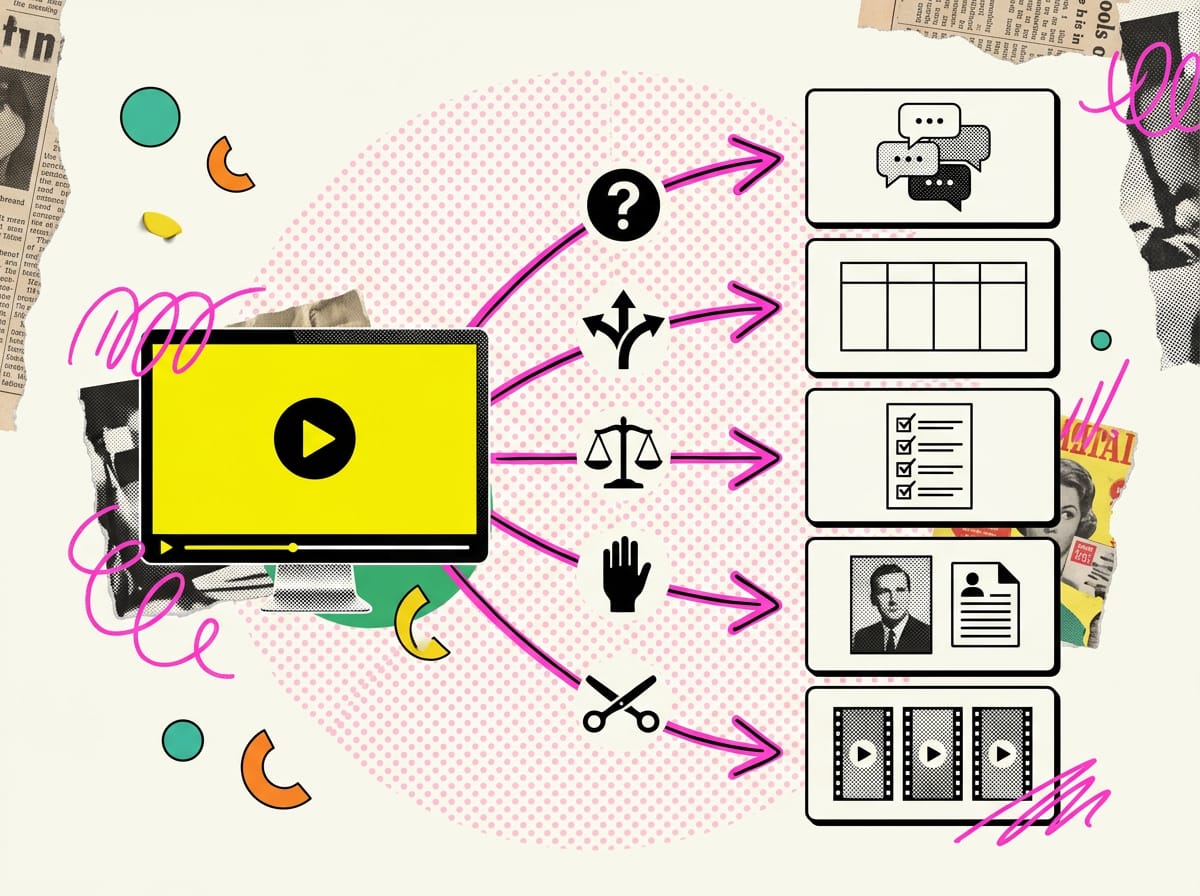
For a small business, setting out to make five separate pieces usually means stopping after the second. You’re better off with a chain that starts from the recording.
- The audience questions become the objections page.
- The section on possible routes becomes the comparison.
- The decision criteria become the checklist.
- The attendee who described their own situation becomes, with their consent, your next case study.
- The clearest moments become short clips for your company’s channels.
In the Terra Solar case too, the content is designed as a coordinated set spread across several media.1 In your business, a shared spreadsheet can handle the coordination: one row per asset and four columns for question, source, owner and review date.
To pull the material out, upload the transcript to NotebookLM and ask for the following.
Use only the uploaded transcript.
List every audience question in its original wording.
Group them by underlying doubt and show how often each one comes up.
For each group, give the speaker's answer and where it appears
in the text.
Flag any questions that went unanswered.
The unanswered questions are the outline for your next webinar.
Who does what in a small business
No asset gets made unless there’s a name next to it. Here’s a minimal SOP for a business with an owner, a salesperson and one person in marketing.
| Step | Owner | Done when |
|---|---|---|
| Collect the alternatives customers mention | Sales | There’s a list in the customers’ own words |
| Pick the question | Marketing | The question names at least two routes |
| Run the webinar | Owner or senior technical person | Recording and questions are filed |
| Get permission for the case study | Sales | There’s written consent |
| Write the comparison and checklist | Marketing | Every option has its “When this isn’t for you” |
| Fact-check the content | Owner or technical person | Every claim is confirmed |
If you’re starting from scratch, start with the comparison. It only needs knowledge you already have in-house, and it forces you to nail down the decision criteria you’ll then use in the webinar. The case study comes third, because it depends on a customer being willing.
The assets then need a path to the reader. Your MOFU strategy sets when and to whom you offer them, and email nurturing is the channel that delivers them. To see whether they’re working, pick a handful of funnel metrics and add one question to every first call: “What did you read or watch before getting in touch?” Note the answer next to the contact’s name. After a few dozen calls you’ll have a clear enough picture to decide which asset to update.
What are some examples of MOFU content?
Webinars that compare several solutions, case studies built around the customer’s reasoning, comparisons between approaches, self-assessment checklists and objections pages. What they have in common is the question they answer: which type of solution suits a given situation.
Is a case study MOFU or BOFU?
It can be either. It’s MOFU when it shows how the customer weighed the alternatives, and BOFU when it builds the case for one specific supplier. You can get two separate pieces out of the same project, one for each question.
Should middle of funnel content sit behind a form?
Comparisons and objections pages perform better when they’re open to everyone, because the people looking for them are still evaluating. For a live webinar, registration has a practical purpose. Either way, only ask for the details you’ll actually use.
Sources
Footnotes
FAQ
What is MOFU content?
It's content built for people who already know your company and are weighing which type of solution to adopt. It covers the middle of the funnel, between recognizing the problem and choosing a vendor.
What's the difference between TOFU, MOFU and BOFU content?
The difference is the question each one answers. TOFU content helps people recognize the problem, MOFU content compares types of solutions, and BOFU content is about choosing a vendor and the risks involved. The same format, a webinar for example, can work at all three stages.
Which formats work best for MOFU content?
The three main formats for the consideration stage are webinars, case studies and comparisons. The format alone isn't enough, though: a piece is MOFU when it helps the reader choose between at least two possible paths.
How can I tell if a piece of content is really MOFU?
Write down, in one sentence, the reader's question it answers. If the question includes your company name, it's BOFU. If it only names the problem, it's TOFU. If it includes at least two possible paths, it's MOFU.
How do I choose a webinar topic for the consideration stage?
Start with your sales team and ask which alternatives customers bring up. Then pick a title that compares several paths, like "How to decide whether to replace your system, upgrade it, or wait". A presentation of your services only speaks to people who have already decided.
Can I use ChatGPT or Claude to classify my existing content?
Yes. Paste in titles and intros and ask it to name, for each one, the reader's question, the funnel stage and the sentence in the text that supports that choice. Also ask it to list the MOFU questions you haven't covered yet. Then check the quoted sentences and fix any classification that doesn't hold up.