
Restaurant Marketing Without an Agency: 4 Levers to Fill More Tables
Restaurant marketing without an agency: the 4 levers in order. Get found, get chosen, run promotions that protect margin, and bring guests back.
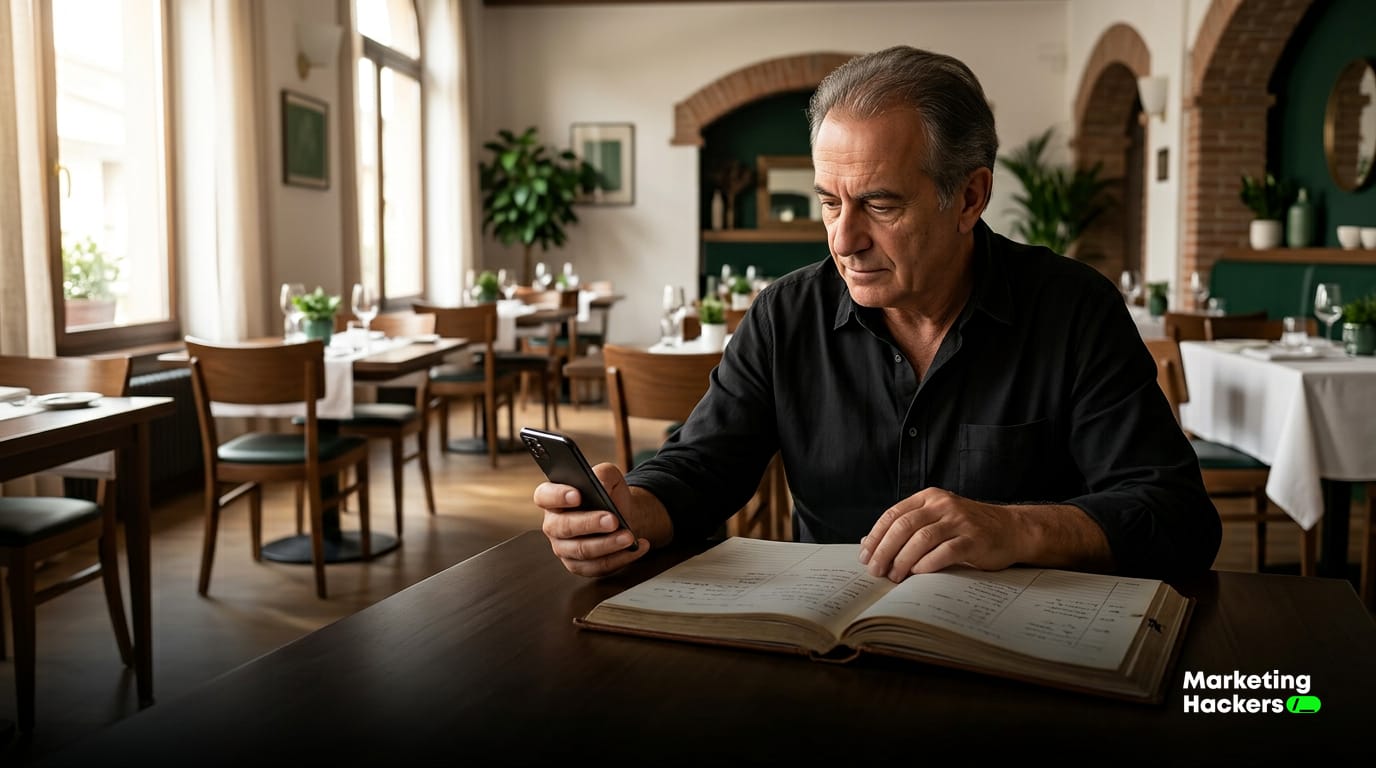
Tuesday night. Eight tables out of twenty are taken. The kitchen has prepped for a full service, your server is wandering the floor with nothing to do, and you’re staring at the room thinking your marketing has stalled somewhere. The gut reaction is to search “ideas to bring in customers” and land on yet another list of twenty tricks. The trouble is that twenty ideas presented as equals leave you exactly where you started. None of them tells you where to begin, what it will actually cost, or what to do on Monday morning to fill more covers by Thursday.
This piece puts things in a different order: the process first, then the tools that speed it up. You get four levers, done in sequence, and for each one you work out the cost before you launch any promotion.
Why lists of twenty ideas get you nowhere
A list of ideas treats every action as interchangeable. Run an event, open a social account, launch a happy hour, print a loyalty card. They all sound useful, and they are, but with no order to them you end up spread across five fronts and covering none of them properly.
Academic research on restaurant marketing works differently. It builds models to find out which lever actually moves revenue and what it costs to pull. That was the approach Tim Norvell and Alisha Horky of Elon University took when they built a model to measure the real effect of promotions on a restaurant’s profit, rather than taking that effect on faith.1
Restaurants also differ a lot from one another. A neighborhood trattoria, a takeout pizzeria and a sit-down place with an à la carte menu pull in customers in very different ways, with hours, prices and crowds that have little in common.2 The same promotion that packs a pizzeria on a Thursday can wipe out the margin of a mid-range restaurant. That’s why the sequence matters more than any single idea.
The four levers, in order
Restaurant marketing has four jobs, and they need tackling in this order.
First, get found by people looking for somewhere to eat right now. Second, get chosen by the people who found you and are comparing three places on their phone. Third, promote in a way that brings in new covers without eating into the margin on the ones you’d have had anyway. Fourth, bring back the people who’ve already walked through the door once.
The most common mistake is jumping straight from the first to the third. You launch an aggressive discount, but your Google listing is bare and the reviews are stale, so the only people who see the offer are customers you already had. Do them in order.
Lever 1: get found when someone’s looking for a place to eat
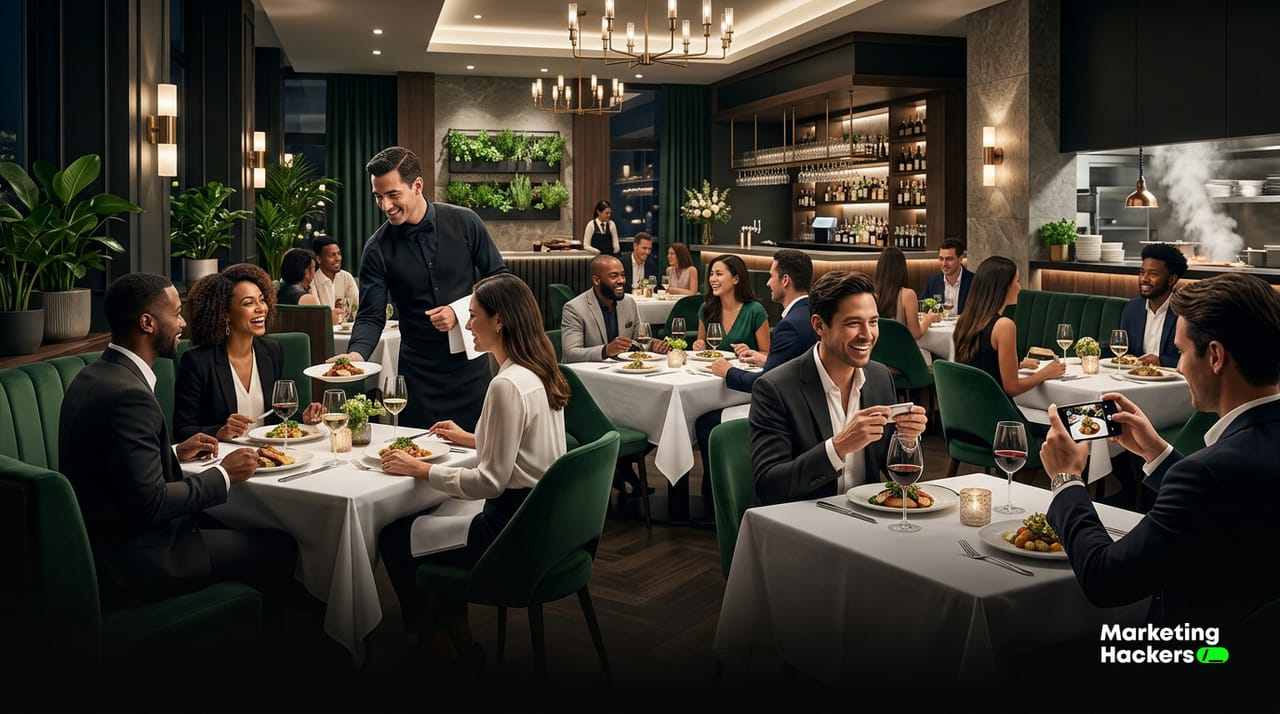
When someone in Cortona types “where to eat tonight” or “pizza open near me”, the decision gets made in seconds, across a handful of Google listings. If you’re not on that screen, you don’t exist for that person. Start with this lever, because it catches demand that’s already there: people who are hungry now and choosing now.
Your Google Business profile needs correct opening hours, recent photos of the dishes you actually serve, an up-to-date menu and a steady stream of new reviews. Reviews carry real weight. Paul Phillips and colleagues analyzed 442 hospitality properties and 68 review platforms and found that the attributes guests rate, from room quality to the human side of service, affect how the business performs.3
Doing this by hand is where you get stuck. Replying to every review, writing optimized descriptions and keeping the profile alive all take time you don’t have mid-service. You can hand that work to a tool like GMB Restaurant Suite AI, which replies to reviews, analyzes competitors in your area and collects new reviews through a QR code on the table.
Here’s a prompt you can also use by hand to answer a critical review without sounding defensive:
“You own a family-run trattoria. Reply to this 3-star review in English, warm and direct, four lines max: acknowledge the specific point the customer raised, explain without excuses what you’ve already changed, and invite them back without offering a discount. Review: [paste].”
Replying pays off, and the numbers are there. Davide Proserpio and Georgios Zervas estimated that properties which start responding to reviews see their average rating rise by 0.12 stars and get 12% more reviews. That sounds small, but 27% of those who started responding gained a rounded half-star within six months, and an extra half-star on your listing changes where you show up.4
What reviews are really worth in revenue
It’s tempting to treat reviews as vanity, a number to show off. The data says otherwise. A study of actual restaurant revenue in Texas between 2011 and 2015 found that for a high-quality independent restaurant, doubling review activity lifts revenue by 5% to 19%. For a low-quality place the effect runs the other way, by a similar amount, and that tells you something uncomfortable. If the food or service doesn’t hold up, pushing for reviews speeds up the decline.5
The same study found that restaurants near highway exits are twice as sensitive to reviews as those in areas without passing travelers, because reviews matter most to people who don’t know the area.5 If a lot of your trade is tourists passing through, this lever counts double for you.
So lever 1 comes with a precondition that no tool can replace. Fix the food and the service first, then amplify.
Getting found by AI as well
A second discovery channel is growing alongside classic search. More and more people ask a chatbot something like “recommend a seafood restaurant in Livorno for two tonight” and get back a shortlist of three names. Your restaurant makes that shortlist if the public information about you (Google listing, menu, reviews, descriptions) is consistent, current and easy for a machine to read.
Social media and digital platforms are now a central marketing channel for any business, and their rules shift quickly. In their work on the future of social media in marketing, Gil Appel and colleagues identified nine themes reshaping how it works, spread across three time horizons.6 The practical upshot for you is simple. Whatever you publish now speaks to two audiences: people, and the algorithms that decide what those people see.
In practice, that means writing descriptions of your restaurant and your dishes so a machine can understand them and repeat them. A starting prompt:
“Write the Google Business description for a trattoria in Cortona specializing in Tuscan cooking from the Valdichiana. 60 words, in English. Include the neighborhood, three signature dishes by name, the average price per person, and who it suits (couples, families, tourists). No generic adjectives like cozy or unique.”
Lever 2: get chosen by the people who already found you
Getting found brings someone to your listing. What they see next decides the rest. If they scroll through a confusing menu, they close it. The second lever plays out in the few seconds when that person is weighing you against two other places open on the same street.
The menu decides this, and it’s the most underrated part of restaurant marketing. Your dish descriptions are your sales pitch. “Sliced beef” and “Dry-aged Tuscan heifer tagliata with wild arugula and shaved Parmigiano” describe the same cut, yet customers read them as two different dishes.
Rewriting every dish, handling allergens and mandatory information, and keeping the menu readable and printable is tedious work you keep putting off. A tool like MenuMaster AI Engineer rewrites descriptions, flags allergens, estimates calories and hands you a print-ready PDF. You still decide what goes on the plate, though. You pick the three dishes to push because they carry the best margin, and the tool makes them shine.
Lever 3: promote without cheapening your work
This is the lever everyone pulls first, and gets wrong: the promotion. Two-for-one, kids eat free, 20% off. None of the lists you find online tell you what these really cost, and the math is brutal.
Take an average cover of €25 with a 30% food cost. Your gross margin on that cover is about €17.50. A 20% discount means you take €20 instead of €25, but the food still costs you the same €7.50. Your margin drops to €12.50. The €5 you gave away comes straight off your profit. To break even on that discount you need far more new covers than you’d guess.
That’s why promotions are hard to judge. As Norvell and Horky explain, a business doesn’t know how much of a promotion creates genuinely new transactions and how much simply hands a discount to customers who would have paid full price. To measure the real impact you have to estimate three things: the share of incremental versus substituted transactions, how many of the new ones come from new customers versus existing ones, and how the promotion changes total spend. Only then, setting the discount against your margin, do you see the real financial result.1
In practice, don’t hand discounts to people who already come in. Use promotions to bring new faces in on your dead nights, with a mechanism that captures their contact details so you can reach them again. A QR-code wheel of fortune turns foot traffic into WhatsApp contacts and lets you set the odds of winning, so you control how much you give away in prizes. To plan your year of promotional events instead of making them up as you go, WApp Booster AI builds a calendar of 12 to 15 events based on your product and your city, with teaser campaigns in the days beforehand.
A prompt for building the calendar yourself:
“You run marketing for a pizzeria in Livorno. Suggest 12 promotional occasions for the year tied to local holidays, seasonality and slow days of the week. For each, give a rough date, the offer mechanic, the target (new or existing customers) and how to capture the customer’s contact details. Avoid flat discounts on full price.”
Lever 4: bring back the people who’ve already been in
A customer who has already come in and had a good time has cleared the hardest hurdle. They know you and they know what to expect. The fourth lever closes the loop, and without the first three it has nothing to work with.
A happy customer who leaves a review works for you twice: they come back themselves, and they persuade others to come. Review platforms have opened this kind of word of mouth to any restaurant, including places no food guide has ever mentioned, as Kevin Mellet and colleagues describe in their study of the democratization of restaurant criticism.7
A well-designed loyalty program gives customers a concrete reason to come back a third and fourth time, once the novelty has worn off. The risk is giving away rewards you can’t afford. A tool like Smart Loyalty AI checks whether a reward is sustainable before you launch it, and prepares the social posts and a poster with space for the QR code. The right reward costs you little and feels generous to the customer, like a free coffee or a digestif on the fifth visit.
When you actually need an agency
You can run these four levers in-house in a couple of hours a week, with a process and the right tools. Paying someone every month to carry out decisions you’re making anyway is money down the drain.
An agency earns its fee elsewhere. When you open a second location and need to build a consistent brand identity from scratch. When you want cinematic-quality video you can’t shoot on a phone. When you’re running a paid ad campaign with a serious budget, where a targeting mistake burns thousands of euros. When you’re repositioning, changing your price point and the kind of customer you want to attract.
The day-to-day marketing of your restaurant (getting found, getting chosen, promoting with your head and bringing people back) stays your job. The right tools turn it into an hour a day instead of a lost day. Start with lever 1: sort out Google and your reviews this week, and move on to the next lever only once the first one runs on its own.
Sources
Footnotes
-
A framework and model to evaluate promotions: A restaurant cross-promotion in-market study. doi.org ↩ ↩2
-
Ristorante — Wikipedia. it.wikipedia.org ↩
-
Understanding the Impact of Online Reviews on Hotel Performance. kclpure.kcl.ac.uk ↩
-
Online Reputation Management: Estimating the Impact of Management Responses on Consumer Reviews. open.bu.edu ↩
-
The Effects of Online Review Platforms on Restaurant Revenue, Consumer Learning, and Welfare. doi.org ↩ ↩2
-
The future of social media in marketing. link.springer.com ↩
-
A “Democratization” of Markets? Online Consumer Reviews in the Restaurant Industry. valuationstudies.liu.se ↩
FAQ
Where should restaurant marketing start if you don't have an agency?
Start by getting found by people looking for somewhere to eat right now. Keep your Google Business Profile up to date: correct opening hours, real photos of your dishes, a current menu and recent reviews. This lever captures demand that is already there, from people who are hungry now and will decide now.
What are the four levers of restaurant marketing?
Get found by people searching for a place to eat, get chosen by people comparing several restaurants online, run promotions that bring in new covers without eroding your margin, and bring back guests who have already been in once. Work on them in exactly that order.
Why don't lists of 20 ideas to attract restaurant customers work?
They treat every tactic as equal and never tell you where to start, what it costs or what to do to get more covers. Without an order you spread yourself across five fronts, cover none of them properly and stay where you are.
Does the same promotion work for every type of restaurant?
No. A neighborhood trattoria, a takeout pizzeria and a full-service restaurant attract customers in very different ways, with different hours, price points and clientele. A promotion that fills a pizzeria on a Thursday can wipe out the margin of a mid-range restaurant.
How much do reviews matter for a restaurant?
A lot. Reviews are the most consulted source of information when people decide where to spend their money, and they carry more weight than anything a business says about itself in its ads. A steady flow of recent reviews on your Google profile is key to getting chosen.
Why is launching a discount before fixing your Google profile a mistake?
If your profile is empty and your reviews are old, the only people who see the promotion are customers you already had. Skipping the first lever to jump to the third burns margin without bringing in new covers.