Back-to-School Campaigns for Small Businesses: Plan Early with AI
Back-to-school marketing for small businesses: why it's won in July, a week-by-week plan from June to September, and 3 ready-to-use AI prompts.
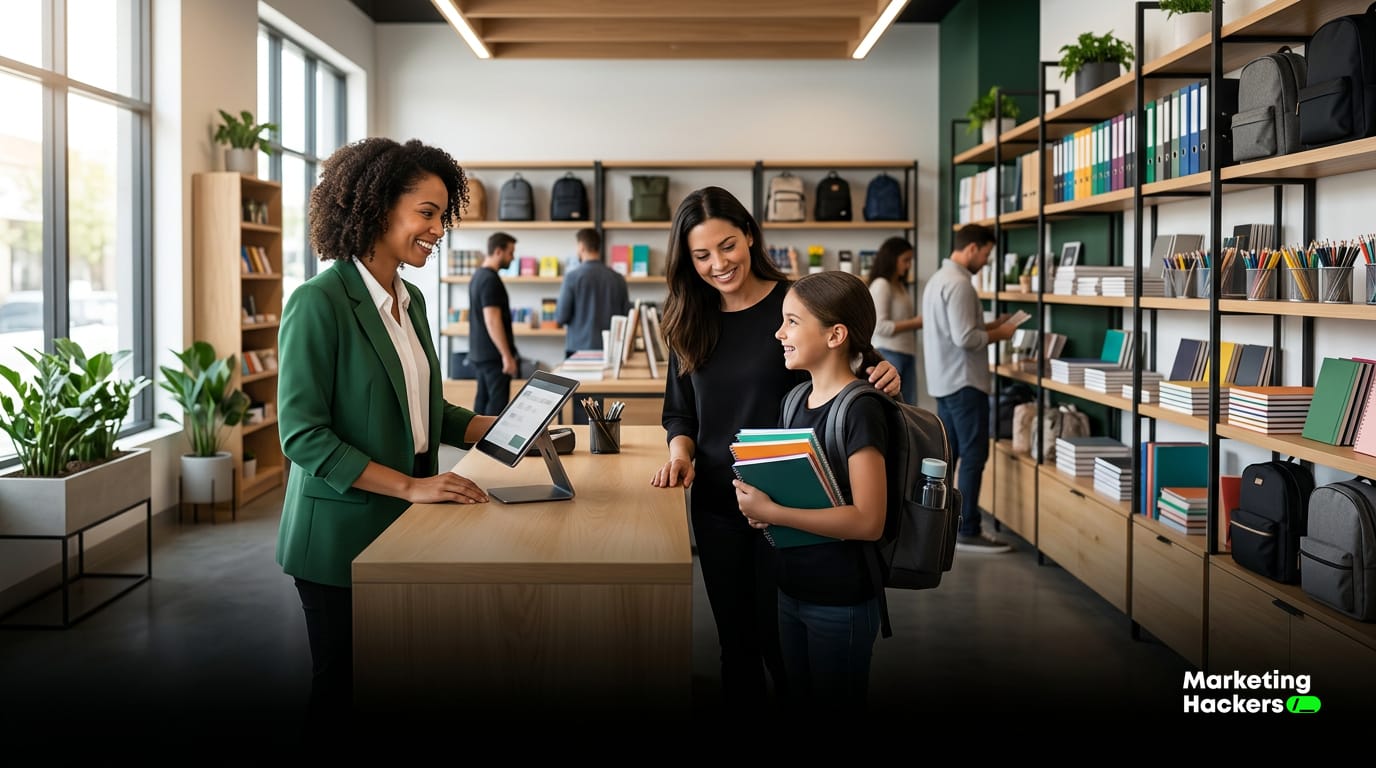
Send your teaser on September 3 and it lands after your customers have already spent the money. According to data gathered by Leevia, 59% of shoppers start their back-to-school buying in the last two weeks of July, and 55% buy online 1. For a small business, the back-to-school campaign is won or lost in July, while the big retailers are still shooting their TV spots. Below you’ll find a week-by-week plan from June to September, plus three ready-to-use prompts for producing emails, posts and promo copy with AI. Use them once you’ve settled your offer and your audience. Process first, tools second.
Why back to school is won in July
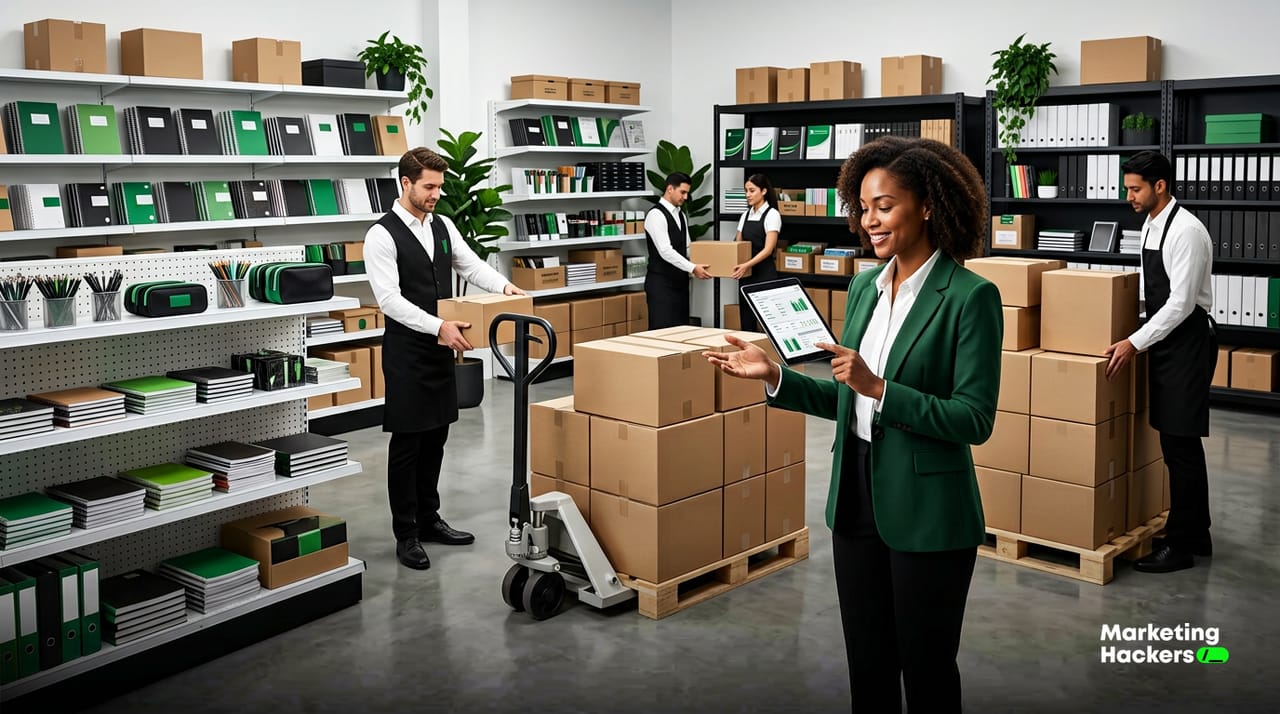
In Italy, back to school is the buying window that runs from mid-July to mid-September, when families rebuild their budgets around the new school year. Idealo data cited by Adlook puts the peak right after Ferragosto, the mid-August holiday. Skuola.net’s 2025 research puts average spending at around €810 per student, textbooks included 2.
Wait until September and your customer is already halfway down the shopping list. A paper from Dunărea de Jos University shows how compressed the season is. At peak, stationery sales run 800-1,000% above an ordinary month, and distributors book 20-25% of their annual revenue between July and September 3. For a shop, those two or three weeks matter more than almost any other stretch of the year.
And it reaches well beyond backpacks and notebooks. September is when gyms, courses and wellness businesses restart, and when professionals slip back into their work routines 4. Sport shows it clearly: 66.5% of online purchases in the category are sporting goods, mostly among 18-34-year-olds, with soccer at 17%, cycling at 11% and swimming at 10% 5. A back-to-school campaign works as well for a stationery shop as it does for a sports center, a bookstore, an optician, or a restaurant relaunching its lunch deal for people heading back to the office.
The operating calendar: June to September, week by week
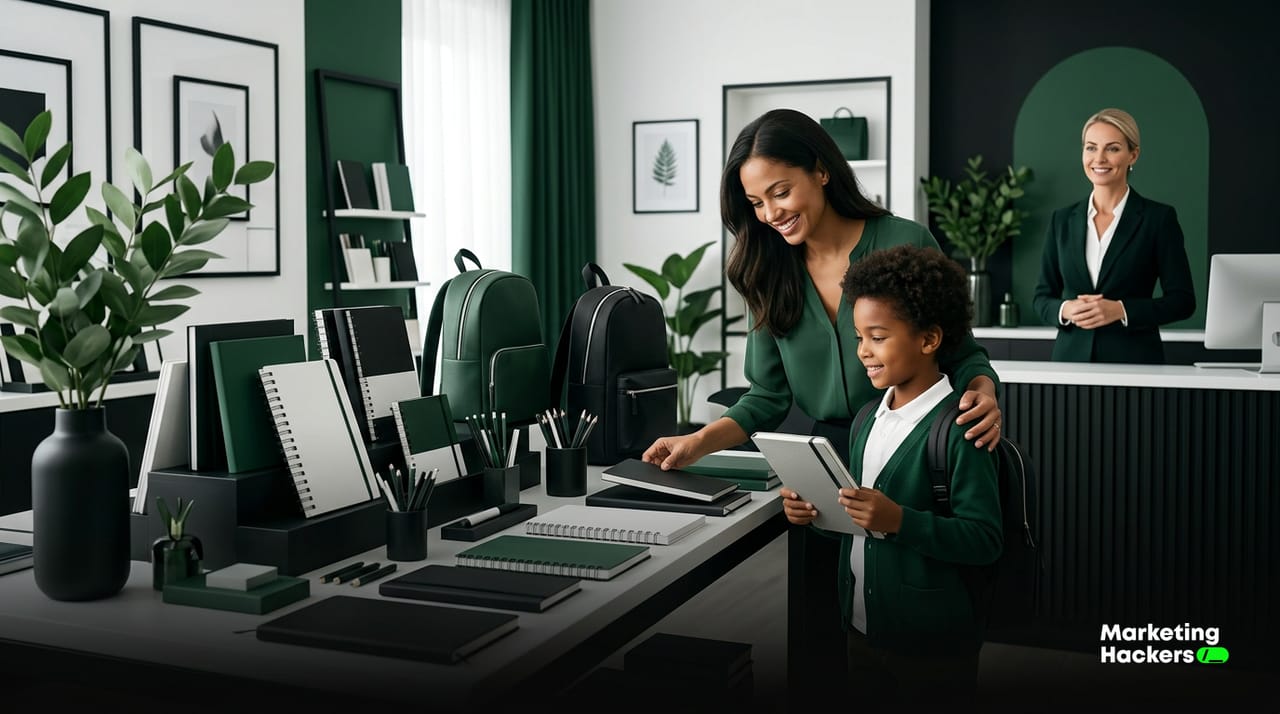
This is where the real work happens, and one rule covers it. Anything that goes live in September should be written and scheduled in July, so you can take your August break with everything already queued up. The big players already work this way. Pepco’s TV campaign starts on August 31, but its cinema run begins on August 21, and production wrapped weeks before that 6.
| Period | What to do | Ready output |
|---|---|---|
| Mid-June – July 20 | Settle the offer, the audience and the message. Pick the 2-3 products or services to push. Write the copy with AI. | Offer locked, content calendar, draft emails and posts |
| July 21 – August 20 | Schedule emails and social posts. Set up the window and the store floor. Close deals with local schools and clubs. | Email sequence loaded, 12 posts scheduled, window display up |
| August 21 – September 15 | Run it. Launch the main offer, handle last-minute promos, answer messages. | Campaign live |
| September 16 – 30 | Measure. Compare average ticket, redemption and conversions against last year. | Report on the 5 KPIs |
Keep the table next to your screen. Each row is a block you finish and close. If you reach the end of July without the “ready output” from the first row, you’re already behind the school bell.
Step 1: define your offer and audience (parents, students, teachers)
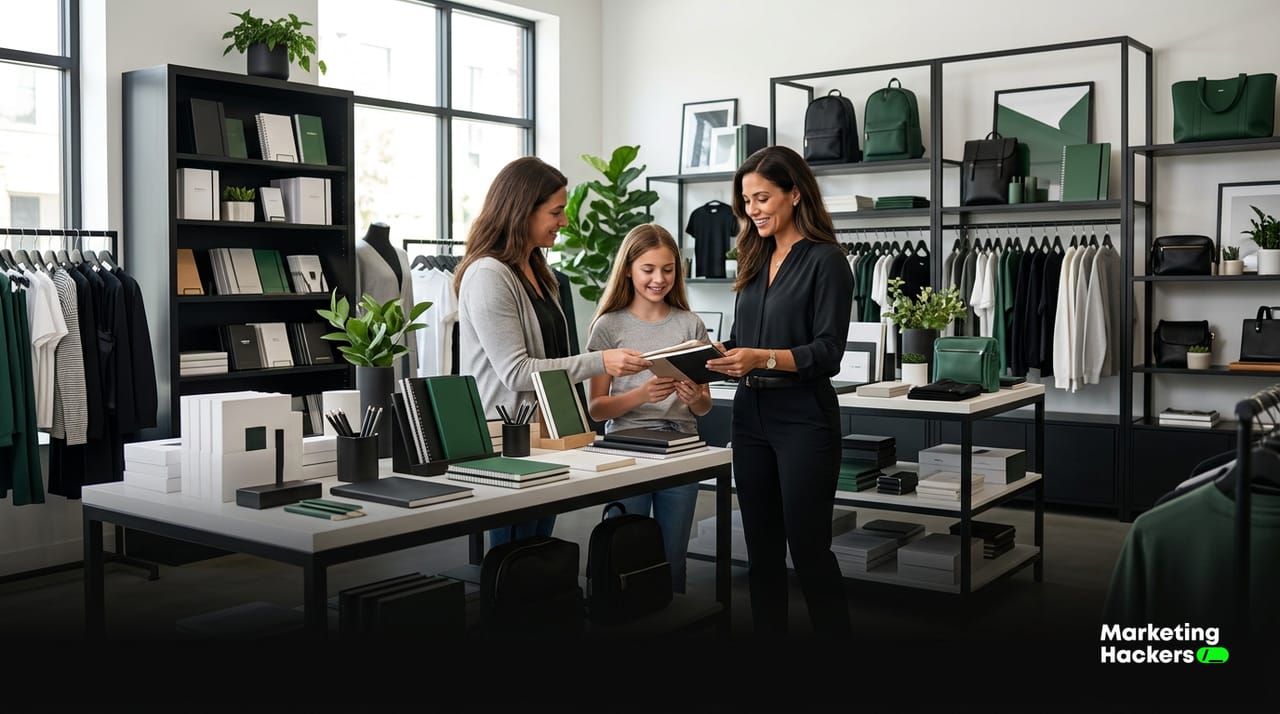
The person who pays and the person who picks are rarely the same. According to the Adlook Children’s Category Study 2026, children directly influence 76% of purchases in the kids’ category, and 28% of decisions start with an explicit request from the child 2. The parent signs off on the receipt, but the kid chose the backpack brand back in June. Your back-to-school campaign has to speak to both, in different voices.
Back to school has three distinct audiences 1:
- Parents and caregivers: they pay, and they want convenience and savings. They’re the audience for a stationery shop selling a ready-made “first-grade kit” in a single purchase.
- Students (middle school and up): they choose based on looks and belonging. They’re the audience for a gym or language school that sells the course as part of a new September identity.
- Teachers: they buy classroom supplies and shape the supply lists. They’re the audience for a bookstore that sets up a “classroom reads” shelf with a teacher discount.
Before you write a word, sketch your 2-3 typical customers from your sales history. An assistant like ChatGPT or Claude can help. Paste in last September’s best sellers and ask it to work out who bought them and why. In Huang and Rust’s framework for AI in marketing, this is the job of “thinking AI”, which spots patterns in data for segmentation, while “feeling AI” is about understanding the customer 7. The machine gives you a hypothesis. You check it against what you see at the counter.
Step 2: build the campaign content with AI (ready-to-use prompts)
This section saves you days in July. AI speeds up a process you already settled in Step 1, and the upstream decisions stay with you. Carrefour ran a back-to-school campaign made entirely with AI to promote 20% discounts 8, yet people had set the offer, the audience and the discount. Open the tool without deciding what you’re selling and to whom, and you get generic copy that doesn’t convert.
Here are three reusable prompts. Swap the bracketed parts for your own details.
Prompt 1 – A 3-email sequence
You’re a copywriter for a [stationery shop] in [city]. Write a 3-email back-to-school sequence aimed at [parents of elementary school kids]. The offer is [back-to-school kit at 15% off until September 20]. Make the first email a friendly teaser, 120 words max. Make the second the main offer, with the deadline. Close with a third email as a last-day reminder. For each one, give me subject line, preheader and body, with a single call to action.
Check three things before you load them. Prices and dates must match the real ones. The tone has to sound like you, the way you’d talk at the counter. Each email should say one thing. Cut any sentence that could belong to any shop in the country.
Prompt 2 – A 12-post social plan
Create a 12-post [Instagram] plan for August and September for [shop]. The theme is back to school and the audience is [parents]. Split them into 4 build-up posts in August, 5 on the offer in early September and 3 reminders. For each post give me date, format (photo, reel or carousel), a hook in the first line, copy of 60 words max and 3 local hashtags. Don’t make up prices I haven’t given you.
Make sure the August posts don’t give the offer away too early, and that the hashtags actually belong to your area. A post plan finished in July is what lets you go on vacation with a clear head.
Prompt 3 – Copy for the landing or promo page
Write the copy for a back-to-school promo page for [shop]. Follow a four-part structure. 1) a headline that names the customer’s problem ([the school supply list that never seems to end]); 2) your offer in 3 points; 3) one concrete proof point ([how many families you serve every September]); 4) the deadline and how to claim it. Direct tone, second person, no superlatives. 300 words max.
The fix here is nearly always fake enthusiasm. Strike “amazing”, “unmissable” and the rest, and leave the facts. If you need the page built and live fast, that’s the kind of job you hand off to a landing page service, so you come out of the season with the asset already indexed.
Step 3: schedule email and social before your summer break
The sequence that converts is short and tightly timed: a teaser in late August, the main offer in the first days of September, a reminder just before the first bell. Pan di Stelle went on air on August 29 for exactly that reason, to ride the back-to-school wave 9. Your budget is far smaller, but you get the same calendar as Barilla, and any email tool will schedule everything ahead of time.
Keep segmentation minimal, with two lists: customers who’ve bought from you before, and new contacts. With the first group, talk loyalty and early access. With the second, lead with a trial offer. Two versions of each email are enough. You don’t need an elaborate funnel.
On social, the big brands put everything into storytelling. WindTre built its back-to-school campaign with ZooCom around videos and a web series for Gen Z on Instagram and TikTok 10. For a small business, the practical version is showing real people: your counter, the kit you put together, the new window. For subject lines, have AI generate five or six variations, test two on a small slice of your list, then send the one with the higher open rate to everyone else.
Step 4: window display, store floor and local promotions
This is where you win on home turf, somewhere Amazon can’t reach. Search results are packed with e-commerce advice and almost silent about physical stores, so that’s your opening. Use this checklist for your August setup:
- A back-to-school window, up by August 20, with one message you can read from the sidewalk.
- A ready-made “back-to-school kit” bundle at a round price, for people who don’t want to pick item by item.
- A sign with the offer deadline clearly visible at the register.
- A deal with a local school or sports club offering a discount to their members.
- A tie-in with a nearby non-competing business (stationery shop with bookstore, gym with sports store).
- Posts in neighborhood Facebook and WhatsApp groups with your back-to-school promo.
- A small charity drive, like collecting school supplies to donate, that brings people into the store and gets them talking 11.
- A flyer with a QR code pointing to the promo page, linking the store to your online presence.
One detail outweighs the rest: the deadline. A date turns a promo from information into a reason to come in today.
Step 5: measure the campaign with 5 KPIs
If you don’t measure a back-to-school campaign, you can’t do it better next year. Research on retail promotions splits sales response into three separate effects: how many people you attract, how many convert, and how much they spend 12. Turn that into five numbers you can read with the tools you already have:
- Average ticket for the period vs. last year: pull it from your POS system. It tells you whether the offer raised the value of each purchase.
- Email open and click rates: your sending platform reports them. Below 20% opens, rework your subject lines.
- Promo redemption: how many people used the code or picked up the bundle, out of everyone who saw it.
- Landing page traffic and conversions: sessions and leads captured, from a free analytics tool.
- New contacts captured: how many new emails or phone numbers are on your list after the campaign.
Log the numbers in a spreadsheet right away, before the end of September, while the data is fresh. They become the baseline for next year’s campaign.
4 mistakes to avoid
- Starting in September. By the time the bell rings, most of the spending has been decided. Wrap up production in July.
- Copying the big retailers’ promos. Their budgets and margins aren’t yours. Your edge is being close to the customer.
- Generating AI content before defining offer and audience. You get copy that goes nowhere. Do Step 1 first, then the prompts.
- Measuring nothing. Without the 5 KPIs, you repeat the same mistakes every September.
Sources
Footnotes
-
Back to School - Il ritorno a scuola per il marketing - Leevia Blog. blog.leevia.com ↩ ↩2
-
Back to School 2026: il vero acquirente potrebbe non … engage.it ↩ ↩2
-
Promotion Strategy Specific to Organizations Participating in “Back to School” Program. eia.feaa.ugal.ro ↩
-
Calendario Marketing: Settembre, Ripartenza e Nuove … professionebusiness.com ↩
-
AliExpress, al via la campagna dedicata al back-to-school. stampaparlamento.it ↩
-
Pepco va on air con il suo primo spot tv dedicato al Back to … engage.it ↩
-
A strategic framework for artificial intelligence in marketing. link.springer.com ↩
-
L’Ai per il back to school di Carrefour. gdoweek.it ↩
-
Pan di Stelle celebra il back to school con una campagna … engage.it ↩
-
WindTre e ZooCom insieme per il back to school con un … engage.it ↩
-
Non solo promo: gdo e retailer interpretano il back to school. gdoweek.it ↩
-
Evaluating promotions in shopping environments: Decomposing sales response into attraction, conversion, and spending effects. pubsonline.informs.org ↩
FAQ
When should I start preparing my back-to-school campaign?
Between mid-June and July 20. That's when you pick your offer, your audience and the 2-3 products to push, and write the copy. 59% of consumers start buying in the last two weeks of July, so if you launch in September you reach customers who are already halfway through their shopping list.
Is back-to-school worth it if I don't sell school supplies?
Because September restarts everyone's routine: gyms, classes, wellness and professionals heading back to work. The campaign works for a stationery store, a sports center, a bookshop, an optician or a restaurant relaunching its lunch deal for people returning to the office.
How much does back-to-school season matter for a retail store?
A lot. At peak season, stationery sales jump 800-1000% compared with an average month, and distributors make 20-25% of their annual revenue between July and September. For a single store, two or three weeks can be worth more than almost any other stretch of the year.
What should I have ready by the end of July?
Everything from the first row of your calendar: a defined offer, a content calendar and draft emails and posts. If you don't have them by the end of July, you're already behind. By August the machine should be loaded so you can actually take your vacation.
How do I use AI to write my campaign copy?
Decide your offer and audience first, then use AI to produce emails, posts and promotional copy from ready-made prompts. The rule is simple: process first, tool second. AI speeds up the writing, but it doesn't replace the strategic choice of what to offer.
Which KPIs should I track when the campaign ends?
Between September 16 and 30, compare average order value, promo redemption rate and conversions with the previous year. These numbers tell you whether the campaign worked and give you a baseline to plan next year's edition better.