
Content Creation for Small Businesses: A Repeatable 5-Step Process
Small business content only works with a written, repeatable process. Here's a 5-step system to publish consistently and use AI where it helps.

You make content when you have a spare hour, which means it comes in bursts. One month you publish three articles and two newsletters. Then a big quote lands on your desk and the blog sits untouched for six weeks. That stop-start rhythm never builds an audience. When content creation fails at a small business, the cause is rarely a shortage of ideas or the wrong tools. It fails because there’s no written process that anyone could follow while you’re busy elsewhere.
By the end of this guide you’ll have three things you can use straight away. A five-stage production process you can hand to a colleague or an AI model. A method for turning one pillar piece into ten pieces of material. And a way to tell whether your content is bringing in real enquiries or just likes. The tool is the last thing to worry about. The process comes first, so that’s where we start.
What content creation means when you’re a €1M business
Content creation is the making of material for a medium, from writing articles to photography to graphic editing, to meet the needs of the people who receive it.1 For a small business, that definition needs bringing down to earth. Posting the odd update when you remember doesn’t count. Content creation means building a repeatable system that turns the expertise already inside your company into articles, emails, videos and product pages that attract customers and walk them all the way to a purchase.
This is also the distinction that saves you the most time. A large share of people searching for “content creation” want to know how to become a content creator, the individual career. Your question is a different one: how your business can produce material consistently without relying on one inspired person. Those are two separate jobs.
Academic research on B2B content marketing is blunt about this. Creating valuable content requires companies to think like publishers, starting with what information their audience needs and where those people are in the buying journey. Valuable content is useful, relevant, compelling and timely, and producing it takes a cultural shift from selling to helping.2 For a small Italian business, that means you stop writing only when you have something to push and start writing when you have something useful to give.
The numbers show what’s at stake. More than 92% of active businesses in Italy are SMEs, and they employ most of the workforce.3 Micro-businesses alone make up 94.8% of the total.4 You’re in good company, which also means your direct competitors are wrestling with exactly the same problem. Whoever gets their content production process in order first gains an edge the rest don’t have.
| Sporadic content | Content system |
|---|---|
| You write when you find the time | You publish on a fixed calendar |
| Every piece starts from scratch | Every piece comes out of a process |
| Only you know how it’s done | Anyone can follow the steps |
| Nobody measures results | You know how many enquiries it brings in |
Write the process before you write the content
Here’s the part nobody teaches you. Before you worry about what to write, write down how writing gets done in your company. That’s an operating procedure: a step-by-step document covering who does what, in what order and how long it takes, from first idea to publication. Keep one rule of thumb in mind. If you can’t describe how a piece of your content comes together in a document someone else could follow to the letter, you can neither delegate it nor speed it up with AI. Automate a process that doesn’t exist and all you get is more mediocre content, faster.
Break the production of a single article into five stages.
- Idea. Where the topic comes from. A question customers keep asking, a doubt that came up on a sales call, a request that arrived by email. Time: fifteen minutes.
- Research. Gather the data, sources and examples you need. Whoever holds the technical knowledge in the company spends twenty minutes dictating the key points. Time: forty-five minutes.
- Draft. A rough first version with the full structure in place. Time: one hour.
- Editing and tone of voice. This is where you check that the piece sounds like your company and meets your quality bar. Time: forty-five minutes.
- Publishing and distribution. Put it live, then prepare the newsletter and social versions. Time: thirty minutes.
This is where AI stops being a gadget and starts speeding things up. What matters is where you slot it into the process. A language model is excellent at stage 3, the draft, and stage 4, adjusting the tone. Stages 1 and 2 stay with you, because no model has your expertise or your experience with customers.
Turn each stage into a reusable prompt. For the draft, you can start with this one, pasting it into your assistant along with your research notes.
“Act as a writer for a company that sells [service]. Write a draft article for small business owners based on these key points: [paste notes]. Structure it in five paragraphs with concrete subheadings. Direct tone, address the reader as ‘you’, no motivational lines, and every claim must rest on a practical example. Do not invent data or statistics.”
That last constraint matters more than everything else in the prompt. The people least able to check the output are the ones who most need prompts that explicitly forbid the model from making things up.
Step 1. Start with a single pillar piece
The quickest way to burn time is to open ten different topics and finish none of them. When you have no marketing department, the opposite approach works better. You produce one well-made asset, the pillar piece, and build everything else from it.
To pick the right pillar, check it ticks four boxes.
- It answers a concrete question your customers actually ask you.
- It draws on expertise your company already has, so the research is cheap.
- It works across several channels, from the blog to the newsletter to video.
- It has a long shelf life and won’t go stale in a week or a season.
Let’s run the numbers. Take a 1,500-word guide on a technical problem you solve for customers every day. From that one piece you get five social posts, a monthly newsletter, a script for a two-minute video and three ready-made answers for sales emails. A single round of research fills four weeks of your editorial calendar. That’s the pillar-and-derivatives system, and it’s why a small business with no team can hold its own against companies with a full press office.
For the derivation stage, AI once again speeds up a process you’ve already defined. Here’s a prompt to adapt to your own case.
“From this article [paste the pillar], generate five LinkedIn posts of no more than 120 words each. Each post should isolate a single idea from the article, open with a concrete observation and end with a question for the reader. No hashtags, no emoji, same tone as the original article.”
This is where research on AI in marketing comes in handy. It separates three kinds of application. Mechanical AI automates repetitive tasks, thinking AI processes data to reach conclusions, and feeling AI handles interaction with people.5 Deriving content is a job for mechanical AI: pure standardisation. Handing it over frees up hours for the two stages that really count, the idea and your relationship with the reader.
Who checks what goes out, and against what standard
When a model does part of the work, quality control matters even more. You need a written checklist that someone applies to every piece before it’s published. Without it, your tone of voice falls apart and readers notice.
A five-point checklist covers almost everything.
- The piece answers a real customer question and doesn’t waffle.
- Every figure or statistic has a verifiable source and no number is made up.
- It sounds like your company, in the same register you’d use on the phone with a customer.
- Every abstract idea comes with at least one concrete example.
- The ending gives the reader something useful instead of trailing off with an empty line.
Give this check to one named person. In most small businesses that’s the owner or the head of sales, because they know the right tone and can spot when a piece is fudging the facts.
Turn your content into a newsletter people actually open
There’s one lever most small businesses underrate, and it’s email. The way Italians get their news has changed fast. Today TV is the main source of information for only 46.5% of the adult population, down from 67.4% in 2019, and more and more Italians turn to the internet instead.6 If you produce useful content, there’s room for you that simply didn’t exist six years ago.
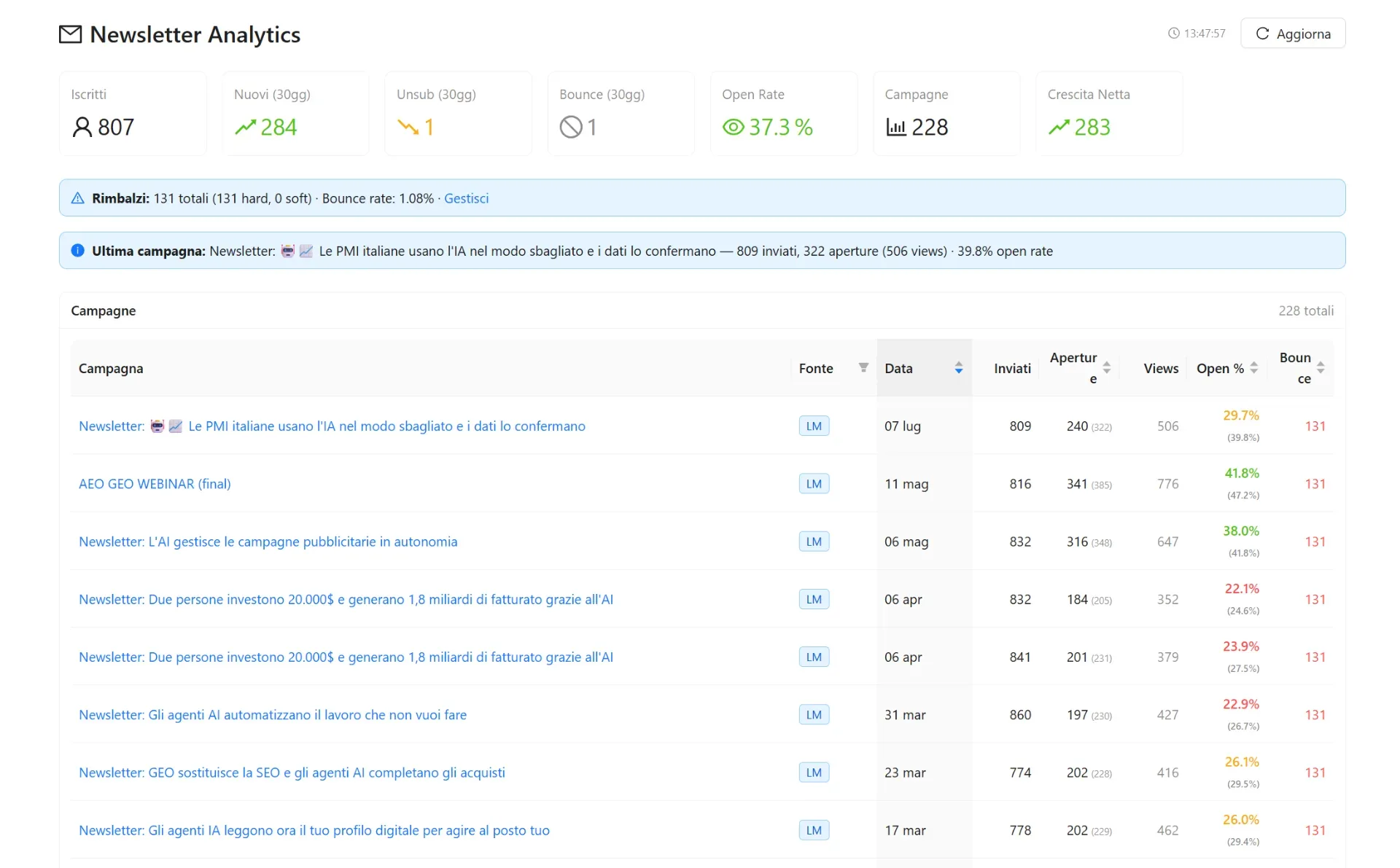
Here’s one of our own numbers. With the Marketing Hackers newsletter, we take industry news and the guides we write and condense them into a monthly issue. The average open rate is 37.3%, with peaks of up to 42%. The mechanics are simple and you can copy them. We also publish the newsletter on our website, even though getting traffic from search engines and chatbots keeps getting harder. Search engines tend to drop this kind of content from their index as low-value, favouring pages that show personal expertise and a company’s own data.
What a content newsletter really does is keep your audience engaged over time, and keep you on top of your field too, without burying readers in sales offers. When one of them needs a service you sell, chances are you’ll be at the top of their list.
The pillar piece we talked about earlier is the perfect fuel for this. A solid guide becomes the centrepiece of that month’s newsletter, so you don’t have to dream up fresh content every thirty days.
When it makes sense not to produce content in-house
Doing it yourself has limits, and it’s only fair to say so. There are three situations where improvising internally costs more than bringing someone in.
The first is volume. If you need a pace your setup can’t sustain, producing in fits and starts drags down the quality of everything. The second is missing skills. A cinematic video or a technical SEO campaign needs hands that a €1M business rarely has, and improvised results show. The third is verification. If nobody in the company can check whether AI-generated content is accurate, you’re publishing blind, and your reputation takes the hit.
The sign that it’s time to delegate is when the written process exists but you can’t run it consistently. At that point your SOP becomes the document you hand to an outside supplier, so they can produce content in your tone of voice. The written process stays your asset even when production moves out of the building.
How to measure whether your content is bringing in enquiries
Likes and views tell only a small part of the story. For a small business, content matters if it generates leads, quote requests and sales. Tie every piece to a measurable business goal before you publish it.
Three indicators are enough to get started. Contact requests that come in after someone reads an article, which you can track with a “how did you find us?” question on your form. Your newsletter open rate, which tells you whether the content is useful enough to get opened again next month. And the number of sales conversations where a customer mentions something you wrote, which is the strongest signal and the most overlooked. If none of the three moves in three months, content is the first place to look. Go back to stage 1 of the process and check whether you’re answering the right questions.
Further reading
Sources
Footnotes
-
Creazione di contenuti — Wikipedia. it.wikipedia.org ↩
-
Business to business digital content marketing: marketers’ perceptions of best practice. e-space.mmu.ac.uk ↩
-
la comuni cazione strategica non è roba da grandi. webthesis.biblio.polito.it ↩
-
osservazione e indagine delle PMI italiane. sni.unioncamere.it ↩
-
A strategic framework for artificial intelligence in marketing. link.springer.com ↩
FAQ
How do I create content consistently without a marketing department?
Write a standard operating procedure (SOP) that covers how a piece of content goes from idea to published. A team member or an AI model can then run that process, and you can stick to a publishing schedule even in your busiest weeks.
What's the difference between posting content occasionally and having a content system?
When you post occasionally, you publish whenever you find the time and start from scratch every time. Quality depends on your mood and nothing gets measured. A system runs on a written procedure and a checklist, so you can delegate the work and see how many leads each piece brings in.
Which comes first, the tool or the process?
The process. Before you choose between video and blog posts, and before you open ChatGPT, write down how your content actually gets made. Tools come later, to help you run an existing procedure faster.
Where does AI actually save time in content creation?
AI saves time on the steps that are already written down, because it can follow an SOP the way a junior team member would. A step-by-step procedure is what lets an AI model produce consistent, repeatable work.
Are small businesses ready to produce content digitally?
Mostly not. In Italy, SMEs make up over 92% of active businesses and employ 82% of the workforce, yet about 60.3% have only basic digital intensity. That's why a structured method gives you an edge most of your competitors don't have.