Content Marketing Strategy for Small Businesses: A 2026 Guide
A small business content marketing strategy starts with one number to grow, not an editorial calendar. Here's the full method, step by step, for 2026.

You’ve published a post every week for ten months. The blog has around forty articles, the newsletter goes out every Friday, and your LinkedIn feed is full. Then you ask your sales lead where the good leads come from, and the answer never changes: word of mouth and two trade shows. Nine times out of ten, the trouble started before anyone wrote a word. You started producing content before deciding what it was for.
A content marketing strategy for a small business is the set of decisions you make before you open the editor. Which business number you want to grow, who you’re talking to, what you talk about, who writes, and how often. The writing comes after, and it’s the easiest part to hand off or speed up. This guide walks you through the method in order, and flags the points where AI saves you real hours while leaving the judgment calls with you.
Why a $1M business fails at content before writing a single post
Content marketing works for small companies too. That much is settled. In a study published in Frontiers in Psychology, content marketing generated three times as many leads as a paid ad campaign in the final month of the third year of observation. The paid ad only stayed effective for the first year and a half, then its returns started to slide. The authors put it plainly: with digital content marketing, small and medium businesses can build an effective campaign and reach the right customer with good content. 1
The catch is that the result shows up after three years of consistent work, and that’s exactly where a company turning over a million trips up. Productivity in Italian small businesses is low on average, and small firms employ most of the country’s workforce, as the OECD notes in its 2026 Economic Survey of Italy. 2 In practice, you have very few hours and nobody whose job is only content. Start without a method and here’s what happens: you produce plenty for eight months, see no sales, lose heart, and shut the blog down in month nine. The failure was baked in from the start, the day you skipped deciding what to measure.
There’s also outside pressure that makes 2026 a bad year to put this off. The EU’s “Digital Decade” target aims to bring 90% of small and medium businesses to a basic level of digital adoption by 2030, according to ISTAT. 3 Your competitors are already moving down that track. Whoever builds a content system that delivers predictable leads will have a head start that’s hard to close.
Pick one number before you touch the editorial calendar
Before you choose topics, choose the metric that has to go up. Just one. For most small businesses it’s qualified inquiries per month: how many people in your target market get in touch because they read or watched something of yours. Everything else (visits, followers, email opens) is a dashboard light. Handy for telling you the engine is running, useless as a goal.
Why only one? Because with a single guiding number, every decision gets easy. Say you sell practice management software to accounting firms and today you get 4 qualified inquiries a month, one of them from content. Your target for the end of 2026 is 12, with 6 coming from content. Now you know what every article is for: getting an accounting firm to fill in the form. A piece on “5 tax trends for 2026” does nothing for that number. A guide on “how to close the year-end accounts in half the time with practice software” does.
Your guiding number also ties back to acquisition cost. If you know what a customer from paid channels costs you today, you can compare it with the cost of one who came in through content, and see what this work is actually worth. Putting spend next to return is the core logic of content marketing for small businesses, and it’s what sets the cost of content marketing for a business your size.
How to pick the three pillars that hold everything up
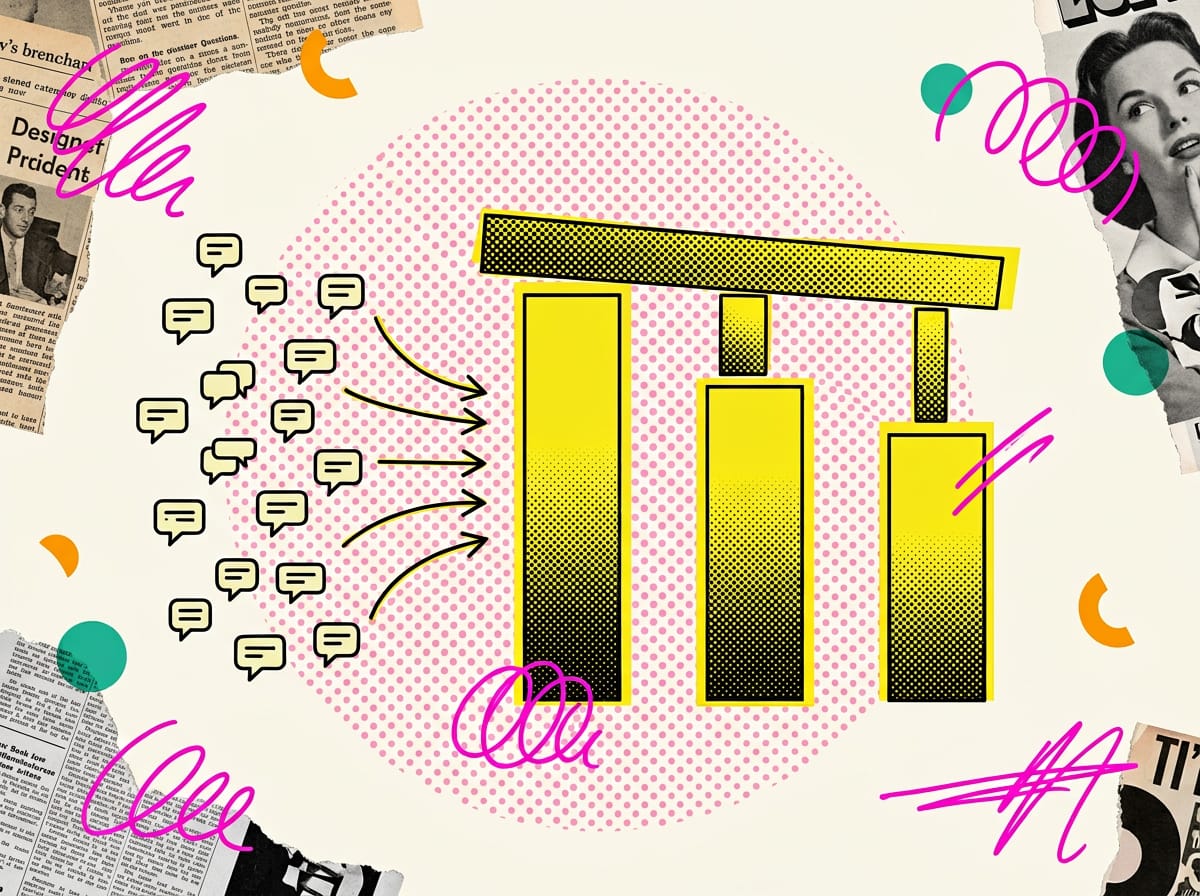
A pillar is a recurring topic you want to own. Three is plenty for a small business. Go past three and you spread your few hours too thin; go below and you start repeating yourself.
The way to find them is hands-on. Pull the last 30 inquiries that reached sales and the last 30 support emails, and read the actual questions customers ask. The ones that keep coming back are your pillars. A window manufacturer finds the same three questions over and over: how much will I save on my energy bill, how does the tax rebate work, and how do I choose between aluminum and uPVC. Those are the three pillars, straight from customers’ mouths instead of from your head.
This is where AI cuts out a big chunk of the time the job takes by hand. Paste the raw questions into a model like Claude or ChatGPT with a prompt along these lines:
“You’re a marketing analyst. I’m pasting 40 questions asked by real customers of a company that makes windows and doors for homes. Group the questions into no more than 5 recurring themes. For each theme, give the theme label, how many questions fall under it, and a typical question written in the customer’s own words. Don’t invent themes that don’t come out of the data. Sort from most frequent to least frequent.”
The model hands back the clusters in seconds. You keep the three most frequent ones that also sit closest to what you sell, and drop the rest. The final call stays with you, because the model has no idea which topic carries margin.
Do it in-house, hand it off, or pay as you go

Nobody writes this decision down, and it’s the one that sinks editorial plans. Before budget even comes up, the question that matters is who actually writes Monday morning’s piece. There are three routes, and you match them against the hours you really have and the expertise you’ve got in-house.
| Where your business stands | Hours per week for content | Who produces | Why |
|---|---|---|---|
| You can explain your product well and someone on the team can write | 4 or more | In-house, with AI as an accelerator | The expertise is inside; AI lets you write more in the same hours |
| Deep expertise, but the owner or technical lead has zero time | under 2 | Managed service or agency | You need someone who turns your know-how into finished pieces without eating into operating time |
| You need a specific format now and then (a landing page, a video) | varies | Pay-per-use tool, you pay only when you produce | No fixed cost; you switch the format on when a campaign needs it |
| No in-house expertise and a tight budget | under 2 | Hybrid: strategy in-house, execution outside | You set the pillars; you buy execution where you have no leverage |
As a rule, strategy and pillar sign-off always stay in-house, because nobody knows your customers better than you do. Repetitive execution gets handed off or bought in, for example from a content marketing agency for small businesses, where what matters is understanding what you’re paying for and at what price.
How often to publish without burning out the team
Frequency comes from the hours you have. Take the real hours one person can put into content in a week, divide them by the hours it takes to produce one piece in your chosen format, and you’ve got your maximum sustainable pace.
A solid article, with research and editing, takes several hours even for someone who knows the trade. If your weekly hours barely cover one piece, your pace is one article a week. Full stop. Pushing for two means shipping a weak one or skipping the following week. One solid piece every seven days for a year beats four pieces in a month followed by silence. Consistency over time is what produced that three-year result in the study above. 1
AI changes the math here, because it cuts the hours per piece and leaves the quality of the thinking intact. With a good workflow you can bring the time per article down noticeably, which means a faster pace with the same people. As long as the thinking (angle, examples, data) stays yours. Day-to-day text production is where it pays to set yourself up properly, and content creation for small businesses is what turns strategy into things that actually get published.
Give every piece of content its own metric
The classic mistake is measuring everything against the same number. A piece meant to get you noticed shouldn’t be judged on sales, and a piece meant to close shouldn’t be judged on traffic. Tie each type of content to its stage.
Discovery content (broad guides, intro videos, social posts) you measure on qualified traffic and new subscribers. Evaluation content (comparisons, worked case studies, calculators) you measure on information requests and downloads. Decision content (service pages, pricing, sales FAQs) you measure on qualified inquiries, which is your guiding number. If a discovery piece brings no traffic, rework it. If a decision piece gets visits and zero inquiries, the offer is the problem. Content marketing examples for small businesses sort the same way, by stage, so every piece knows what it has to deliver.
Where AI genuinely speeds up the process
In 2026, AI is no longer optional from a financial standpoint. According to BCG’s AI Radar 2026, companies will invest an average of 1.7% of revenue in AI this year, more than double the 2025 figure, and 94% of CEOs will keep investing even without an immediate return. 4 The winners put process and skills ahead of the tool. AI speeds up a sound method, and the method has to come from you.
Where it earns its keep most is quality control, the step nobody does because it’s tedious. Here’s a ready-to-use prompt:
“You’re a tough editorial reviewer. I’m pasting a draft article aimed at Italian small business owners. Check three things and give me a table: 1) does every claim involving numbers or data cite a source? Flag the ones that don’t. 2) are there vague or padded sentences I can cut without losing meaning? List them. 3) does the piece answer the question of an owner who’s short on time, or does it beat around the bush? Score it 1 to 10 for concreteness and give me the top three changes. Don’t rewrite the text, just give me the diagnosis.”
In a few minutes the model rereads the draft for you and points out the weak spots. Then you decide what to fix. Same principle for topic research, first drafts, and turning one long article into three social posts. The thinking and the sign-off stay with you; the grunt work goes to the machine.
The first 90 days, week by week

A plan is only worth something if you know what to do on Monday. Here are the first three months, stripped to the bone.
Weeks 1 and 2: decide. Set your guiding number and the target you want to hit by year-end. Read the last 30 sales inquiries and 30 support emails and pull out your three pillars. Pick your make-or-buy route from the table above. No publishing yet.
Weeks 3 to 6: build the engine. Put together a brief template for every piece (angle, customer question, data point or example, call to action). Write your first 4 pieces, one a week, spread across the three pillars. Set up the bare minimum of tracking to see traffic and inquiries.
Weeks 7 to 12: measure and adjust. Keep going at the sustainable pace you worked out. Halfway through, look at the numbers by stage and see which pillar brings inquiries and which only brings visits. Shift hours toward what’s working. At 90 days, the concrete win is knowing which topic pulls; the line of customers at the door comes later. The full return lands in the months that follow, as the study’s three-year curve shows. 1
Further reading
- Content creation for Italian small businesses
- Company newsletters for small businesses: the complete guide to copy and editorial planning
- Outsourcing content creation
Sources
Footnotes
FAQ
Why do so many small businesses fail at content marketing before they even start writing?
They start producing content before deciding what it is for and which number it should move. Results only come after years of consistent work, so the business publishes for months, sees no sales and shuts the blog down out of frustration.
Where do you start when building a content marketing strategy for a small business?
Start with a single metric you want to move, before you touch the editorial calendar. Once you have that guiding number, every later decision about topics, frequency and formats gets easier, because you know what each piece of content is for.
Which metric should a small business track?
For most small businesses, the right metric is qualified inquiries per month: how many people in your target market get in touch after reading or watching something you made. Traffic, followers and email open rates are dashboard warning lights, not goals.
Does content marketing actually work for small businesses?
Yes. A study published in Frontiers in Psychology found that content marketing generated three times as many leads as a paid campaign, but the payoff took about three years of consistent work.
Why is 2026 the wrong year to put it off?
The EU's Digital Decade targets call for 90% of small and mid-sized businesses to reach at least a basic level of digital adoption by 2030. Your competitors are already moving, and whoever first builds a content system that brings in predictable leads will hold an advantage that is hard to claw back.