
Flowise: What It Is and How to Build AI Marketing Agents (No-Code)
Flowise is an open-source, no-code tool for building AI marketing agents and chatbots. See if it fits your small business before sinking days into it.

Take the owner of a small company turning over €1.2 million. They spend a week wiring up an AI agent to answer sales emails automatically, then switch it on. The agent replies, and the replies are bad. The business had never had a standard sales reply for it to copy, so the model started making up the tone, the prices and the terms. It automated a gap. The tool worked first time. What was missing was the process everyone assumed sat underneath it.
Flowise lives right at that friction point. A company senses AI could take repetitive work off two people’s plates, but doesn’t yet know which work, or what it’ll cost to find out. This guide comes before the “where do I click” stage. Use it to decide whether Flowise is worth it for you before you sink days into it.
What is Flowise
Flowise is an open-source, no-code platform for building conversational agents and chatbots on top of language models. You drag and connect visual blocks with the mouse, so you don’t write code. You plug in your documents, a model such as GPT or Claude, a memory, and integrations with the tools you already use.
The idea behind it is the same one driving the recent wave of low-code and no-code platforms: drag-and-drop interfaces, visual components and pre-built modules that cut development time and complexity, so people who don’t code can still put together a working application 1. In Flowise terms, a marketing manager with no developer on staff can build an agent that reads the product catalogue and answers customers, just by moving boxes around a canvas.
The software itself costs nothing. What you do pay for comes later, and we’ll lay it out plainly further down.
Before you open Flowise, map the process
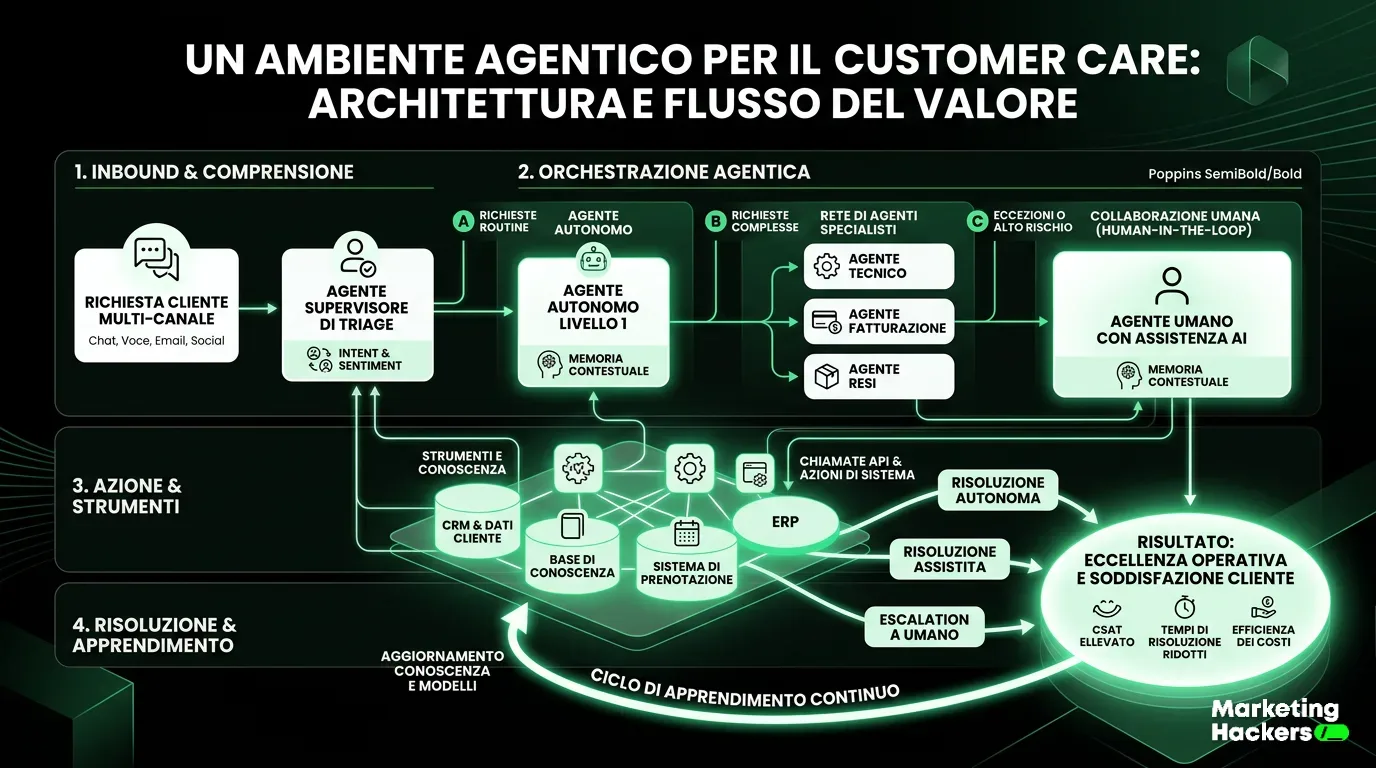
This is where most projects fall over. An agent built on a process that doesn’t exist makes the mess bigger, because it repeats decisions nobody ever standardised, at machine speed. The research on AI in business says the same thing more cautiously. Organisations struggle to adopt AI and get value out of it, and there’s still no shared understanding of how these technologies create business value 2. For a small business, that comes down to one rule: map the process first, then decide what to speed up.
The quickest way to do it needs no special software. Open a chat with ChatGPT or Claude and get it to pull out the procedure that currently lives only in the owner’s head. Here’s a prompt that works.
“You’re an operations consultant. I’m going to talk you through how I handle quote requests that come in by email. Ask me 12 questions, one at a time, to rebuild the process step by step: who receives them, what they check, what information is needed to reply, when the answer is no, which replies are always the same. At the end, give me a numbered procedure and a list of standard replies I could reuse.”
If you finish the exercise and find there are no recurring replies, you’ve got your most important answer: that process isn’t ready for an agent yet. If eight replies turn up that cover 80% of cases, you’ve found the material the agent will actually work with.
The five building blocks of a Flowise agent

Every agent you build in Flowise is a combination of five components. Knowing them up front stops you treating the platform like a magic box.
The language model is the engine that writes the replies. You pick GPT, Claude or an open model, and that choice drives the cost of every conversation. The knowledge base is where you upload your documents (price lists, FAQs, spec sheets). They get chunked and turned into a vector database, which the agent queries so it answers with your data instead of general knowledge. The memory keeps track of the conversation, so the agent remembers what the customer asked two messages back. The tools are actions the agent can take outside the chat, like checking a calendar or adding a row to a spreadsheet. The system prompt is the instruction that sets its role, tone and limits.
The order of these blocks mirrors the way research describes AI as a system: data collection and storage, statistical and computational techniques, and output systems that produce a response or communicate with the person 3. In Flowise, those three layers become three boxes joined by a line. The platform’s strength is making them visible and editable without touching code. Its limit, shared by every no-code tool, is that past a certain level of complexity you still need technical skills to customise the agent and fix behaviour that falls outside the norm 1.
Which agents make sense for a €1M business
For a business turning over one or two million, four agents hold up: a lead qualifier on the website, a catalogue FAQ, a content-writing assistant trained on your tone, and inbound email triage. They only make sense where the task is repetitive, high-volume and has predictable answers.
The four use cases that actually hold up
Listicles name abstract categories like customer support, sales and HR. They’re not much use until you pin them down by workload and by the data you already have. An agent earns its place when there’s a repetitive, high-volume task with largely predictable answers. Outside those conditions, it isn’t worth a week of work.
Four cases work well in a business turning over one or two million.
The lead qualifier greets people who get in touch through the website, asks three questions and works out whether the enquiry is relevant before passing it to a salesperson. It runs on the logic of the old digital sales assistant, which alternated targeted questions with sample suggestions to draw out what the customer really needed 4. The catalogue FAQ agent answers questions about opening hours, availability and product features by pulling from your documents, and takes dozens of tiny replies a week off whoever’s in the office. The content-writing assistant, trained on your product sheets and your tone, drafts product descriptions and posts for a person to polish. The first-pass email triage agent sorts what’s urgent, what’s spam and what’s a quote request.
Research on AI’s impact on marketing, based on interviews, focus groups and surveys in the hotel industry, identifies ten trends grouped into four themes. The first is that AI re-engineers internal processes, using data and content as levers of competitiveness 5. That holds well beyond hotels. An agent that works gets grafted onto a process someone has already designed; when it has to invent one, it fails.
How to choose between Flowise, n8n and a custom GPT
Choose by task. Flowise if you need an agent that holds a conversation and reasons over your documents, n8n if you just need to move data between your CRM, email and spreadsheets on fixed rules, a custom GPT if you want to test the idea in an hour with no infrastructure. One question settles it: conversation or data transfer?
Side-by-side comparison
People searching for Flowise are often weighing up two other routes at the same time. These are different tools solving different problems, and picking one because it’s fashionable is the first mistake.
| Tool | Strength | When it’s the right choice | When it’s the wrong one |
|---|---|---|---|
| Flowise | Conversational agents that read your documents, built visually, with control over your data | You want an assistant that answers customers or your team using company knowledge, and you want to keep the data on your own server | You only need to connect two apps to move data, with no conversation involved |
| n8n | Automations across hundreds of apps, driven by triggers and events | You need your CRM, email and spreadsheets to talk to each other automatically on precise rules | You need an agent that converses and reasons about content, which n8n doesn’t cover because it was built to run workflows |
| Custom GPT | Built in an hour, no infrastructure to manage | You want a quick internal prototype and a single vendor’s ecosystem is enough | You need control over your data, deep integrations or portability outside a closed ecosystem |
One question settles it. Does the task mean holding a conversation and reasoning over your own documents, or moving data between systems on fixed rules? The first answer points to Flowise, the second to n8n. The custom GPT stays as the shortcut for validating an idea before you build it properly.
How much Flowise really costs
The Flowise software is free. The project isn’t. You pay for the server it runs on, model tokens on a pay-as-you-go basis, the vector database once you’re past low volumes and, above all, maintenance hours: updates, fixes and reviewing wrong answers. That last item almost never makes it into the budget, and it’s the heaviest.
The costs, line by line
Open source means the code is free. The confusion starts when “free” quietly becomes “no cost”, and that’s where people get caught out. Here are the real costs, laid out plainly, with no promised ROI figures.
| Item | Cost | Note |
|---|---|---|
| Flowise software | Zero | Open source, install it freely |
| Server it runs on | Recurring | A small cloud server or a local machine that’s always on |
| Model tokens | Pay-as-you-go | You pay for every conversation, based on the model you choose and how long it runs |
| Vector database | Free to recurring | Free tiers cover low volumes, then you pay for capacity |
| Maintenance hours | The heaviest item | Updates, fixes, reviewing wrong answers |
The last row is the one nobody budgets for, and it’s what sinks DIY projects. Language models hallucinate and make mistakes, and you still need technical expertise to validate or correct what they produce. Whoever keeps the agent running has to be able to tell a correct answer from one that sounds right and is false 1. Put those hours in the budget before you start.
How to tell if the agent works
Before it goes anywhere near customers, test it on twenty or thirty real questions from your history, each with the correct answer next to it. Two metrics count: the share of correct answers, and the share of cases where the agent admits it doesn’t know and hands over. The second matters more than the first.
The test bench, step by step
You judge an agent on numbers. Build the test set from your email history: real questions, the correct answer beside each one, and a count of how often the agent gets there.
You can have the test set generated for you with a prompt like this.
“From these 40 real customer messages I’m pasting in, pull out the 25 most frequent questions. For each one, write the question in one column and the correct answer, based on the attached price list, in another. Flag the 5 questions the price list doesn’t let you answer: those are the cases where the agent will have to hand over to a person.”
There’s little room for doubt about why the second metric weighs more. An agent that’s confidently wrong does damage; one that admits its limits saves time. On LLM-assisted low-code, a study of 48 developers measured an average 41% cut in task completion time and over 90% accuracy in well-structured logic scenarios 6. The takeaway for you: the gains show up where the task is precisely defined, and collapse where it’s vague.
From flow to first agent: the practical step
So far you’ve decided whether to build and what. The how, click by click, is in the tutorial that walks through a complete agent build (uploading documents, configuring the vector database, connecting external tools) using a real estate agent as the example: how to build an AI agent in twenty minutes with Flowise. The same steps work for any sector; you just swap the documents you upload and the system prompt.
When the agent’s job is to catch customers on a page that also has to convert, the bottleneck moves from the logic to the content and design of the landing page it sits on. That’s where our design and development team comes in, for anyone who’d rather have the page built for them while keeping the process in-house.
Sources
Footnotes
-
Large Language Model Framework for Device Orchestration in Low-Code No-Code Solutions. doi.org ↩ ↩2 ↩3
-
Artificial Intelligence and Business Value: a Literature Review. link.springer.com ↩
-
Consumers and Artificial Intelligence: An Experiential Perspective. eprints.lancs.ac.uk ↩
-
ExpertClerk: A Conversational Case-Based Reasoning Tool forDeveloping Salesclerk Agents in E-Commerce Webshops. doi.org ↩
-
Artificial intelligence’s impact on hospitality and tourism marketing: exploring key themes and addressing challenges. tandfonline.com ↩
-
Low-Code Development Enhancement Integrating Large Language Models for Intelligent Code Assistance in Oracle APEX. doi.org ↩
FAQ
Flowise è gratis?
Il software Flowise è open source e in sé non si paga. I costi arrivano dopo: le chiamate ai modelli linguistici come GPT o Claude, l'hosting e soprattutto il tempo per mappare i processi e costruire l'agente.
Serve saper programmare per usare Flowise?
No. Flowise è una piattaforma no-code basata su interfacce drag-and-drop e componenti visivi. Un responsabile marketing, anche senza uno sviluppatore in organico, può assemblare un agente spostando riquadri su una tela.
Cosa devo fare prima di aprire Flowise?
Devi mappare il processo che vuoi automatizzare. Un agente costruito sopra un processo che non esiste amplifica solo il disordine. Se non emergono risposte ricorrenti, quel processo non è ancora pronto per un agente.
Come mappo un processo aziendale senza software dedicato?
Basta una conversazione con ChatGPT o Claude. Chiedi al modello di farti domande, una alla volta, per ricostruire passo per passo come gestisci oggi l'attività, e di restituirti una procedura numerata con la lista delle risposte standard riutilizzabili.
Da quali componenti è fatto un agente Flowise?
Ogni agente Flowise nasce dalla combinazione di cinque mattoni: i tuoi documenti, un modello linguistico come GPT o Claude, una memoria e le integrazioni con gli strumenti che già usi, il tutto collegato tramite blocchi visivi.
Perché un agente AI a volte risponde male?
Spesso perché automatizza un vuoto. Se in azienda non è mai esistita una risposta standard da imitare, il modello inventa tono, prezzi e condizioni. Il problema non è lo strumento, ma il processo che nessuno aveva standardizzato prima.