Cognitive Biases in Business Communication: 10 Common Examples
Cognitive biases distort meetings, emails and reports. Learn the 10 to watch for, each with a telltale phrase, a real example and a simple fix.
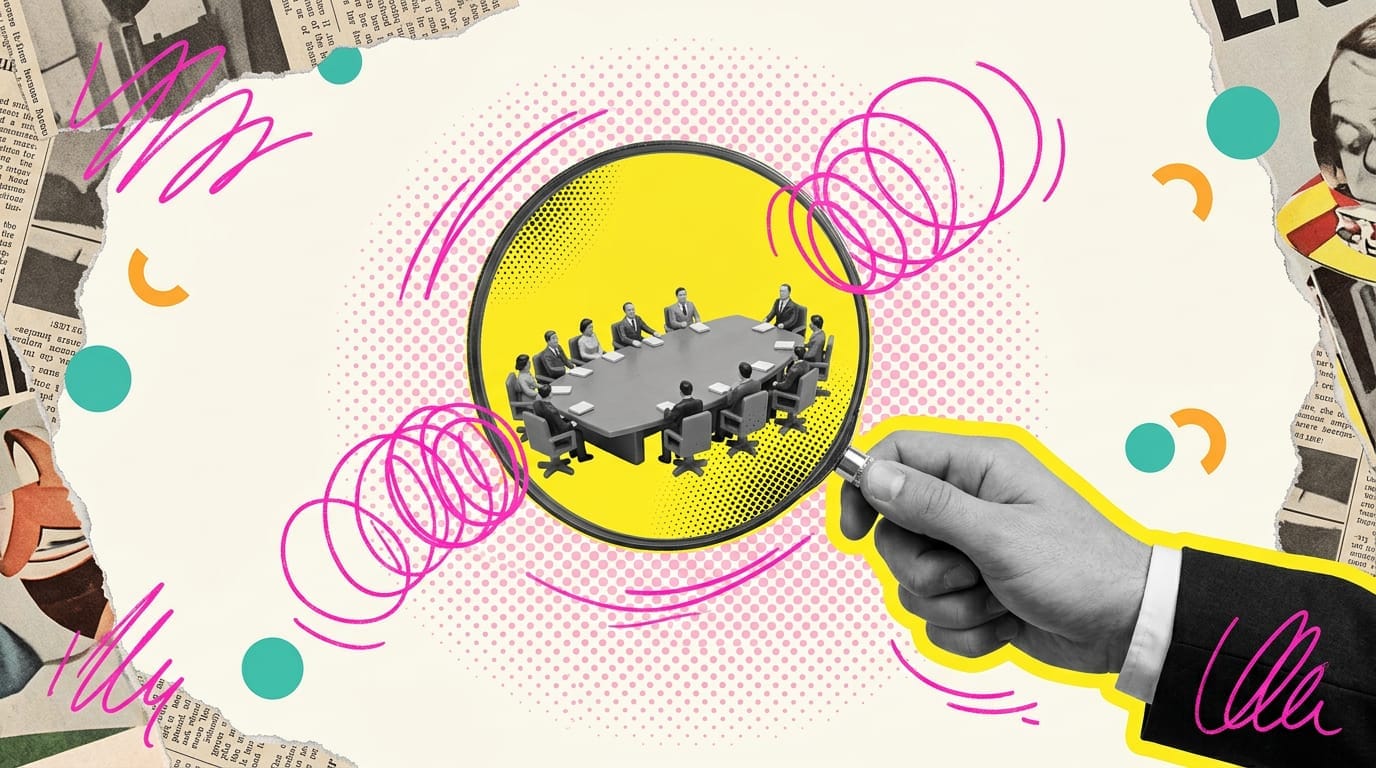
Thursday, 3pm. The owner opens the meeting with “I reckon we can wrap up the new website in three weeks.” The marketing manager nods, the sales lead nods, and twelve minutes later it’s decided. By the end of the quarter the site is still a draft, and nobody can remember where those three weeks came from.
At least three cognitive biases were sitting at that table. Business communication is full of them, because every email and every report passes through a head that takes shortcuts. They make up one chapter of communication psychology for small businesses. For each of the ten below you get the line that gives it away, a typical scene, the evidence and one thing to do this week.
A quick word on the title. No official ranking exists, and we found no studies measuring how often these biases show up in business communication. We picked these ten because they turn up in everyday work: meetings, emails, reports.
The 10 biases at a glance
| Bias | Where it hits | Giveaway line |
|---|---|---|
| Confirmation | Reports, analysis | ”Told you so” |
| Anchoring | Estimates in meetings | ”Two weeks should do it” |
| Framing | Internal reports, announcements | ”We only lost two clients” |
| Halo effect | Delegation, performance reviews | ”I trust her, she’s a great talker” |
| Scarcity and fake urgency | Internal emails, requests | ”I needed this yesterday” |
| Status quo | Procedures, change | ”We’ve always done it this way” |
| Curse of knowledge | Delegation, briefs, emails | ”It’s obvious, I already explained it” |
| Sunk costs | Project reviews | ”We’ve put too much into it to stop now” |
| Overconfidence | Plans, forecasts | ”Relax, I know this market” |
| Availability | Priorities in meetings | ”My last client told me…” |
How a cognitive bias wrecks your meetings
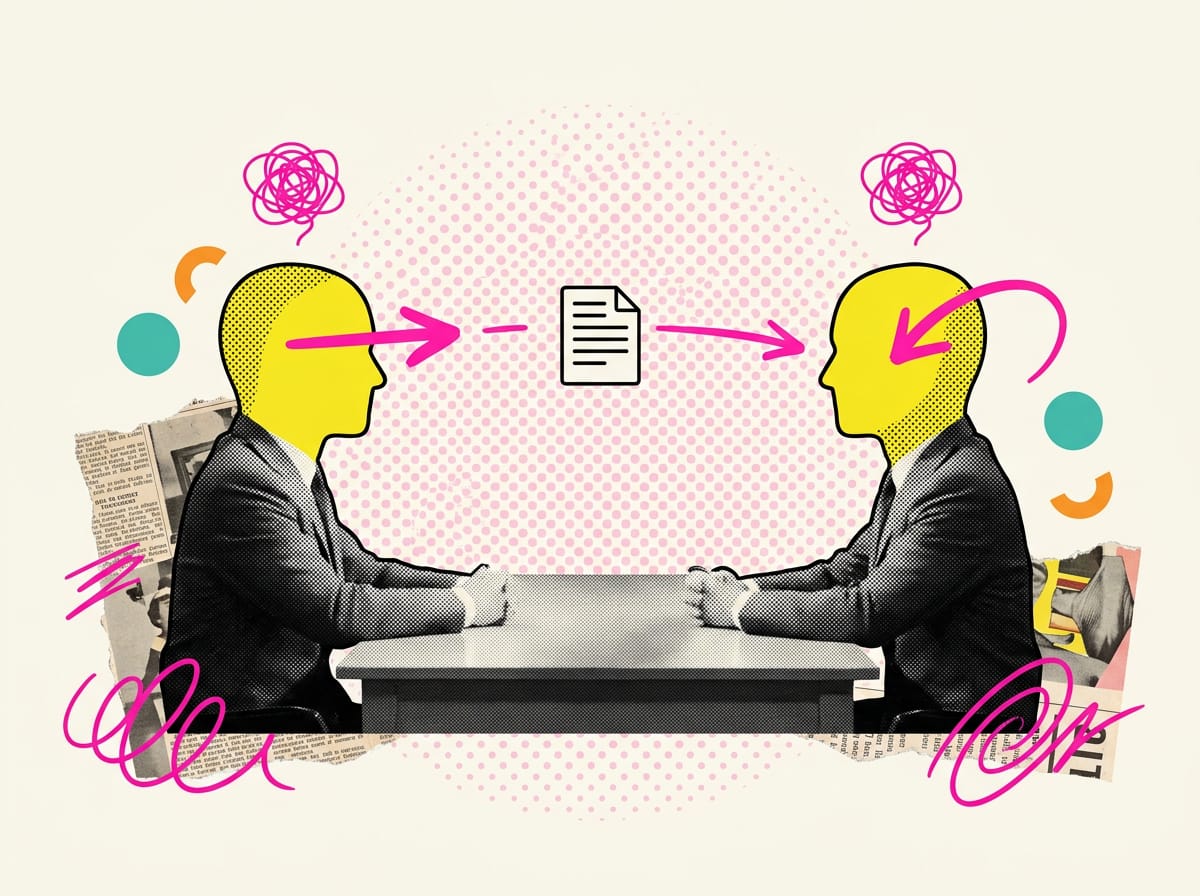
Think back to the last time an hour-long meeting wrapped up in ten minutes with everyone in agreement. That speed comes at a price. A cognitive bias is a systematic deviation from norm or rationality in judgment, and some of these mechanisms do have real value, because they help us decide quickly when we have to.1
They grow out of heuristics, the mental shortcuts that simplify choices under uncertainty. The approach Kahneman and Tversky set out in 1979 holds that these shortcuts speed up decisions and, in the same stroke, introduce systematic errors of judgment.2
At work, it pays to separate two situations that almost always get lumped together. There are the biases you fall for, when you read a report with your conclusion already in mind, and the ones you trigger in other people, when you choose which number to say first. A review on technical communication points out that both senders and receivers get caught, so the problem sits on both sides of the desk.3
1. Confirmation bias, when we only listen to people who agree with us
Giveaway line. “Told you so.”
The scene. The marketing manager is convinced trade shows outperform the website. In the monthly report, the three leads from the stand land on page one, while the web form enquiries end up in a table on page six. Every figure is true, and the running order takes the reader exactly where he’d already decided to go.
The evidence. The mechanism works on three levels at once, automatically. We seek out information that backs us up, we notice facts that fit our view, and we remember confirmations better than contradictions.4 Companies add an aggravating factor. A study of 120 international executives published in the Rutgers Business Review (Evirgen and colleagues, 2026) lists the pressure to appear right among the five root causes of mistakes at the top.5
The fix. Before you sign off a report, ask its author which figure would have changed their mind, and whether they went looking for it. The same filter works on people too, which is the case of confirmation bias in feedback.
2. Anchoring, the first number that bends all the others
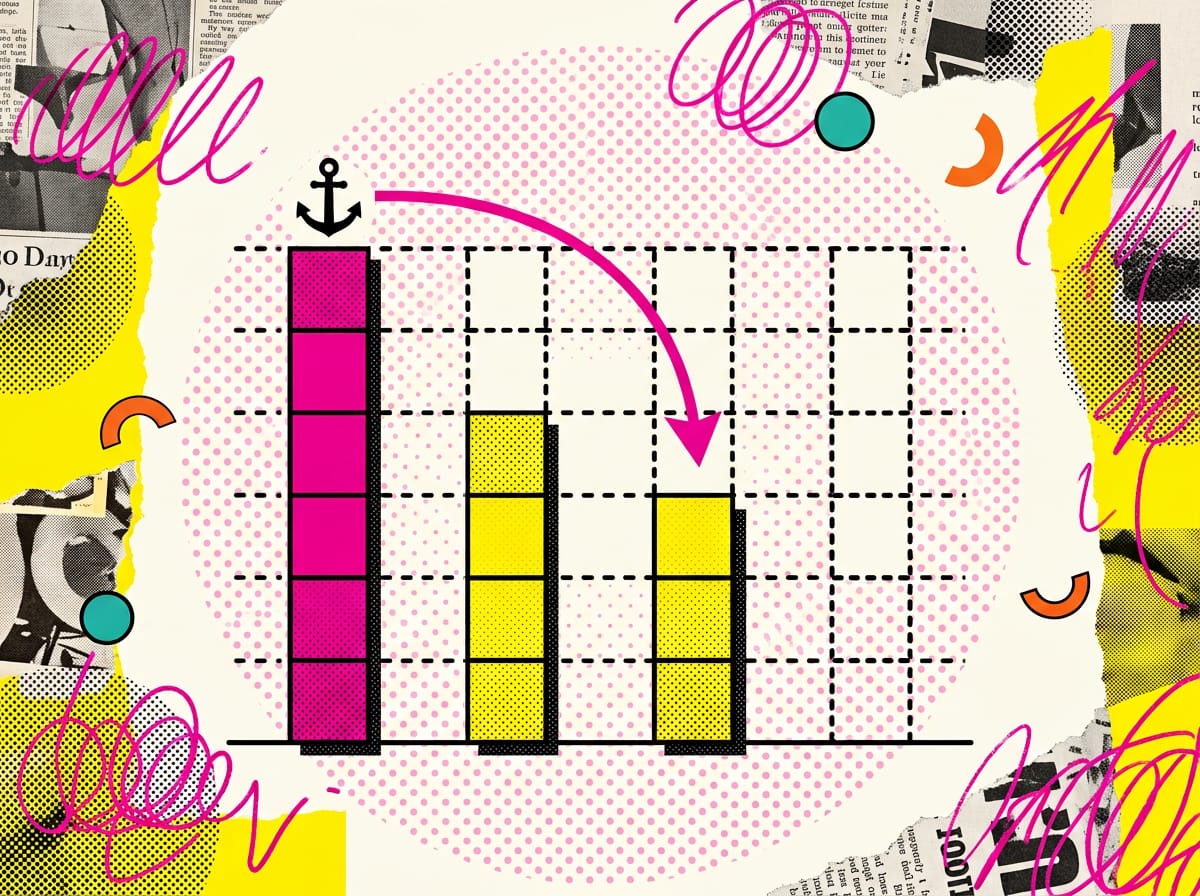
Giveaway line. “Two weeks should do it.”
The scene. The owner throws out an estimate before anyone else speaks. The designer, whose chart would have said six weeks, says four. The project manager rounds it to three “to be safe”. The whole meeting now revolves around a number nobody worked out.
The evidence. Anchoring is the tendency to decide based on the first information we come across.1 It happens outside the textbooks too. A three-year quasi-experimental study with managers at a multinational names it among the factors that shaped their commitment decisions on strategic initiatives, alongside risk aversion and overconfidence.6
The fix. Everyone writes down their estimate before anyone talks, then you read them out together. The owner goes last. Pricing and proposals are a different conversation, since anchoring and framing on price follow rules of their own.
3. Framing, when different words for the same thing change the decision
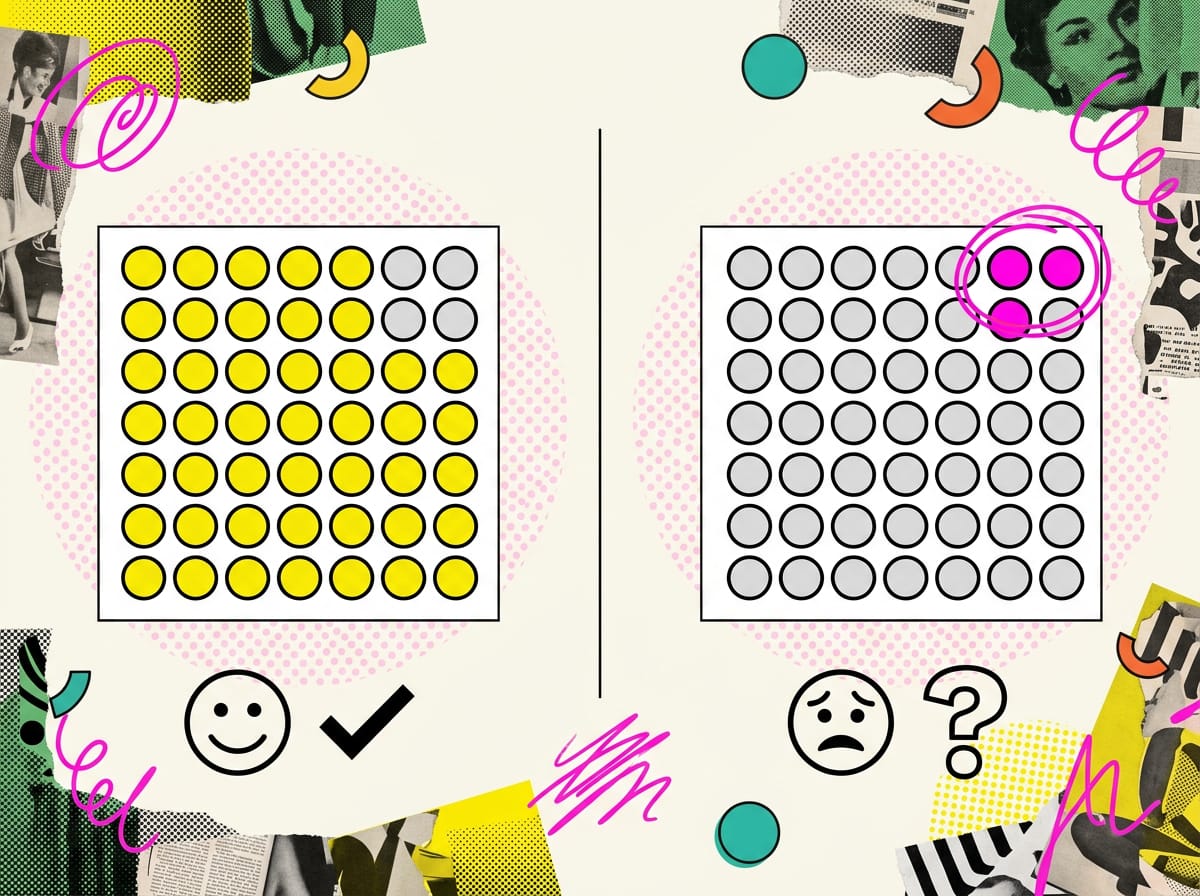
Giveaway line. “We only lost two clients.”
The scene. One figure. The sales lead presents it as “we kept 38 clients out of 40”. Management breathes out and moves to the next item. The same slide reading “two clients out of 40 walked, and we don’t know why” would have set off half an hour of questions.
The evidence. The model validated by the field study mentioned above shows that anchoring, overconfidence and risk aversion interact with framing effects in managers’ decisions.6 So the frame adds an error of its own and also changes how much weight the others carry.
The fix. In internal reports, write each key number both ways, side by side, the positive version and the negative one. It takes thirty seconds a line, and the author loses the power to set the mood of the meeting.
4. Halo effect, why likeable people seem competent too
Giveaway line. “I trust her, she’s a great talker.”
The scene. The new account manager shines in meetings and clients love her. Two months in, she’s handed the ad budget as well, something she has never run. Nobody checked whether she could do it, because the talent everyone could see covered for the one nobody could.
The evidence (indirect). Our sources for this page don’t include a study specifically on the halo effect, so we’ll stick to what holds up. Other people’s opinions and our mental schemas are among the factors that colour our assessments1, and once we’ve labelled someone, we tend to collect only the evidence that fits the label.4
The fix. When you hand over a new responsibility, assess one activity at a time and look at something the person has already delivered in that activity. If nothing exists yet, start with a small assignment.
5. Scarcity and fake urgency, when everything was due yesterday
Giveaway line. “I needed this yesterday.”
The scene. Three emails with URGENT in the subject line in a single week, for a price list that could have waited. The fourth one really is urgent, and the reply takes two days. Fake urgency burns through the sender’s credibility, and the whole office clocks it sooner than the sender thinks.
The evidence (indirect). The Rutgers Business Review study measures a close relative of scarcity. 46% of the executives surveyed name short-termism as the leading cause of management mistakes.5 The pressure of the moment weighs more than people admit. On the outward-facing side, genuine scarcity in sales copy falls under bias in copywriting.
The fix. Every “urgent” has to come with a date and a consequence, such as “if this lands after Friday, we miss the print run”. If you can’t write the consequence, take the word out of the subject line.
6. Status quo, the hidden cost of staying put
Giveaway line. “We’ve always done it this way.”
The scene. Quotes have lived for nine years in a spreadsheet only Marco knows how to update. Every proposal to replace it dies in a meeting on the same objection. Nobody has ever written down what keeping it costs, so the comparison is between a visible cost and a phantom one.
The evidence. Faroque, Casulli, Kuivalainen and Sundqvist (International Journal of Entrepreneurial Behavior & Research, 2026) note that bad experiences raise perceived risk and lead to loss aversion and status quo bias. The result limits growth opportunities and creates inertia, especially in small firms with few resources.2 A review on risk communication adds that we tend to prefer harm from omission over harm from direct action.7 If we stay still, we feel less responsible.
The fix. When you weigh up a change, list “change nothing” among the options and put a cost on it too, in hours a month or errors a year.
7. Curse of knowledge, the obvious that isn’t
Giveaway line. “It’s obvious, I already explained it.”
The scene. The owner messages a team member: “do me a landing page for the trade show.” In their head they have the audience, the tone, the offer and three clients to mention. On the screen there are ten words. A week later the page arrives, it’s wrong, and the owner concludes the team member didn’t get it. Once you know something, it’s hard to remember what not knowing it felt like, and you can’t see the gap.
The evidence (indirect). Again, no dedicated study among our sources. The review on technical communication comes close: it reminds us that people conveying technical information are as exposed to bias as those receiving it, and need to know these biases to understand users better and communicate with empathy.3
The fix. Before starting, whoever takes on the task rewrites it in three lines, in their own words. Every difference from what you had in mind is information you thought you’d passed on.
8. Sunk costs, carrying on because you’ve already paid
Giveaway line. “We’ve put too much into it to stop now.”
The scene. The custom management software has been in development for fourteen months and the team doesn’t use it. In meetings, every doubt gets shut down with a reminder of how much has been spent. That money isn’t coming back under either scenario, yet it’s the only argument on the table.
The evidence. The study on strategic initiative continuance decisions describes exactly this case. Some managers keep investing in projects with little or no hope of success because they’ve already put so much in, while others pull the plug too early.6 The mistake runs both ways, which takes away the excuse of anyone who thinks you just need to “stick it out” or “cut your losses”.
The fix. Ban the word “already” for fifteen minutes. Then ask just one thing. Starting from zero today, knowing what we know, would we do this?
9. Overconfidence, past success talking over the data
Giveaway line. “Relax, I know this market.”
The scene. The company sells well in Italy and opens in Germany with the same offer and the same message. The owner presents the plan to the team with the swagger of someone who’s won before. Awkward questions feel like a lack of faith, so nobody asks them.
The evidence. Good experiences build confidence and encourage people to assume past success guarantees future success, at the risk of missing changes in context. Faroque and colleagues call the tendency to apply limited experience to new settings, believing it’s enough, the “experience gap paradox”. The less experience you have, the less you see its limits.2 The field study with managers also confirms the weight of overconfidence on commitment decisions.6
The fix. Before launching the plan, ask whoever is presenting it to list three things that differ from the last time it went well. If the list stays empty, the analysis is missing.
10. Availability, the latest incident that sets the priorities
Giveaway line. “My last client told me…”
The scene. On Monday a client complains about the website. On Tuesday the sales meeting scraps the planned campaign and moves the budget to a redesign. One voice, still fresh in memory, has outweighed twelve months of data nobody opened.
The evidence. Faroque and colleagues list availability bias, meaning over-reliance on recent experience, among the typical mistakes entrepreneurs make.2
The fix. Whenever a single incident pushes you to change a priority, ask “how many cases, out of how many?” If the answer is “one, out of I don’t know”, the incident goes on the agenda and the priority stays where it is.
Spotting biases won’t help much if the process stays the same
The title of the Rutgers Business Review study sums up the problem: executives know the biases, and the mistakes keep coming. The authors combined interviews, a Delphi consultation and a survey of 120 international executives, and landed on a clear thesis. Biases explain how an individual mistake starts; organisational dynamics explain why it sticks around. The five causes they identified are short-termism, always thinking the same way, the pressure to appear right, misalignment between stakeholders, and weak cultures, and 94% of participants recognised them from their own experience.5
The practical takeaway for a small business follows from there. A training course on biases won’t change much, whereas a fixed check before decisions holds up even in your worst weeks. That’s the reason to give disagreement a set slot on the agenda: when dissent is scheduled, it stops being a snub to the boss.
Before you approve an important decision, five questions will do. Print them and keep them in the meeting room.
- What figure would change our minds, and have we looked for it?
- Where did the first number mentioned in this meeting come from?
- How would this conclusion sound written the other way round?
- Are we counting what we’ve already spent?
- How many cases is this based on, beyond the latest one?
How to use AI without it just agreeing with you
An assistant speeds up the check described above; let it replace the check and the risk is yours. The trap lies in the question. Confirmation bias starts when we phrase searches that already lean one way4, and “does my strategy look good to you?” is exactly that kind of search. With ChatGPT or Claude, you’re better off asking for the opposite.
Prompt 1, devil’s advocate. Use it before a decision meeting, pasting in the draft report.
I'm pasting an internal report. Don't give me an overall verdict.
List the three conclusions that depend most on my starting beliefs.
For each one, say what data would disprove it and where I could look for it.
Then state the opposite of my position as strongly as you can.
Prompt 2, double frame. It takes away the writer’s control over the reader’s mood.
I'm pasting the key numbers from this report.
For each number, write two versions of the same sentence, one highlighting
what went well and one highlighting what went badly.
Don't add data and don't comment.
Prompt 3, the reader who knows nothing. Good for delegated tasks, briefs and emails to people who weren’t in the meeting.
Read this task as someone who joined a week ago and knows neither
the client nor our previous conversations.
List the information you'd need before you could start and the words
you wouldn't understand. Don't rewrite the text.
The answers are still hypotheses to check. Their value lies in the questions they raise, and the decision stays in the meeting room, with the real numbers in front of you.
What are the most common cognitive biases at work?
No measured ranking exists. Confirmation, anchoring, framing, status quo and overconfidence are the most reasonable candidates for a small business, because they get into reports, estimates and decisions every week, and the research cited here documents several of them among managers and entrepreneurs.
What’s the difference between a heuristic and a bias?
A heuristic is the mental shortcut that simplifies a decision under uncertainty. A bias is the systematic distortion that shortcut can produce. The same shortcut that gets you to a decision in five minutes can also lead you astray.2
Can cognitive biases be eliminated?
No. Recognising them doesn’t remove them, and willpower alone won’t switch them off.4 You can limit the damage with fixed habits, like writing estimates down before anyone speaks and deliberately looking for contrary data.
Does AI eliminate cognitive errors in communication?
No. It makes them quicker to spot if you ask for objections and contrary data. Ask it for confirmation and you’ll get answers to the loaded question you wrote. The five-question checklist is for people to use; the assistant belongs in the preparation phase.
Further reading
Sources
Footnotes
-
Bias cognitivo — Wikipedia. it.wikipedia.org ↩ ↩2 ↩3
-
[PDF] cognitive biases and heuristics in the internationalization of small firms. strathprints.strath.ac.uk ↩ ↩2 ↩3 ↩4 ↩5
-
A Framework for Understanding Cognitive Biases in Technical Communication. doi.org ↩ ↩2
-
Bias di conferma: perché cerchi solo ciò che ti dà ragione. psicantropo.it ↩ ↩2 ↩3 ↩4
-
Executives Know the Biases. So Why Do They Still Repeat Mistakes?. rbr.business.rutgers.edu ↩ ↩2 ↩3
-
Bias in strategic initiative continuance decisions: framing interactions and HRD practices. doi.org ↩ ↩2 ↩3 ↩4
-
Cognitive Biases, Cognitive Limits, and Risk Communication. doi.org ↩
FAQ
What is a cognitive bias in business communication?
It's a systematic deviation from rational judgment that shows up in everyday work like meetings, emails and reports. It comes from heuristics, mental shortcuts that simplify decisions under uncertainty but can also introduce consistent errors.
Are cognitive biases always bad for a business?
No. Some of these mental shortcuts are useful because they help you decide quickly when you need to. The risk is that the same speed leads to bad calls, like a meeting that wraps up in minutes around an estimate nobody checked.
Which cognitive biases should small business owners know?
The ten most useful to recognize are confirmation bias, anchoring, framing, the halo effect, scarcity and false urgency, status quo bias, the curse of knowledge, sunk costs, overconfidence and the availability heuristic. There's no official ranking: these were chosen because they show up in everyday meetings, emails and reports.
How can you spot a cognitive bias in a meeting?
The most practical signal is a telltale phrase, like "We've always done it this way" for status quo bias or "We've put too much into this to stop now" for sunk costs. A decision made very quickly with everyone in agreement is also worth a second look.
What is anchoring bias in a meeting?
It's when the first estimate said out loud steers the whole discussion, as when the owner says "I think two weeks should do it." It mainly affects estimates made in meetings, where a number can turn into a decision without anyone remembering where it came from.
Do cognitive biases affect the speaker or the listener?
Both: speakers and listeners fall for them equally. At work, it helps to separate the biases you're subject to, such as reading a report with your conclusion already in mind, from the ones you trigger in others, such as choosing which number to say first.