Copywriting Psychology for Small Business: Headlines, CTAs, Biases
Put the right words where the eye actually stops: headlines, CTAs and cognitive biases that turn small business service pages into quote requests.
Psychological copywriting for a small business means writing a page in the order your reader’s brain actually processes it. First they decide whether the headline is worth their time. Then they decide whether to trust your proof. Only then do they decide whether to fill in the form. You don’t need to manipulate anyone. The job is getting the right words into the spots where the eye really stops.
This piece belongs to our cluster on the psychology of professional communication for SMBs, and it’s built to be used. We’ll follow one example from start to finish: a 9-person payroll and employment law practice that wants more quote requests from its services page. For every block you’ll see the typical copy (the “before”) and a rewrite (the “after”). By the end you’ll have a page rebuilt piece by piece, four prompts to work on it with AI, and a way to tell whether it worked even on a few hundred visits a month.
How your customer actually reads a page
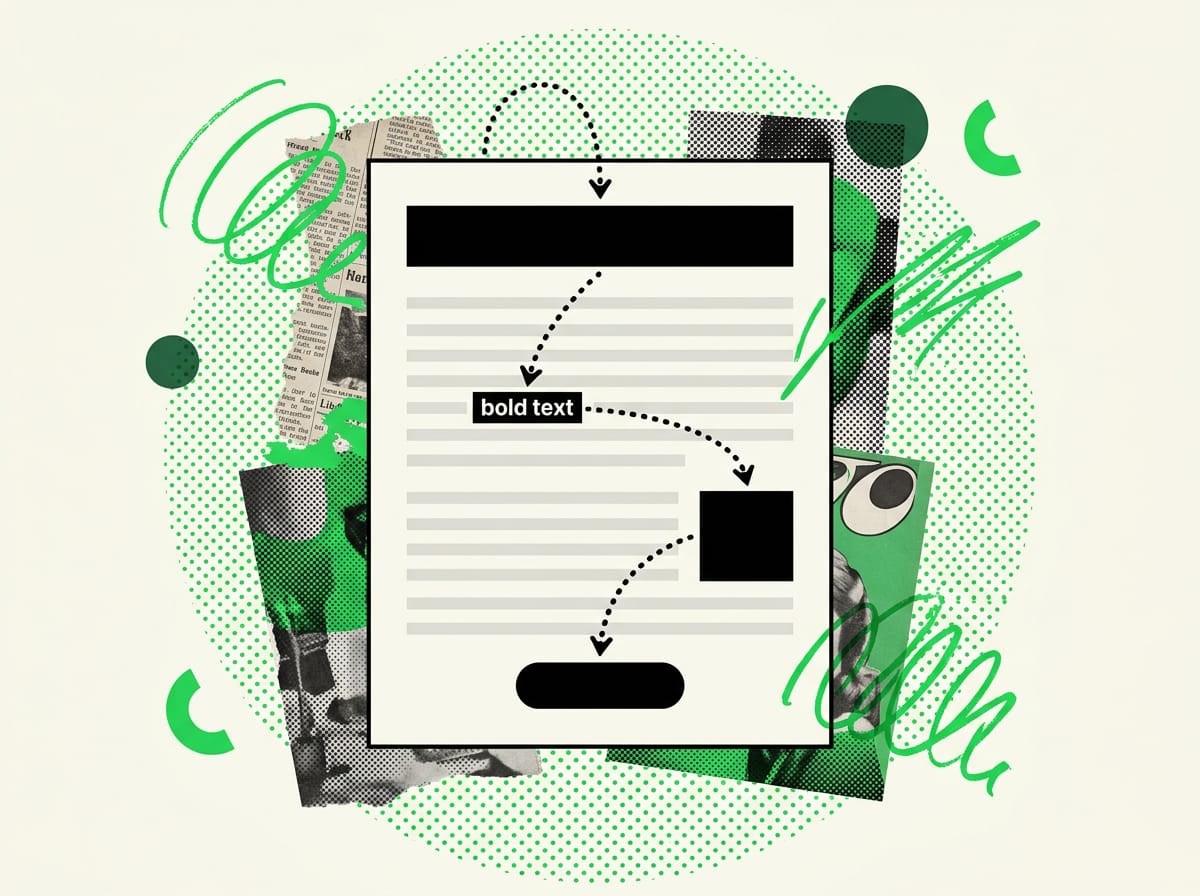
A business owner landing on your services page skims it. They skip the body copy, stop on the headline, catch a bolded phrase, glance at the button and decide within seconds whether to keep going. That’s the foundation of copywriting psychology on the web. Most of the words on a page never get read, so the headline, subheadline, first paragraph, captions and button microcopy do nearly all the persuading.
One part of reading is fast and close to automatic. It reacts to contrast and to promises it can grasp instantly. A slower, more deliberate part only kicks in if the fast part has been persuaded to stay. Write for the slow reader and neglect the fast one, and your visitor is gone before the good stuff. So work in the order the eye travels: start with what it hits first, then move down into the detail. Flip that order and you end up with beautiful pages nobody finishes.
The headline decides whether the reader stays
Your services page headline has one job: promise the reader something concrete enough that they want the rest. Here’s the typical “before” from our payroll practice.
Before: “Comprehensive employment consultancy and HR management solutions”
It says nothing. “Comprehensive” is filler, and “HR management solutions” describes what you do, not what the client gets. The reader scrolls past.
After: “Payroll paid on time, contracts that pass every inspection, and no more chasing your accountant”
Now there’s an outcome (on time), a reduced risk (the inspection) and the end of a daily headache (chasing someone). A text-mining study of more than two years of posts by well-known brands on Facebook and Twitter found that certain rhetorical devices, alliteration and repetition in particular, make people more likely to share a message.1 In a headline you only need a touch of it. A little alliteration (“payroll paid… pass”) makes the line easier to remember.
If you want to speed up the variant-generation stage, here’s a prompt you can paste into ChatGPT or Claude.
You are a copywriter who specialises in B2B communication. Write 8 headline variants for the services page of a payroll and employment law practice with 9 staff that wants more quote requests from local small businesses. Each headline must promise the owner a concrete result (lower risk of fines, payroll on time, time saved) and stay under 12 words. No generic superlatives like “best” or “leading”. For each headline, say which lever it uses: result, risk reduction or proof.
AI will hand you twenty ideas in a minute. Picking the one that works is still your call, because you know how your customers talk and the AI doesn’t.
Subheadline and social proof: where trust starts
Once past the headline, the reader wants quick confirmation that you can deliver what you promise. The subheadline extends the promise and clears the first doubt. Social proof is what makes trust click.
The real problem for small businesses is that they don’t have big-company numbers. Our practice has 12 regular clients and 4 reviews. The temptation is to hide those numbers or inflate them. Both are mistakes. When your numbers are small, being specific beats being big.
Before: “Countless satisfied clients have trusted us for years.”
Vague, so it reads as suspicious. How many is countless? Satisfied according to whom?
After: “9 local trade and retail businesses have trusted us with their payroll for more than five years. Here’s what one of them says.” Underneath, a testimonial with a name, a role and a result: “Since they started handling our hiring, I haven’t had a single dispute. Marco R., owner, auto repair shop, 6 staff.”
One name and one job title are worth more than ten anonymous stars. If you have client logos, use them only with written permission. If you have 4 good reviews, show all four in full rather than a “4.8 out of 5” that looks bought. Keeping promise and proof together without forcing it is exactly what a persuasive client communication framework does.
Benefits or features: which comes first?
Benefits. Every time. A feature describes what your service does. A benefit describes how the client’s day changes, and that’s what they’re buying. In practice, turn every feature on your services list into a benefit-plus-proof pair.
| Feature (the “before”) | Benefit (the “after”) | Proof |
|---|---|---|
| Payroll management | Payslips land correct on the 27th of every month, and you check nothing | 9 businesses on our books for 5+ years |
| Contract advice | Hire the right person on the right contract first time | 0 disputes in the last three years |
| Compliance and deadlines | No missed deadlines, no surprise fines | Automatic reminders ahead of every deadline |
The proof column is the one small businesses forget. A benefit with no proof is one more promise among many. Put a verifiable number next to it and it becomes believable. If you can’t back a claim up, scale the benefit back rather than inflating the proof.
How to write a CTA people actually click

The call to action is where most small businesses throw away all the work above it. They write “Submit” or “Contact us” and hope for the best. A CTA that converts has three parts: a verb that signals what happens next, the outcome itself, and something that lowers the perceived risk.
Before: a “Submit” button, and nothing else.
After: a “Get your free quote” button, with small microcopy underneath: “We’ll reply within one working day. No commitment, no cost.”
“Get” tells the reader what the click does, “free quote” is the outcome, and the line under the button defuses the two worries that leave a finger hovering (will this cost me? will they bombard me with calls?). The same brand-message study identifies three communicative intentions, and the directive one maps onto call-to-action logic.1 A directive CTA works when it’s clear about what it’s asking for and what you get in return.
A quick rule of thumb: read your button text on its own, out of context. If “Submit” doesn’t tell you where you’re going, it won’t tell your customer either. “Get your free quote” explains itself.
Framing your offer as a gain or a loss
You can pitch the same service as something people gain or something they avoid. That choice is called framing, and it changes how readers react. A study of 855 American adults compared identical messages presented as a “gain” (what you get) and a “loss” (what you risk) to encourage a preventive behaviour.2 The broader research in this area points the same way: when you’re asking someone to adopt a preventive behaviour, gain-framed messages tend to outperform loss-framed ones.3
For our payroll practice, getting contracts in order is a preventive behaviour through and through.
Loss frame: “Avoid fines running into thousands for non-compliant contracts.”
Gain frame (usually stronger here): “Hire on solid contracts and walk into every inspection relaxed.”
Loss framing has its place. When your offer exists to prevent a problem, though, lead with the gain and keep the loss as a footnote. Framing also ties in with anchoring and how you present prices, as covered in framing and the anchoring effect on SMB pricing.
When persuasion turns into manipulation
There’s a line here a small business can’t afford to cross, because the damage lands on your reputation, locally. A countdown timer that resets on every visit, “only 2 spots left” when you have twenty, a fake offer deadline: customers see through these tricks the second time around, and after that they don’t believe anything you say.
Biases work because the brain takes shortcuts, but use them sparingly. Scarcity is powerful when it’s real. If you genuinely have three slots open this month, say so. If you don’t, don’t make it up. The same goes for urgency and social proof. Cognitive biases in business communication can carry a message without tipping into manipulation. You only need one rule: every psychological lever has to rest on a real fact. If you’d have to lie to pull it, leave it alone.
Testing copy when you don’t get much traffic
Now for the part no guide covers. You’ve rewritten the page. How do you know the new copy actually converts better? The honest answer for a small business is that a classic A/B test on final conversions often isn’t practical.
Run the numbers on our example. The services page gets 800 visits a month and, say, 16 quote requests (2%). To tell with reasonable confidence whether a new version lifts that 2% to 3%, you need several hundred conversions per variant. At this rate you’d wait months, and in the meantime everything shifts: seasonality, traffic sources, campaigns. The test never gives you a clean answer.
Here’s what to do instead:
- Test micro-conversions. Instead of the final request, measure button clicks or scroll depth down to the pricing section. These happen far more often, so you get a signal sooner.
- Run the test where the traffic is. If you’re sending 3,000 emails or running two ads, try your two headlines there. An email subject line or an ad headline collects usable numbers in days, and you can then carry the winner over to the page.
- Do a sequential before/after comparison. Keep the old version for a month and measure it, publish the new one the following month, then compare. On low traffic this tells you far more than nothing, as long as you compare like-for-like periods. It’s less rigorous than a parallel test, and for a small business that’s fine.
The point is to stop waiting for a statistical significance that will never show up on 800 visits, and to look for signals where the numbers actually exist.
Rewriting and reviewing copy with AI
AI churns out twenty variants fast. Deciding which one is right for your customer is still down to you. Use it for the two things it’s genuinely good at: generating alternatives and acting as a critical reviewer of copy you already have.
You’ve already got the headline prompt above for generation. For reviewing, this is the prompt I use when a page just isn’t working and I can’t see why.
Act as a critical copy reviewer, not a writer. I’m pasting the text of my services page. For each block (headline, subheadline, first paragraph, benefits list, CTA) tell me three things: 1) what a reader who only reads that block for three seconds takes away; 2) whether it promises a concrete benefit or only describes a feature; 3) a more specific rewrite. Don’t rewrite everything; flag only the three weakest blocks and explain why. Text: [paste here]
You can add a third pass to check the framing.
Reread my page and tell me which sentences are loss-framed (what the client risks) and which are gain-framed (what they get). My service exists to prevent employment-related fines, so rewrite the sentences that currently lean only on fear in gain-framed terms.
And a fourth, before you publish, to get the tone right.
Check that this copy speaks to the owner of a local small business, not an HR director at a multinational. Flag every word that’s too technical or too corporate and suggest a more direct version.
Tone is still your decision, and you can settle it once and for all with a brand tone of voice for your small business so it carries across every page you write next. AI speeds up the rewriting, but the judgement about what to keep comes from knowing your customer, and no prompt will give you that.
Now put the page back together in the right order. A headline that promises, a subheadline that extends the promise, proof with a name and a role, benefits with their evidence, a CTA with a clear verb and reassuring microcopy. Test where you have the numbers, and check that every lever rests on something true. That’s psychological copywriting for a small business, and you can repeat it on every page you write from tomorrow.
Further reading
Sources
Footnotes
-
Cutting through Content Clutter: How Speech and Image Acts Drive Consumer Sharing of Social Media Brand Messages. academic.oup.com ↩ ↩2
-
Message Framing for Health: Moderation by Perceived … labs.psych.ucsb.edu ↩
-
Health message framing effects on attitudes, intentions … pubmed.ncbi.nlm.nih.gov ↩
FAQ
What is copywriting psychology for a small business?
It means writing a page in the order the reader's brain processes it: first they decide whether to stay based on the headline, then whether to trust the proof, then whether to fill in the form. It isn't manipulation. It's putting the right words where the eye actually stops.
How do prospects actually read a services page?
They skim it. They skip the body copy, stop on the headline, catch a bolded phrase and glance at the button text, deciding within a few seconds whether to keep going. That's why the headline, subheadline, opening paragraph, captions and button microcopy do most of the work.
How do you write a strong headline for a services page?
Promise something concrete: a result, a lower risk, or the end of a daily headache, instead of describing what you do. Cut filler like "full-service solutions" and talk about what the customer gets.
Where should you start when rewriting a page's copy?
Start with what the eye hits first, the headline and subheadline, then work down to the details. Flip that order and you end up with polished pages nobody reads to the end.
Can you use AI to write headlines and copy?
Yes. Tools like ChatGPT or Claude are useful for generating variations quickly. Give them a precise prompt, for example asking for 8 headlines that promise a concrete result to a business owner, then pick the best ones and refine them.
How do you know if the changes worked when the page gets few visits a month?
Even with low traffic, you can measure results by tracking how many quote requests the page generates before and after the rewrite, comparing the before and after of each section.