Effective Team Communication for Small Businesses: 7 Practical Habits
Effective team communication in a small business: 7 practical habits, from weekly 1:1s to a decision log, so you stop chasing information.

Monday, 9:40 a.m. Your sales rep messages the team chat to ask whether the quote for the client in Brescia has gone out. Admin assumed he was handling it. He assumed admin was. The quote has been sitting there since Thursday. Everyone did their job. Nobody had written down whose job this one was.
In a small business, good team communication comes down to a handful of weekly routines, each with a set format and a fixed length. A team of 5 to 30 people needs seven written habits to stop chasing information: a weekly one-on-one, a decision log, a written recap after every meeting, channel rules, a feedback template, a fixed slot for disagreement, and a Friday reflection.
For each one you get the format to copy, the mistake that kills it within three weeks, and a prompt to run it faster with AI. Together they’re the hands-on side of a bigger topic: the psychology of professional communication in small businesses.
What does broken communication actually cost you?
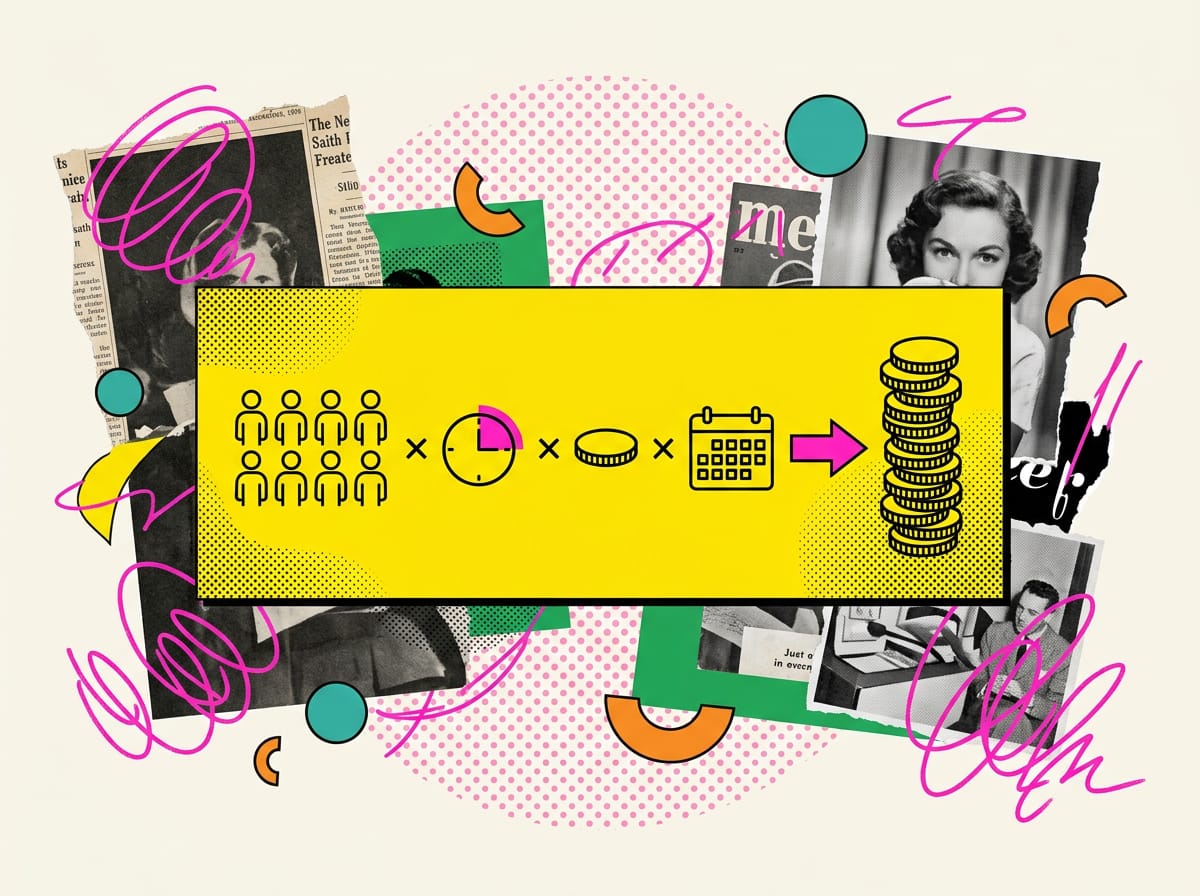
This cost rarely shows up on a P&L, because you pay it in ten-minute installments. You can estimate it in half an hour with a formula built on three of your own numbers: headcount, hours lost per week, and hourly cost. The result is usually enough to win over even a skeptical owner.
The installments look the same everywhere. Ten minutes hunting for the latest price list. Half an hour redoing a proposal built on stale figures. A phone call to ask what was decided on Tuesday. Then there’s the load nobody sees. A review of electronic communication at work identifies three sources of technostress: tool overload, interruptions, and work spilling into private life. The authors also point out that companies have to balance giving people the tools they ask for against protecting them from those effects1.
Before you change anything, put a number on the waste.
Work out your cost
Team members × hours per week lost to clarifying, repeating or redoing work × average hourly cost × 46 working weeks
Illustrative assumption, not research data. 8 people × 1.5 hours × €25 × 46 weeks = €13,800 a year.
To get the hours per person, run a one-week test. Every time someone has to ask, wait, or redo something because information was missing, they jot one line on their phone. On Friday, paste the notes into Claude or ChatGPT with this request.
Here are one week of notes from my 8-person team. Each line is an interruption or a piece of rework caused by missing information. Group them into categories (decision not communicated, file not found, request on the wrong channel, other), estimate the minutes lost per category, and tell me the two categories that cost the most. Don't add generic advice.
[notes]
Those two top categories tell you which habit to start with.
1. A 30-minute one-on-one every week, on the team member’s agenda
A one-on-one is a standing meeting between a manager and one person on their team, same day, same time. It lasts 30 minutes, and the team member writes the agenda in a shared doc five minutes beforehand.
The agenda has three headings:
- What’s blocking me. Stalled tasks and why.
- What I need from you. A decision, a piece of information, a contact.
- What I learned. A client, a mistake, a faster way of working.
Keep the same doc for months, with the date at the top of each meeting. After a quarter you have a track record worth more than any annual review.
Common mistake. The owner uses the 30 minutes to run through their own projects and the team member ends up as an audience. The second mistake is cancelling the one-on-one at the first emergency. Push it twice and the team learns the meeting is expendable, and so is whatever gets said in it.
Six direct reports means three hours a week. Past eight people, hand the one-on-ones to your area leads and meet each of them every other week.
To prep in five minutes, open the shared doc and give Claude or Gemini this prompt.
This is the history of my one-on-ones with [name] over the last 6 weeks. List the blockers that come up more than once, the requests I still haven't answered, and one open question to ask on Thursday. 8 lines max.
[history]
2. A decision log with five columns
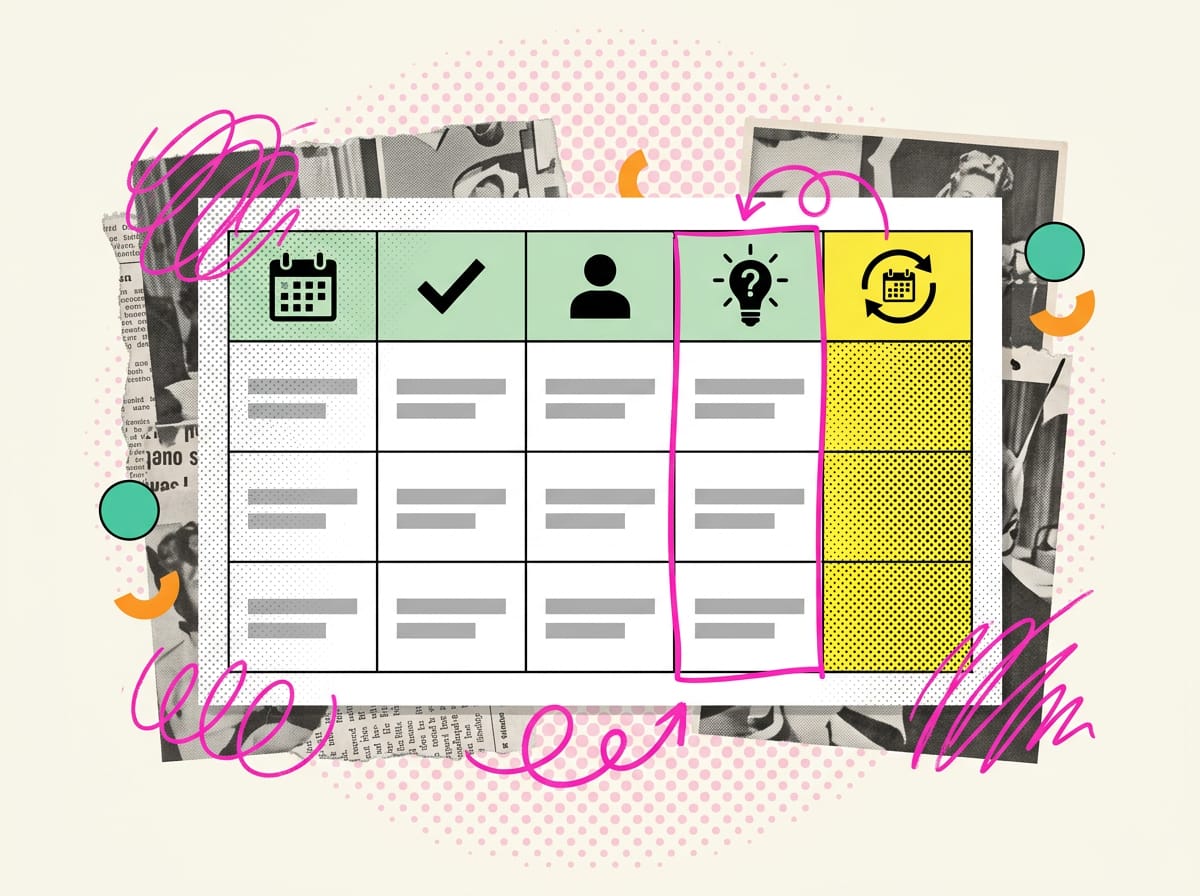
Plenty of arguments start over from scratch because a decision was made out loud and everyone remembers a different version. A decision log is one shared sheet for the whole company, and only decisions that change someone’s work go in it.
| Date | Decision | Owner | Why | Review on |
|---|---|---|---|---|
| Nov 3 | Quotes over €5,000 need Marta’s approval | Marta | Three off-margin discounts in October | Feb 3 |
| Nov 5 | Client requests come in through info@ only | Luca | Orders lost in personal WhatsApp chats | Dec 5 |
| Nov 10 | The current price list lives only in the Sales folder | Sara | Two proposals sent with old prices | Jan 10 |
The “why” column is the one that saves you time six months from now, when a new hire asks why things work this way. The review date stops a decision made in a crisis from hardening into a permanent rule.
Common mistake. Turning the log into meeting minutes and writing everything down. If a line doesn’t change anyone’s work, it stays out.
Format matters more than the tool. A narrative review of workplace journaling lists formats and digital tools among the organizational details to get right when you introduce a writing habit2. For a small business, that means a Google Sheet with five locked columns, always one click away.
To fill it in without effort, paste your notes or messages into ChatGPT with this instruction.
From the notes below, pull out only the decisions that change someone's work. For each one, fill in a row with: date, decision in 15 words max, owner, reason in one sentence, and a proposed review date 3 months out. If any information is missing, write "TO ASK" instead of making it up.
[notes]
The “TO ASK” line does the heavy lifting: it stops the model from filling gaps with guesses.
3. A written recap within 15 minutes of the meeting ending
Two days later, a meeting with no written recap exists in as many versions as there were people in the room. To prevent that, a message of five lines max goes to the team channel within 15 minutes of wrapping up, covering three points:
- What we decided (and the matching line goes into the log).
- Who does what, by when.
- What’s still open, and who brings it to the next meeting.
The person writing the recap rotates every week. That way nobody sees it as secretarial work, and everyone learns to listen with an ear for what will need writing down.
Common mistake. The recap grows into two pages of minutes that nobody opens. If it runs past five lines, the meeting covered too many topics.
Here’s a sample recap, imagined after the Monday sales meeting at a small window and door manufacturer.
Max discount 8% without approval. Giulia calls the 4 clients who’ve gone quiet for 30 days by Friday. Andrea sends the new catalog to dealers by Wednesday. Still open: whether we go to the March trade show. Paolo brings the costs on Monday.
If you record the meeting with Teams or Google Meet transcription (and tell everyone you’re doing it), hand the text to Claude with this request.
From the transcript below, write a recap of 5 lines max in three blocks: decisions made, actions with owner and deadline, open points with who's carrying them. Use names as they appear in the transcript. Ignore small talk and tangents.
[transcript]
Whoever generated it reads it through before posting. AI cuts the time; a person still owns what it says.
4. Which message goes on which channel?
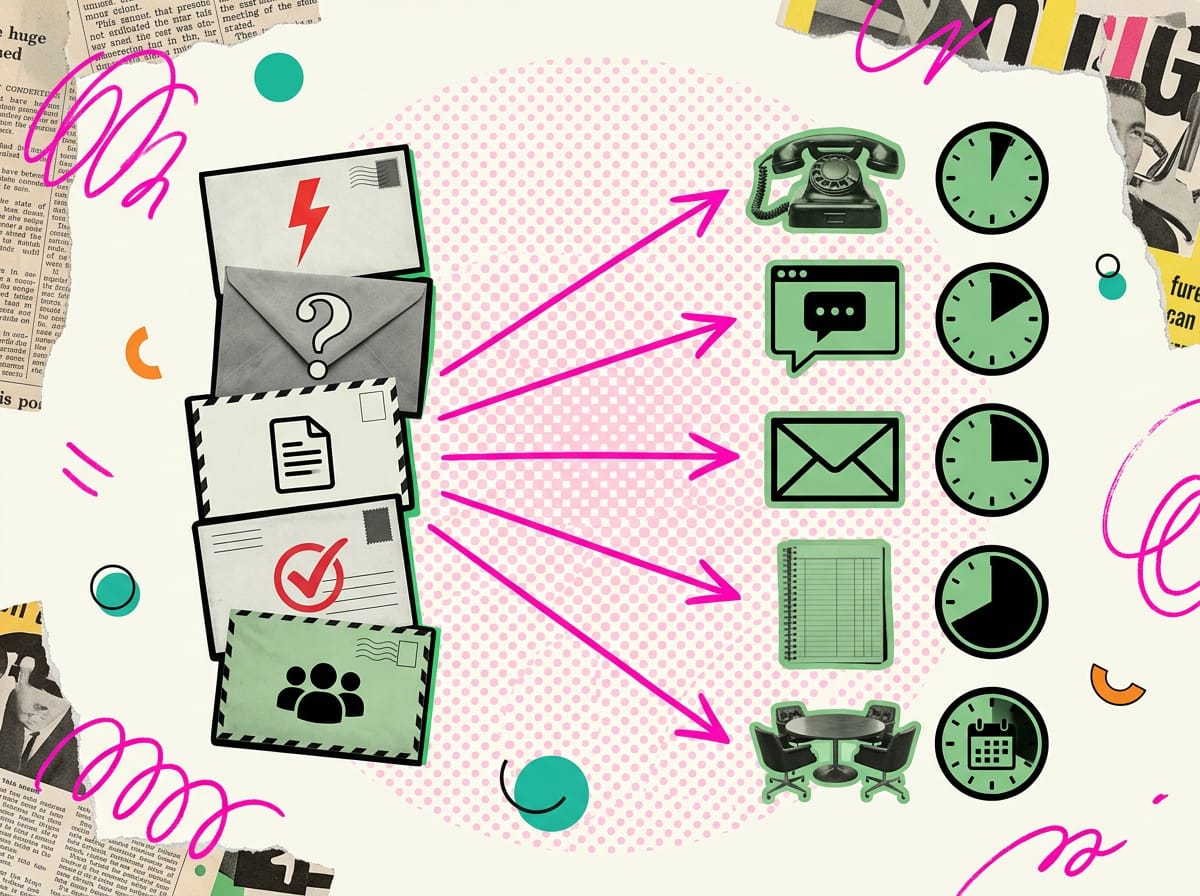
Pick the channel based on how tightly the people involved depend on each other’s work. If two or more people have to coordinate in real time, you need a live conversation: phone, call, or face to face. If each person works on their own and just needs the information, a written message they can read when they get to it will do.
The research points the same way. In an experiment in Spain with 240 participants, randomly split into 80 virtual teams of three, the best results came from low-interdependence tasks paired with asynchronous communication, or high-interdependence tasks paired with synchronous communication. The authors conclude that performance depends on matching the channel to the nature of the task. The study ran in a lab, though, so treat it with caution outside that setting3. A survey of 400 employees and managers at large Japanese companies lands somewhere similar: it explains team communication effectiveness (coordination, inclusion, satisfaction with results) through a mix of synchronous and asynchronous channels4.
In a small business, this becomes a table pinned on the noticeboard and at the top of the team chat.
| Type of message | Channel | Expected response time |
|---|---|---|
| Problem blocking a client today | Phone call | Immediately |
| Practical question about a task in progress | Company chat | Within 2 working hours |
| Information to keep on record (agreements, prices, terms) | Email + decision log | By end of day |
| Decision involving 3 or more people | 15-minute call or meeting | Next available meeting |
| Sensitive feedback about a person | In person, one to one | Within 48 hours |
Add one line on hours. Personal WhatsApp stays out of work, and after 7 p.m. people only message for the emergencies listed in the table. That cuts back on the work-into-private-life spillover the electronic communication review flagged earlier as a source of technostress1.
Common mistake. Writing the rule, then being the first to send a four-minute voice note at 10 p.m. The team copies what the owner does.
5. Feedback on a fixed template, within 48 hours
Feedback saved up for the year-end review lands when nobody remembers the episode. The habit is short feedback, positive or corrective, within 48 hours of what happened, always in the structure of the SBI feedback model: the specific situation, the behavior you saw, and the concrete impact on the work.
For example: “On Thursday’s call with the client in Verona (situation), you wrapped up by summarizing the three points we’d agreed (behavior). The next day the client confirmed the order by email with no further questions (impact).” Three sentences, not one adjective about the person.
On a team of ten, the working rule is at least one piece of feedback a week for each direct report, noted at the bottom of the one-on-one doc.
There’s another reason to anchor feedback in facts. A systematic review of 13 peer-reviewed studies on workplace envy concludes that unmanaged envy gets in the way of effective communication and hurts organizational performance5. Recognition handed out on visible criteria that apply to everyone leaves less room for suspicions of favoritism.
To prepare corrective feedback, dash down what happened and ask Claude to rework it with this prompt.
Rewrite this feedback in situation, behavior, impact format. Remove any judgment of the person and any adjectives like "sloppy" or "disorganized". End with an open question to understand their side. 5 sentences max.
[draft]
6. Disagreement gets a fixed slot on the agenda
In founder-led companies, decisions often sail through the meeting without a single objection, then stall in the hallway afterwards. Treat silence in the room as an unanswered question: before closing, whoever is running the meeting asks the people who haven’t spoken for their view, by name.
The ritual takes five minutes and applies to every decision headed for the log:
- Two minutes of silent writing. Everyone answers “What could go wrong?” on paper or in a private chat.
- A read-out round, one line each, no comments.
- The owner speaks last.
Writing privately before the discussion has a basis. According to the journaling review cited earlier, reflecting privately and then sharing voluntarily helps people see things from others’ perspective, reduces ego-driven conflict and supports a dialogue where people feel safe, with stronger effects when the manager leads by example2. When the owner speaks last, part of the room doesn’t fall in line with their view before saying their own. When disagreement turns into a clash between people, you need the tools of conflict management.
Common mistake. Asking “Any objections?” with your hand already on the door handle. Nobody answers, and the decision looks unanimous.
AI can help train the team to look for weak spots before the meeting.
We're about to decide this: [decision]. The context is an 18-person small business selling [product] to [customers]. List the 5 most likely ways this decision could fail in the next 6 months, ranked by probability, with one signal to watch for each.The list goes into the meeting as a prompt for discussion, read alongside what people wrote themselves.
7. Ten minutes of written reflection on Friday
The last habit is the lightest, and it holds up all the others. On Friday afternoon, everyone spends ten minutes writing answers to three questions:
- What worked this week in the way we talked to each other?
- Where did I lose time because I was missing information?
- What message should I have sent and didn’t?
The answers stay private. Anyone who wants to shares one line in the team channel, and the owner goes first every week. The same journaling review credits the team effects (mutual understanding, less conflict, safer dialogue) to this pattern of private reflection and voluntary sharing, which gets stronger when the manager does it personally2. Since it’s a narrative review of studies and practices, take it as guidance on method and don’t expect hard numbers.
After a month, the answers to the second question become your priority list. If five people out of eight write “I didn’t know the client had moved the delivery date,” you’ve found the leak in your process.
To read them quickly, whoever shares can paste them into a single sheet and hand it to Gemini or Claude, asking it to group the missing information by theme and count how often each theme comes up.
How to roll out the habits without a team revolt
In small businesses, the owner often runs the company directly6. That’s why every new routine rests on how the owner behaves, and the document describing it counts for far less. Skip your one-on-one and the team gets a louder message than any written rule, in line with the axioms of communication applied to teams.
Go in four steps.
- Start with the cost. Present the calculation from the first section using the numbers from your one-week test. People accept a rule when they can see the problem it solves.
- One habit every three weeks. Begin with the post-meeting recap, because it takes work off people’s plates. Then the decision log, then the channels.
- Rules on one page. All seven habits have to fit on a single sheet, with format and duration. Anything that doesn’t fit on one page won’t get followed.
- Review at 30 days. After a month, ask the team what to keep, what to change and what to drop. A rule nobody uses gets cut, full stop.
Drop the clichés about younger workers too. In an exploratory study with 207 participants and 6 interviews, run between January and March 2020, Gen Z workers (born between 1995 and 2012) showed attitudes and behaviors that ran against expectations about workplace communication habits. The authors urge employers to avoid generational stereotypes and write new communication norms that fit how technology is used today7.
One last practical point is about form. Write the seven habits up as an internal procedure, with one owner for each: who keeps the log, who checks the recap lands within 15 minutes, who updates the channel table. Internal communication that runs on individual goodwill lasts until the first week packed with deadlines.
Further reading
Sources
Footnotes
-
Electronic communication in the workplace: boon or bane?. research.manchester.ac.uk ↩ ↩2
-
The Role of Journaling in Enhancing Workplace Productivity, Emotional Well-being, and Team Dynamics. public.scnchub.com ↩ ↩2 ↩3
-
Effects of task interdependence and type of communication on performance in virtual teams. doi.org ↩
-
Team Communication in the Workplace: Interplay of Communication Channels and Performance. doi.org ↩
-
Workplace Envy: Exploring the Effect of Envy on Team Communication and Organizational Information Sharing. scirp.org ↩
-
Piccole e medie imprese. it.wikipedia.org ↩
-
Generation Z Workplace Communication Habits and Expectations. doi.org ↩
FAQ
Which habits improve team communication in a small business?
There are seven written routines: a weekly 1:1, a decision log, a recap after every meeting, rules for which channel to use, a feedback template, a fixed slot for disagreement and a weekly retrospective. Each one has a set format and a set length.
How do you calculate the cost of poor communication at work?
Multiply the number of people on the team by the hours each one loses per week to clarifying, repeating or redoing work. Then multiply by the average hourly cost and by 46 working weeks. With 8 people, 1.5 hours each and €25 an hour, the illustrative example comes to €13,800 a year.
How do I measure the hours my team loses to missing information?
Run a one-week test. Every team member writes one line each time they have to ask, wait or redo something because information was missing. On Friday, group the notes by category (Claude or ChatGPT can do this for you) and start with the two categories that cost the most.
How should a weekly 1:1 with a team member work?
It's a recurring meeting between a manager and one team member, always on the same day at the same time. It lasts 30 minutes, and the team member writes the agenda in a shared document.
Can digital communication tools stress out your team?
Yes. A University of Manchester review identifies three sources of technostress: too many tools, constant interruptions and work spilling into personal time. A company has to give people the tools they ask for while also protecting them from these effects.
Can AI help a team communicate better?
Yes, it can speed up putting these habits into practice. For example, it can analyze the team's weekly notes, group them by category and estimate the minutes lost, so you know which habit to start with.