
Watzlawick's 5 Axioms of Communication Applied to Business
Watzlawick's 5 axioms of communication for small businesses, with real company cases, practical fixes and AI prompts to check your messages.

The short version. Watzlawick’s 5 axioms of communication, put into business terms:
- Silence communicates too. A quote you never follow up on tells the client something.
- Every message carries content and a judgment about the relationship. The judgment decides how the content gets read.
- In a conflict, each person starts the story at a different point, so each one feels like the person reacting.
- Words come with tone, timing and form. In writing, tone and facial expression disappear, and the reader has to supply them.
- Working relationships rest on equality or on a difference in role, and either one can harden over time.
The quote was right. The prices were clear, the timeline was realistic and the terms were well written. The client read it and stopped replying. Three weeks later you find out they signed with a more expensive competitor, “because we just got on better with them.”
Anyone who runs a small business has seen this play out dozens of ways. A perfectly correct email wrecks a relationship with a supplier. The Monday meeting ends in the same argument between the same two people every week. The content usually holds up. The trouble is in the tone, the timing, and what the message said about the relationship. Paul Watzlawick’s axioms of communication show you where to look. They underpin communication psychology as it applies to work. Below you’ll find each one with a real business case, a fix you can start using on Monday, and a prompt that turns AI into a second reader.
Who was Paul Watzlawick, and why should a business owner care?
Paul Watzlawick was born in Villach, Austria, on July 25, 1921, and died in Palo Alto on March 31, 2007. He was a psychologist and philosopher who became an American citizen. He was a leading figure of the Palo Alto School, helped found the systemic approach, and worked for many years at the Mental Research Institute1.
The five axioms appear in Pragmatics of Human Communication, which he wrote with Janet H. Beavin and Don D. Jackson2 and published in 19673. The key word is “pragmatics.” The study of communication is usually split into syntax, semantics and pragmatics. Pragmatics deals with behavior, meaning the effects messages have on people4. That’s what matters in a business: what a client or an employee does after reading your email.
First, a caveat. Janet Beavin Bavelas, one of the co-authors, spent four or five decades testing the axioms’ hypotheses. By her account, some held up rather well and others didn’t5. So use them as a diagnostic lens and treat them as working hypotheses. They’re still very useful in that role, and the Open University teaches them in its course for entrepreneurs6.
There’s a financial reason to take them seriously too. A study of 613 questionnaires from patients and staff at public hospitals in Madrid found that communication affected organizational performance far more than the organization’s legitimacy did7. The axioms help you see how a relationship gets built or worn down, one message at a time.
Silence after a quote is already an answer
The axiom. One cannot not communicate.
Any behavior someone can notice, including doing nothing, can be read as a message3. You decide whether to speak, but the other person decides what your silence means.
The case. An eight-person engineering firm sends out an €18,000 quote. The owner doesn’t want to seem pushy, so he doesn’t call, and ten days go by. To him, the silence shows respect. The client reads it as a lack of interest, and meanwhile a competitor calls them twice. The same thing happens inside a company. During a tense week, a manager walks through the department without saying hello. They haven’t said a word, but by the end of the day everyone has a theory about what they’re thinking.
What to do. Decide in advance what your silences mean. Put the follow-up date in the quote itself: “I’ll call you on Thursday the 20th to go through any questions.” Until the 20th, everyone knows what the silence means, and the call is a promise kept. Group chats work the same way. If a question goes unanswered for a day, the team will invent an answer anyway, so a quick “I’ll look at it tomorrow” beats saying nothing.
With AI. Paste your sales process into ChatGPT or Claude and look for the gaps.
Below are the stages of our sales process, from first contact
to signed contract, with the number of days between each step.
Flag every point where the client goes more than 3 days without
hearing anything from us. For each one, describe how a skeptical
client might interpret that silence, and suggest a two-line message
that tells them what the wait means.
[paste the stages here]
Every message also says what you think of the other person

The axiom. Every communication has a content aspect and a relationship aspect. The relationship aspect classifies the content and is therefore a metacommunication.
People respond to what you say based on their relationship with you. Coming from a close friend, “idiot” can get a laugh. In other settings it’s an insult3. Hierarchy works the same way at work. A project manager speaks more politely and formally to the CEO than to a peer2.
The case. The head of accounts emails the whole sales team: “As I’ve already said three times, invoices must go out by the 5th.” The content is correct. The relationship message is “you’re careless, and now everyone knows it.” The next day a salesperson questions the 5th as a deadline. The real fight is over “three times” and the group email. As long as they keep arguing about the date, the conflict stays open.
What to do. Read every sensitive message twice. The first time, check the content. The second time, ask what it says about you and the person reading it. If the problem is in the relationship, deal with it separately and in person, and keep the written message to the facts. The difference between content and relationship is behind most of the conflicts an owner ends up dealing with.
With AI. This is the most useful prompt in the article. Save it.
Read the message below and split it into two levels.
Level one, the content: what information and requests it contains.
Level two, the relationship: what the writer is signaling about
their relationship with the reader (trust, distrust, superiority,
impatience, irritation).
Quote the exact words that carry the relationship message.
Then rewrite the text, keeping the content identical and making
the relationship neutral and collaborative.
[paste the message here]
Who started it? The punctuation of events
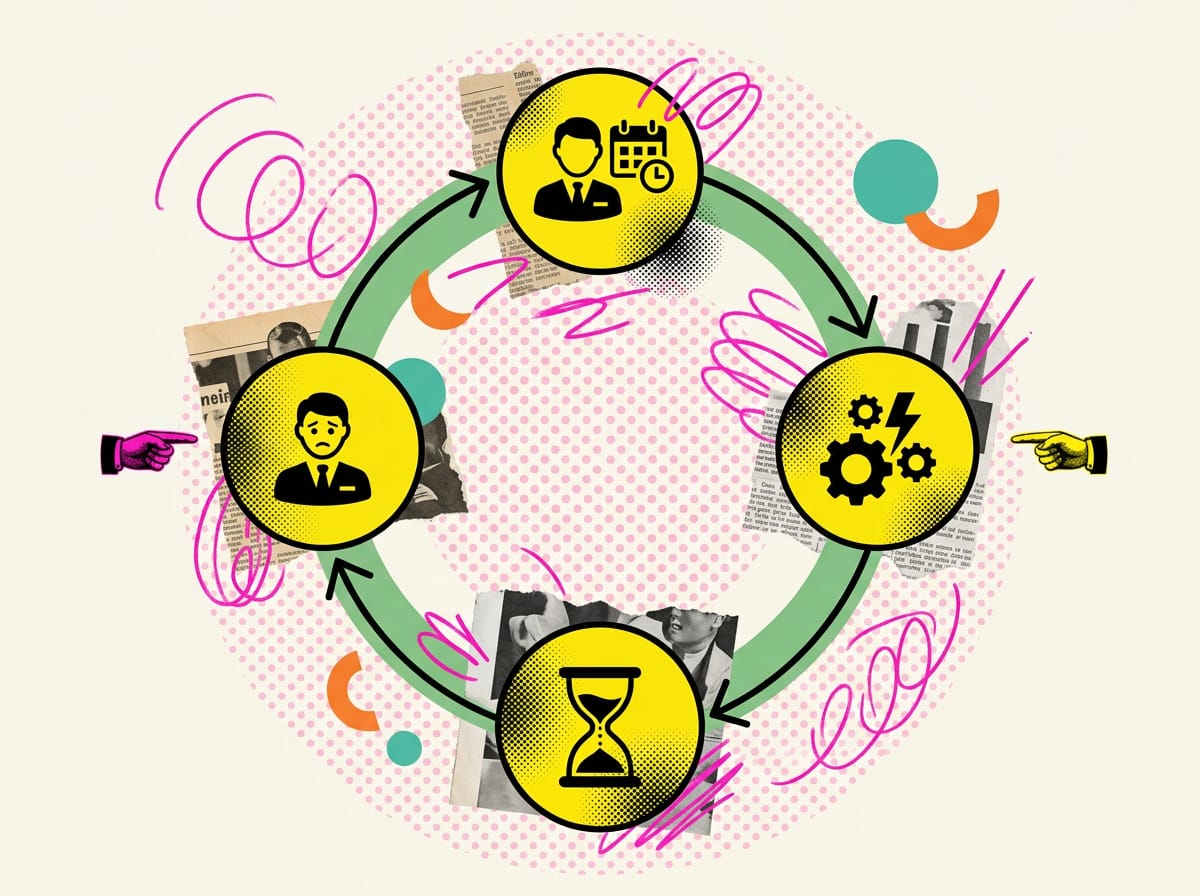
The axiom. The nature of a relationship depends on how the participants punctuate the sequence of communication.
To “punctuate” means to sort a series of messages into causes and effects. If someone reacts angrily after being interrupted, you can read it as anger at the proposal or anger at the interruption. It depends on where the listener thinks the sequence started3. Each line gets a reaction, which gets another reaction, until the only question left is who started it. There’s no clear starting point, so the argument goes round in circles like a dog chasing its tail2. A recent theoretical paper restates the axioms as a testable system. It describes the same mechanism in detail and shows that when people punctuate the sequence differently, they end up accusing each other8.
The case. Sales and production are the classic pair in any small manufacturer. Sales says, “I promise tight deadlines because production always runs late.” Production says, “We run late because sales promises impossible dates and buries us in rush jobs.” Both are right, depending on where you start. It happens with clients too: “They pay late because we deliver late,” versus “We deliver late because they’ll pay late anyway.”
What to do. Stop looking for someone to blame and draw the circle. Put the two versions side by side on a whiteboard. Ask each side to tell the story starting from the other side’s point. Then pick one spot on the circle and break it with an operating rule. For example: “No delivery date goes to a client without written confirmation from production within 24 hours.” This circle drives much of the friction inside a company, and improving communication within your team often means breaking it.
With AI. A language model has nothing at stake, so it’s good at telling the same story without picking a starting point.
I'm going to describe a recurring conflict between two departments
in my company.
Department A's version [paste].
Department B's version [paste].
Reconstruct the sequence of events as a cycle with no beginning.
Show how each side starts the story at a different point and why,
from their point of view, they feel they're the one reacting.
Then identify three points in the cycle where an operating rule
could break it, without blaming anyone.
Why does an “Ok.” on WhatsApp sound cold?

Writing strips out almost all of the analog channel, meaning tone, facial expression and pauses. Only the words are left. The reader works out the tone alone, from the punctuation, the length, how long you took to reply, and the current state of your relationship. A one-word “Ok.” with a period, sent in reply to a long message, invites the worst reading.
The axiom. People communicate both digitally and analogically.
“Digital” means discrete, clearly defined units, usually words, plus a few gestures whose meaning everyone shares. “Analog” means anything that resembles what it refers to. Shaking a fist in someone’s face, for example, suggests violence3. The analog mode is open to interpretation and includes facial expressions and gestures2. In 2002, Valentina Comba of the University of Bologna pointed out that in email, the analog part has to come through in syntax, punctuation, spacing, emoticons and word choice. Even if you get all of that right, some ambiguity remains. What makes a message clear is context and knowing the person who wrote it4.
The case. The marketing manager at a 15-person company sends the owner a two-page proposal for the next campaign. He reads it on his phone between client meetings and replies “Ok.” He meant “I like it, go ahead.” She reads “I don’t care, do whatever you want,” and the next morning she comes into the office already on the defensive. The difference between analog and digital communication explains the whole misunderstanding. He sent only the digital part, and she filled in the rest.
What to do. Follow three rules.
- Anything that affects the relationship (a no, a criticism, a delay, a price discussion) should be handled by phone or video call. Use writing to confirm what you decided.
- When you write, state your intention, even if it takes a few extra words: “Great work. I’ll read it properly tonight and get back to you tomorrow.”
- Choose the channel based on what you need. Face-to-face conversations and phone calls work better for qualitative feedback. An anonymous survey is better for opinions people wouldn’t share in person4. That applies to clients and to your own team.
With AI. Before you send a short message to someone you’re on tense terms with, ask Claude or ChatGPT to play the person reading it.
I run a 15-person company. I'm about to send this reply on WhatsApp
to a team member who sent me a detailed proposal
[paste the reply and a short summary of the proposal].
Imagine three different ways she might read it, from the most
generous to the most negative. Tell me which elements of the text
(length, punctuation, no mention of her work) push toward the
negative reading.
Symmetry and complementarity, the two shapes of power at work
The axiom. All communication exchanges are either symmetrical or complementary, depending on whether they’re based on equality or on difference3.
In a symmetrical relationship, people act as equals. In a complementary one, one person leads and the other follows, as with an owner and an employee or a client and a supplier. Neither form is wrong. As the Open University course notes, the relationship side of communication is often about differences in power and influence6. The danger is repetition. When the same signals keep coming, the relationship gets stuck in its pattern, symmetrical or complementary8. An owner needs to watch for two ways this goes wrong.
Symmetrical escalation. Two partners, or two managers at the same level, reply to each other in emails copied to everyone. Each message is a little harsher than the last, because backing down in public feels like losing. A week later, nobody remembers what the argument was about, but everybody remembers who wrote what.
Rigid complementarity. The owner decides everything, down to ordering printer toner. The employee learns that every decision they make gets overruled, so they stop making any. Then the owner complains that “nobody around here takes responsibility” and tightens control even further. The circle is complete.
What to do. To stop escalation, take the disagreement out of writing and set a simple rule. Managers settle disagreements one-on-one, and only the final decision goes out to everyone. To loosen rigid complementarity, write down delegation levels. Up to €500, the employee decides alone. Between €500 and €3,000, they decide and tell you. Above €3,000, they ask you first. A written rule does more for the relationship than a hundred speeches about “taking initiative.”
A script for talking about how you’re talking
When a relationship problem looks like a content problem, arguing about the content gets you nowhere. Stop and talk about how you’re talking to each other. Watzlawick called this metacommunication, and it resolves most problems involving the second and third axioms. The script has four steps. Adapt them to your situation.
- Pause the content. “Before we go any further on delivery dates, can we stop for a minute?”
- Describe the pattern, using “we.” “I feel like for the past few weeks, each of our emails has been a bit harsher than the last.”
- Own your part. “I’ll go first. I replied with everyone in cc when I should have called you.”
- Propose a rule. “For the next two weeks, when we disagree, let’s talk on the phone and only put the decision in writing.”
Almost everyone skips step three, and without it the other steps sound like a politely worded accusation.
From symptom to axiom in one table
Owners usually start with the problem, so this table starts there too.
| Symptom in the company | Axiom | Fix | Question to ask the AI |
|---|---|---|---|
| The client goes quiet after the quote | 1 | Put a follow-up date in the quote | ”Where does the client go more than 3 days without hearing from us?” |
| A correct email starts a fight | 2 | Read it at both levels and discuss the relationship in person | ”What does this message say about the relationship between the writer and the reader?” |
| Sales and production blame each other | 3 | Draw the cycle and break it with a rule | ”Reconstruct this sequence as a cycle with no beginning” |
| A short message gets read as cold | 4 | Talk through sensitive topics by voice and state your intention in writing | ”How might someone who’s already defensive read this?” |
| Back-and-forth arguments with everyone in cc | 5 | Settle disagreements one-on-one and cc only the decision | ”Which lines in this exchange are escalating the conflict?” |
| The employee no longer decides anything | 5 | Set delegation levels with euro limits | ”Write a delegation matrix for this role” |
| The same two people argue in every meeting | 2 and 3 | Use the metacommunication script | ”Write a neutral opening line for raising this” |
What AI does here, and where it stops
AI plays the same role in every example. It rereads, takes the reader’s point of view, and retells a sequence from a perspective other than yours. It helps you see more clearly, but you still decide what to say, to whom, and on which channel. To make this a team habit, set up a Project in Claude or a custom GPT in ChatGPT with the instructions from this article: the two levels, the cycle with no beginning, and the reader simulation. Then write a two-line procedure (SOP): any message that contains a no, a price or a criticism gets reread before it goes out.
Be clear about the limits. A language model can only read the digital channel, meaning the text. It wasn’t in the meeting, didn’t hear your tone on the call, and doesn’t know your history with that client unless you tell it. Context and knowing the person are what make a message clear4, and those are what AI doesn’t have. Use it to spot a risk, then pick up the phone. And before you paste in an exchange, remove the names and personal details of clients and staff.
Who came up with the 5 axioms of communication?
Paul Watzlawick, Janet H. Beavin and Don D. Jackson, in the book Pragmatics of Human Communication2, published in 19675.
What is the Palo Alto School?
It’s the group of researchers centered on the Mental Research Institute in Palo Alto, California. Watzlawick was one of its best-known members and helped found the systemic approach, which looks at problems in terms of relationships between people more than individuals1.
Why does the order of the axioms vary between sources?
Some authors put the digital/analog distinction second and the content/relationship distinction third4. The five principles are the same either way, only the numbering differs. If you focus on the ideas, the numbering doesn’t matter.
Are the axioms still valid today?
As a diagnostic tool, yes. As scientific theory, they’ve been partly challenged. Janet Beavin Bavelas, one of the co-authors, says some held up rather well and others didn’t5. For a small business, they’re still useful in practice. They make you ask what you’re saying about the relationship, what your silence means, and where you start the story.
Further reading
Sources
Footnotes
-
Paul Watzlawick — Wikipedia. it.wikipedia.org ↩ ↩2
-
Introduction to Business and Professional Communication. oertx.highered.texas.gov ↩ ↩2 ↩3 ↩4 ↩5 ↩6
-
Managing Interpersonal Relations. amsacta.unibo.it ↩ ↩2 ↩3 ↩4 ↩5
-
Communication Today: Were Watzlawick & Co. Wrong?. journalsfp.org ↩ ↩2 ↩3
-
1 Sending and receiving communications | OLCreate. open.edu ↩ ↩2
-
The effect of communication on the legitimacy and performance of organizations. rbgn.fecap.br ↩
-
Beyond Watzlawick: axioms of pragmatic interaction for second-order cybernetics. doi.org ↩ ↩2
FAQ
Why does a client go quiet after receiving a perfectly good quote?
Often the problem isn't the content but what the message says about the relationship: tone, timing, missed follow-ups. Watzlawick's first axiom says even silence communicates, and a quote left without follow-up tells the client something.
What does it mean that every message has a content level and a relationship level?
Every message carries information and, at the same time, a statement about the relationship between sender and receiver. That statement shapes how the content is read, which is why an email that is factually correct can still damage a relationship with a supplier.
Why do the same people keep having the same arguments in meetings?
The third axiom explains that in a conflict each person starts the story at a different point, so everyone feels they are only reacting. Spotting these different punctuations of events is the first step to breaking the pattern.
Why are work emails misread more easily than conversations?
Words always travel with tone, timing and form. In writing, tone of voice and facial expressions disappear, so readers fill them in on their own, often differently from what the writer meant.
Are Watzlawick's axioms scientifically proven?
No. The authors themselves saw them as provisional, and co-author Janet Beavin Bavelas found that some held up under testing and others did not. They are still a useful lens for diagnosing communication problems, and the Open University uses them in its course for entrepreneurs.
Can you use AI to apply Watzlawick's axioms?
Yes, AI works well as a second reader: with a targeted prompt you can ask it to analyze an email or message before you send it. That way you check what it says about the relationship, not just the content.