Luxury Hotel Websites: Storytelling That Drives Direct Bookings
Effective luxury hotel websites pair storytelling with a smooth booking flow, so guests want the stay and book direct instead of through OTAs.
A guest finds your country house hotel on Instagram, clicks through to the website and spends five minutes reading about the family that has run the place for three generations. They decide to book. The button takes them to a slow page that looks like it belongs to someone else. They close it, look the hotel up on an online travel agency and book there. You’ve just paid commission on a guest you’d already won.
A luxury hotel website has two jobs to do at once: make people want the stay, and let them book it quickly. Most sites manage one. Design-led sites forget about the path to purchase, and tech-led sites forget about the story. Below is a five-step process for doing both, the metrics that tell you whether it’s working, and the prompts that let AI speed things up without lowering the bar on quality.
What does a luxury hotel website need to do?
A luxury hotel website is a sales tool. It makes people want the experience before they’ve even looked at a room, answers the questions a high-end guest asks before spending serious money, and gets them to a direct booking in a few clicks while keeping the property’s identity front and centre. It also makes you less dependent on third-party booking sites.1
That’s true whether you run a boutique hotel, a five-star property or a historic house. The scale changes and the principle doesn’t. If you manage a four- or five-star hotel, you already know that premium guests compare several places before choosing, and that they decide largely on what they can picture themselves doing there.
People booking online make up their minds fast. SiteMinder’s analysis of hotel website design says you have the first two or three screens to give guests what they’re looking for and pull them in emotionally, with enough information to do that and no more.2
There are four things a site like this should avoid:
- an endless photo gallery that doesn’t lead anywhere
- a third-party booking engine whose look and tone clash with the rest of the site
- brochure copy that could belong to a hundred other hotels
- a discount pop-up that cheapens the brand before the guest has worked out where they are
One piece of context before the practical steps. This kind of site belongs to the family of premium cinematic websites, the same approach that works for fashion brands and luxury real estate. Here, though, we’ll stick mostly to hotels.
Slow down the emotion, speed up the booking
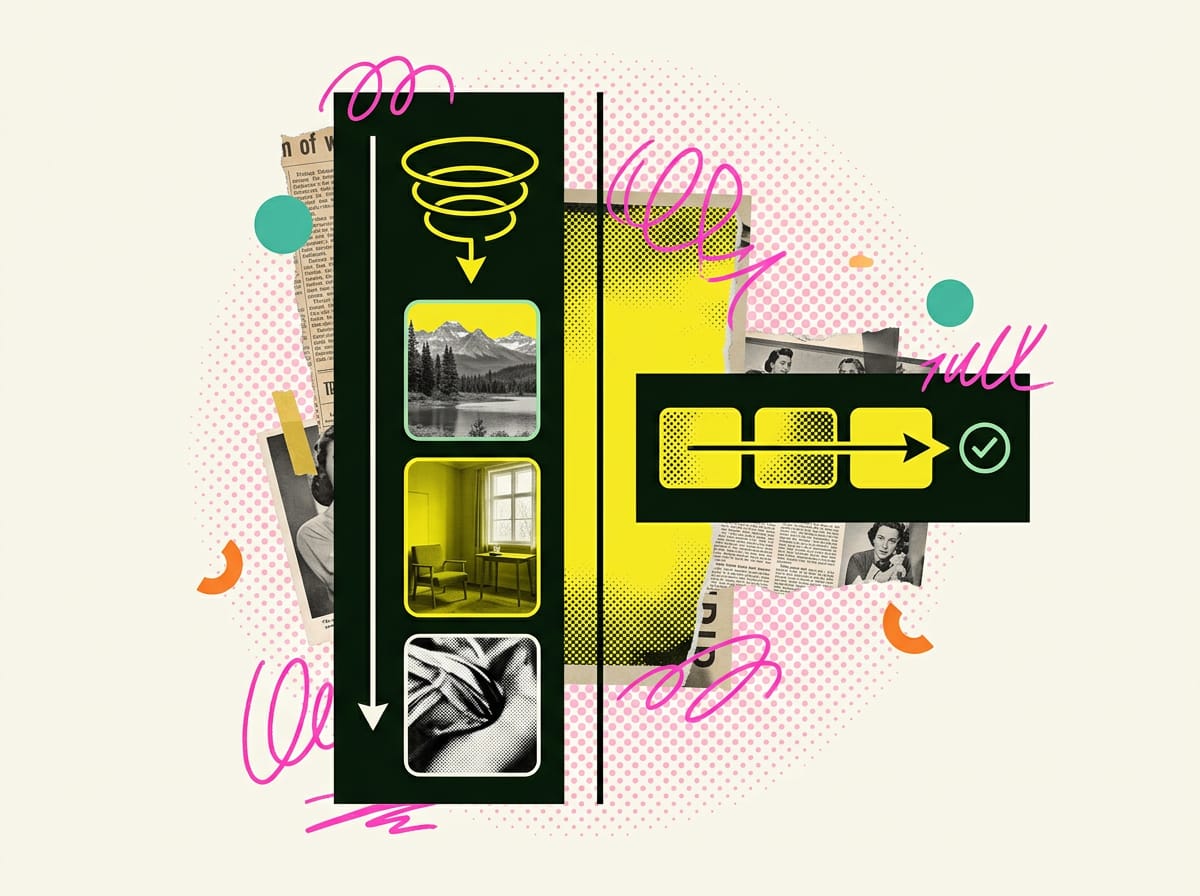
The story should unfold slowly. The transaction should be quick. Those two speeds pull in opposite directions, and they have to share the same page.
The slow part builds desire. A study of online shops with 266 participants compared a text-only version with a version that told a story through parallax scrolling. The visual storytelling improved the user experience, strengthened attitudes towards the brand and increased willingness to pay more.3 That’s exactly what a high-end hotel needs, because the guest is buying an idea of how they’ll feel once they arrive.
The emotional side runs deeper. Research covering 111,926 reviews of 641 hotels in five US cities found that four emotions, together with linguistic style, had a measurable effect on booking conversion rates. The same paper ranks travel and hospitality as the second-largest category of online purchases worldwide.4 Once you measure emotion, you can see it moving bookings.
Then comes the fast part. Once a guest has made up their mind, every extra second and every extra click is a chance to lose them. A hotel website needs an availability button that’s always visible, dates that can be picked in one go, and pages that load quickly.1 Academic research has also looked at how scarcity messages such as “last room available” affect bookings at luxury hotels, and found that the effect depends on how the guest usually shops.5 Go easy on them. Aggressive urgency on a premium property reads like a supermarket flyer and drags the brand down.
Scroll-triggered animation is the technical way to build that slow pace. If you want to see how it works, look at how scrollytelling is used on hotel sites.
Step 1. Find the hotel’s real story
The luxury hotels people remember nearly always have an unusual story. The Taj Mahal Palace in Mumbai opened in 1903 with 285 rooms and suites and a private butler service available around the clock. The Ritz in Madrid, now the Mandarin Oriental Ritz, opened on 2 October 1910 and has hosted royalty and dignitaries for more than 110 years.6 None of them sells itself by listing how many plug sockets each room has. They talk about who built them, who has stayed there and what they stand for.
Your property has a story like that too, even if it isn’t 120 years old. Step 1 is about digging it out and picking just one. Choose a single thread: the place, the family, the region or the craft. A site that tries to tell every story ends up telling none.
The method is simple. Interview the owner and a long-serving member of staff with ten or so open questions, and gather documents, anecdotes and original materials from the building. AI can save you the first round here. Paste a prompt like this into ChatGPT or Claude:
You’re an interviewer with deep hospitality experience. Your job is to draw out the real story of a family-run hotel. Write 10 open questions, 5 for the owner and 5 for a long-serving staff member, that bring out anecdotes about the location, the building’s materials, the guests who have been coming back for years, and why the family opened the hotel in the first place. No brochure questions, nothing with a predictable answer.
The answers still come from people. AI just prepares the ground. Then you choose your guiding story and link every section of the site to something guests can book.
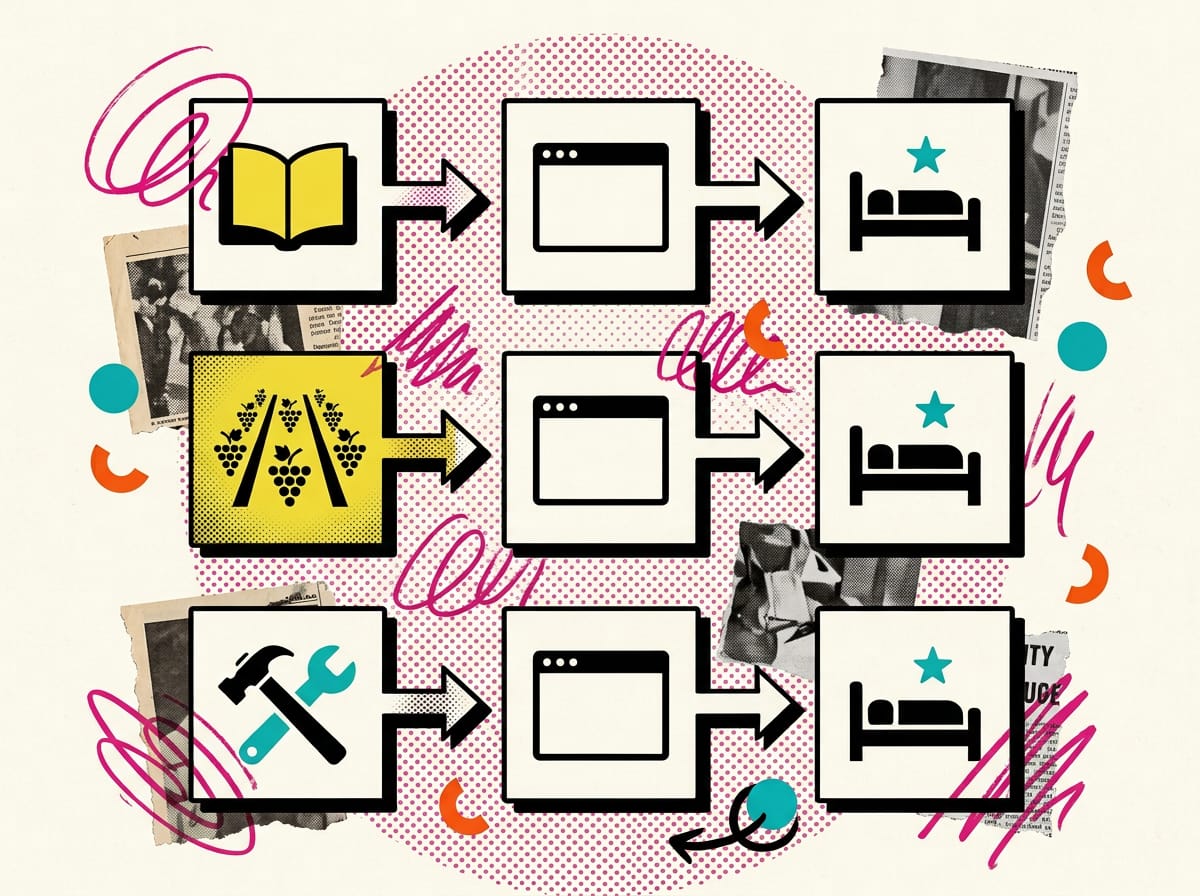
| Guiding story | Site section | Bookable experience |
|---|---|---|
| Grandfather’s vineyard | The region | Cellar tasting paired with the room |
| The 18th-century building | The architecture | Private tour with a local historian |
| Grandmother’s cooking | The table | Chef’s dinner with a family menu |
Every story has to lead to a room or a concrete experience. A gallery that exists for its own sake doesn’t make the cut.
Step 2. Design the experience page by page
Good looks show up in the numbers. A study of 201 categorised hotel websites confirmed that a site’s aesthetic qualities are linked to its share of direct bookings, and that photography and copy show the strongest links.7 In practice, that means putting real money into images and words, page by page.
The home page as a trailer
The home page has one job: make people want to keep going. A short video, one line that says what sets you apart, one clear action. Strip back the complexity and give a clean message that shows at a glance what makes the property unique, because style and story are what guests connect with on a deeper level.
Room pages as chapters
Each room is a chapter. Describe the view, the light at a particular time of day, the materials, who the room is for and what can be booked alongside it. A checklist for every room page:
- an opening photo showing the room in its best light of the day
- the actual view, not a generic stand-in
- the materials and details guests will touch
- the experience that pairs with the room
- the availability button always within reach
Experiences, spa and restaurant: pages that bring in enquiries
These pages should generate a booking or a quote request. For the spa, the restaurant and private events, end every page with a concrete action and a way to contact the property directly.
The shot list for photos and video
This is where the game is won or lost, because photography carries real weight in direct bookings.7 Before the shoot, put together a shot list. For each space, decide the season, the time of day for the light, whether people should be in the frame, and one textural detail to capture. On the technical side, compress your videos and give them a poster image that loads instantly, so the cinematic effect doesn’t slow the page down. Think about accessibility as well. SiteMinder’s analysis estimates that around 15% of Americans and 20% of Australians live with some form of disability, and that almost 10% of the US population has red-green colour blindness.2 Badly chosen colour contrast shuts out a whole slice of your guests.
Step 3. Booking as the final chapter
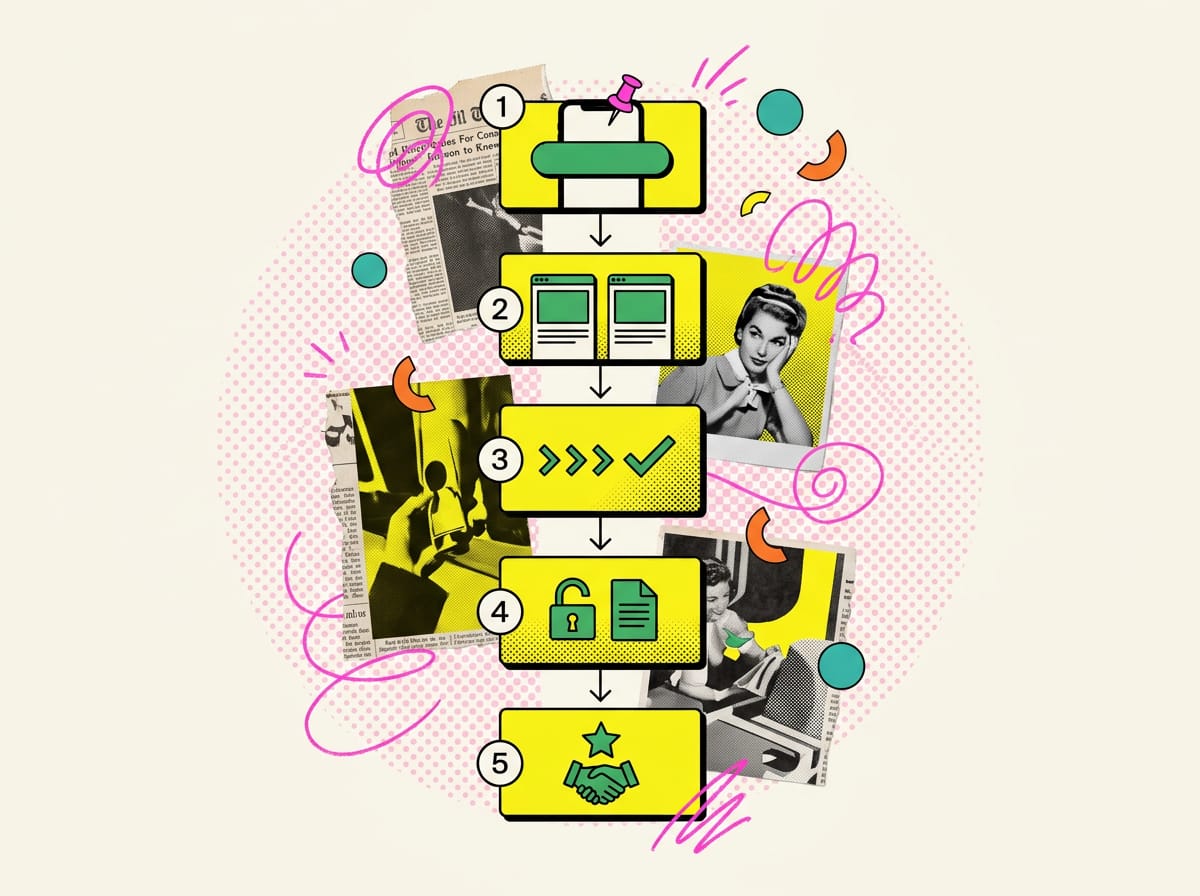
The direct booking is the last scene of the story. Your booking engine has to look like the rest of the site. If it doesn’t, guests feel they’ve been shunted somewhere else and start to get suspicious.
For direct bookings to really pay off you need two things: perceived value and trust. A study of 307 people who had booked hotels online found that perceived value, driven by price and quality, is positively linked to booking intention, and that trust in the hotel matters as much as trust in the booking site.8 Show genuine reviews, visible quality and clear terms, and your direct channel stops competing on price alone.
A well-built booking engine performs best when it ticks these boxes:
- a fixed availability button, visible on every page
- the same design, typeface and tone of voice as the rest of the site
- no more than three steps from choosing dates to confirmation
- cancellation terms shown clearly before payment, never tucked away afterwards
- direct-booking perks that go beyond a discount, such as an included experience, an upgrade subject to availability, or direct contact with the people who run the hotel
That last point is the one that changes the numbers. Direct bookings cut distribution costs and give you full control of the guest relationship, which opens the door to more personalised experiences.9 A strong direct offer, clearly visible on the home page, does the rest by catching attention and nudging people to book.10 Built this way, a luxury hotel’s website stops being a cost and becomes its most profitable sales channel.
Step 4. Get found on Google and by AI
A beautiful site nobody can find won’t bring in bookings. Structure your content for people and search engines at the same time, using keywords that match what guests actually search for, so the hotel shows up when someone needs it.11
Over time, the channel that works hardest is the blog, as long as it answers real questions. Posts like “what to do nearby on a weekend away” or “the best restaurants near the hotel” reach people who are still daydreaming about the trip.12 It’s also why building a hotel website today includes optimising for AI-driven tools like ChatGPT and Gemini, known as GEO.
If you want an AI assistant to pull your content into an answer to something like “boutique lakeside hotel with a spa”, every answer on your site needs to stand on its own, stay short and include a concrete fact. Here’s a prompt to build the skeleton:
Act as a guest looking for a boutique lakeside hotel with a spa. List the 15 questions I’d ask an AI assistant before booking. For each one, write a 40-60 word answer in English that a hotel could publish on its own website, including a concrete fact wherever possible.
Then check the answers, tailor them to your property and add structured data so crawlers understand that the page describes a hotel.
How to use AI to speed up the work
AI speeds up a sound process, and that’s where its job ends. It prepares, organises and saves you the first pass, while the story, the photos and the care stay human. Here are three practical uses, on top of the prompts above.
For the Step 2 shot list, start with a prompt like this:
Based on this hotel [description: style, spaces, surrounding area], create a shot list for the photo shoot. For each space, give the season, the recommended time of day for the light, whether people should be in the shot, and one textural detail to capture. Put everything in a table.
For images, there’s one firm rule. Use AI for moodboards and storyboards, and keep the final photos real. Tools like Midjourney are fine for showing your photographer the atmosphere you’re after, but what you publish has to be real, because authentic photography is what’s most strongly linked to direct bookings.7 Everyone can spot a fake image on a five-star site, and it wrecks trust.
For copy, use AI to draft FAQ answers and section text, and keep it away from the guiding story. That comes from talking to people.
Which numbers tell you it’s working?
Traffic on its own tells you very little. A luxury site should be judged on a handful of metrics that are all about bookings.
The first is your share of direct bookings, the figure that site design can actually move.7 The second is conversion rate, the real measure of how a booking site performs, since a visit doesn’t automatically turn into a sale.4 Add the booking start and completion rates, to see where guests drop off, and the number of quote requests for events and exclusive experiences. Check these four numbers every month and they’ll tell you whether your story leads to a booked room or just to admiring glances.
Bringing story, experience and booking together into one flow takes method. It’s what we do when we build a premium cinematic website for a hotel, from choosing the guiding story through to the booking engine. If you’d like to see who does the work, take a look at our design team and our hotel projects.
Sources
Footnotes
-
Realizzazione Siti Web per Hotel - digihotel. digihotel.it ↩ ↩2
-
I migliori esempi di progettazione di siti Web di hotel. siteminder.com ↩ ↩2
-
Storytelling in online shops: the impacts on explicit and implicit user experience, brand perceptions and behavioral intention. emerald.com ↩
-
Predicting Conversion Rates in Online Hotel Bookings with Customer Reviews. mdpi.com ↩ ↩2
-
[PDF] Luxury Hotel Booking and Scarcity Messages. eprints.whiterose.ac.uk ↩
-
Ieri, oggi, domani. 26 hotel di lusso dalla storia affascinante. ad-italia.it ↩
-
From Looking to Booking: The Relationship of Hotel Website Aesthetics, Hotel Features and Direct Booking. doi.org ↩ ↩2 ↩3 ↩4
-
The Effects of Perceived Value, Website Trust and Hotel Trust on Online Hotel Booking Intention. doi.org ↩
-
Digital marketing hotel di lusso: strategie per il viaggiatore … playhotelnext.com ↩
-
14 caratteristiche che un sito web per Hotel deve avere. eleonoramartis.com ↩
-
Content Marketing per Hotel: 7 consigli per la tua Strategia. danilopontone.it ↩
FAQ
What should a luxury hotel website do?
It has to make guests want the experience before they even look at the rooms. It should answer the questions a high-end traveler actually asks and get them to a direct booking in a few steps. That shows what makes the property distinctive and reduces your reliance on OTAs.
Why do luxury hotels lose direct bookings on their own website?
Often the booking engine is third-party, slow and styled differently from the rest of the site. A guest who was already sold stalls, looks the hotel up on Booking or Expedia and books there. You end up paying commission on a guest you had already won.
How do you balance storytelling with a smooth booking experience?
The story should move slowly, so the desire to stay can build. The transaction should move fast. Those two speeds have to work on the same page: emotion in the first few screens, then a booking flow with only a few steps.
Does visual storytelling really increase perceived value?
Yes. A study with 266 participants compared a text-based version of a site with a parallax-scrolling version. The visual story improved the user experience, made attitudes toward the brand more positive and raised willingness to pay a higher price.
How much time do I have to win over a guest who lands on the site?
Very little. According to SiteMinder, you get the first two or three screens to show guests what they came for and connect with them emotionally. The amount of information has to be right: not too much and not too little.
Does this approach only work for five-star hotels?
No. It works the same way for a boutique hotel, a five-star property or a historic residence. The property may be bigger or smaller, but the principle doesn't change: build desire and drive direct bookings.