Buyer Persona Template: 7 Free Downloads (PDF, Word, Notion)
Free buyer persona templates in PDF, Word and Notion: 7 options, chosen by where your team works and who gets the finished persona.

Most buyer persona templates grabbed in a hurry end up the same way. A few dozen half-filled fields, then the file gets dumped in a shared folder and forgotten. Sales never opens it, the outside agency never sees it, and the next meeting runs on gut feel again. A template in the wrong format does more damage than a few empty fields. A beautiful PDF is no use to a team that lives in Notion all day, and you can’t hand a Miro board to a sales network.
Below are 7 templates, grouped by format and by how you’ll actually use them. For each one we cover where you work on it, what language it’s in, what to check before you download, and when it’s the right pick.
A buyer persona template is a worksheet with the fields already laid out. It helps you organise what you know about your customers: who makes the buying decision, what they want to achieve, what holds them back and where they go for information. The persona itself is a fictional character built on real data1. Its job is to surface what prospects think and do while they’re looking for a solution2. The template organises research you’ve already done. Without that research, all you have is an empty form with nice graphics.
How to choose the right buyer persona template (3 criteria)
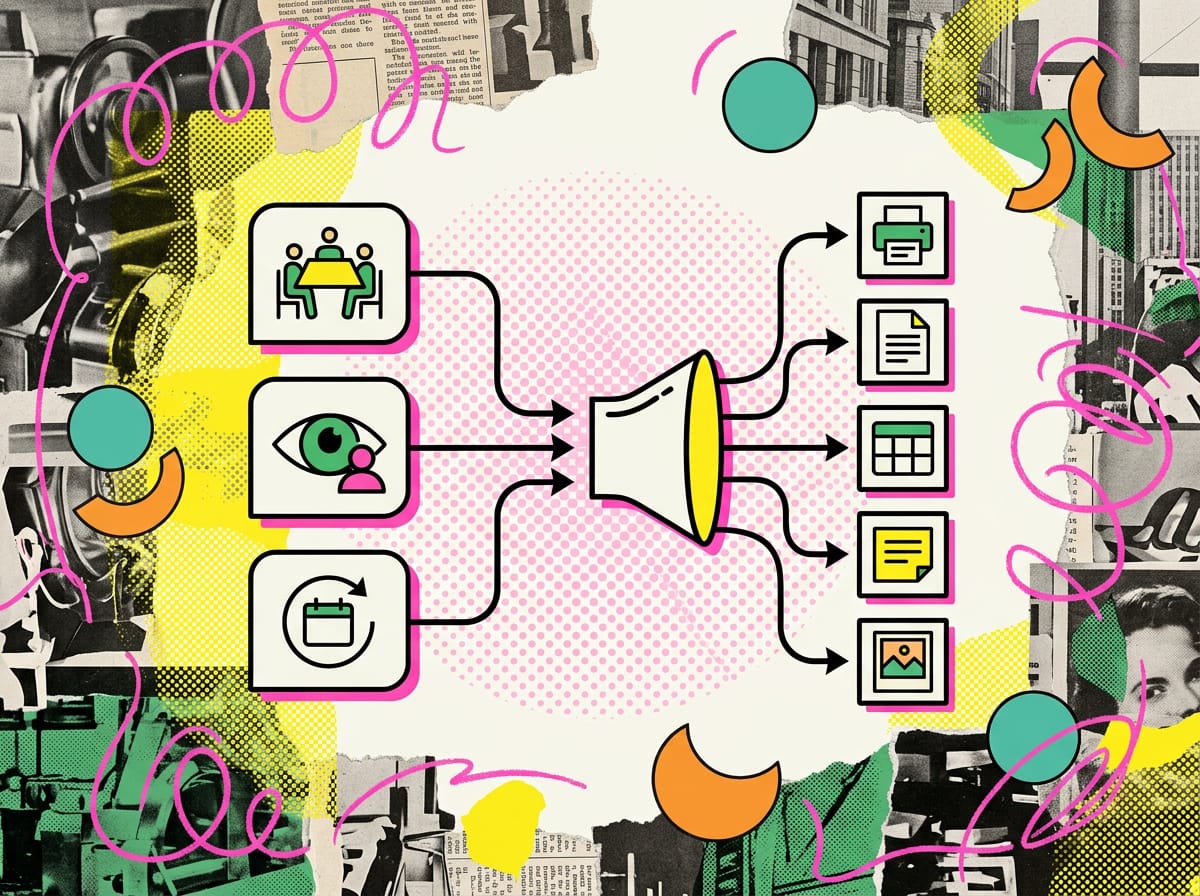
Three questions decide the template: where your team works, who gets the finished persona, and how often you’ll update it. Design and field count come later. Answer those three and you’ve already ruled out five of the seven.
- Where your team works. If meetings happen round a table with the printer next door, you want a PDF. If everything runs through Notion, one more PDF will sit untouched in a folder. Take a window and door manufacturer with three people in the office and two reps on the road. Paper in the meeting and a shared Word doc will cover them comfortably.
- Who the persona is for. The format follows the reader. Your sales reps want a single page they can keep in the car. An agency writing your content wants something editable. Your business partner, or the board, wants something to put on a screen. Personas also keep writers, editors and publishers working from the same picture of the audience3, so the person receiving it matters as much as the person filling it in.
- How often you’ll update it. If you revisit it once a year, a PDF is fine. If you check it against your CRM notes every quarter, you need a document you can edit without starting over.
If there are only two of you
Nobody uses a half-finished template. A study of used car buyers in Indonesia starts from a point that applies here too: some dealers, mostly small businesses, had very little to spend on research. The authors built their personas from just three variables4. Adapted to a small B2B company, that becomes these ten fields:
- role of the person who decides and role of the person who signs the order (often the owner)
- the client company’s sector and size
- the problem they need solved right now
- the trigger that starts the search (a breakdown, a tender, a lost customer)
- the most common objection (“we already do this in-house”)
- the channel they come through (sales rep, reseller, trade fair, word of mouth)
- sources they trust
- how they compare suppliers
- average time from first call to signed quote
- a typical line, lifted from a real email or phone call
Hobbies, marital status and an elaborate made-up name can wait until those ten are filled. The method goes beyond segmentation because it puts behaviour and motivation first and demographics second1. Fill every field without making anything up: that’s the ground rule for completing any template.
Using AI. Before you pick a template, let AI do a first pass on the fields. Paste this prompt into ChatGPT or Claude.
“Sono il titolare di un’azienda che vende [prodotto/servizio] ad aziende italiane con [numero] dipendenti. Il marketing lo seguiamo in due, per circa 4 ore a settimana. Ti incollo l’elenco dei campi di un template di buyer persona. Per ogni campo dimmi se posso compilarlo con dati che ho già (CRM, preventivi, mail dei clienti) oppure se mi servirebbe un’intervista. Ordina i campi dal più utile al meno utile per le vendite e taglia quelli che non cambierebbero nessuna decisione commerciale.”
1. HubSpot Make My Persona template (online tool)
A guided wizard. You answer one question at a time and get a formatted profile at the end. It suits anyone starting from scratch who wants to see a complete persona quickly, maybe just to know what the end result looks like before doing the real work.
- Output format. A profile generated online that you save and share
- Language. Check the language of the interface and fields before you start, as the questions follow English-speaking market logic
- Email required? Read the form before you fill it in. If the download goes through a form, expect to land on a sales list
- When to use it. A first draft, or an alignment exercise with a partner
- Main limitation. Everyone gets the same questions. You’ll have to add a field for the sales channels small manufacturers rely on, like reps and trade fairs, yourself
Pricing and plans for individual persona-building tools change often. What matters here is the file you end up with.
2. Xtensio template (visual canvas)
Xtensio is the one to use when the persona has to look good: an internal pitch, a handover to an agency, or a slide for the partner who wants to see “who the customer is” at a glance. The profile comes out laid out, with a photo, coloured blocks and quotes.
- Output format. A designed canvas you can share and export
- Language. Fields can be renamed, so an hour spent translating and adapting them is well spent
- Email required? You need an account to save your work
- When to use it. Presentations, briefs for outside suppliers
- Main limitation. It’s easy to end up polishing the design more than the content
Putting a photo and a name to the description is common practice, and it helps decision-makers identify with the persona1. On everything else design-related, we keep one simple rule. If the owner of an engineering firm in Brescia opens the profile and can’t find the objections they hear on the phone every week, no layout will rescue it.
3. Miro / Mural template (collaborative)
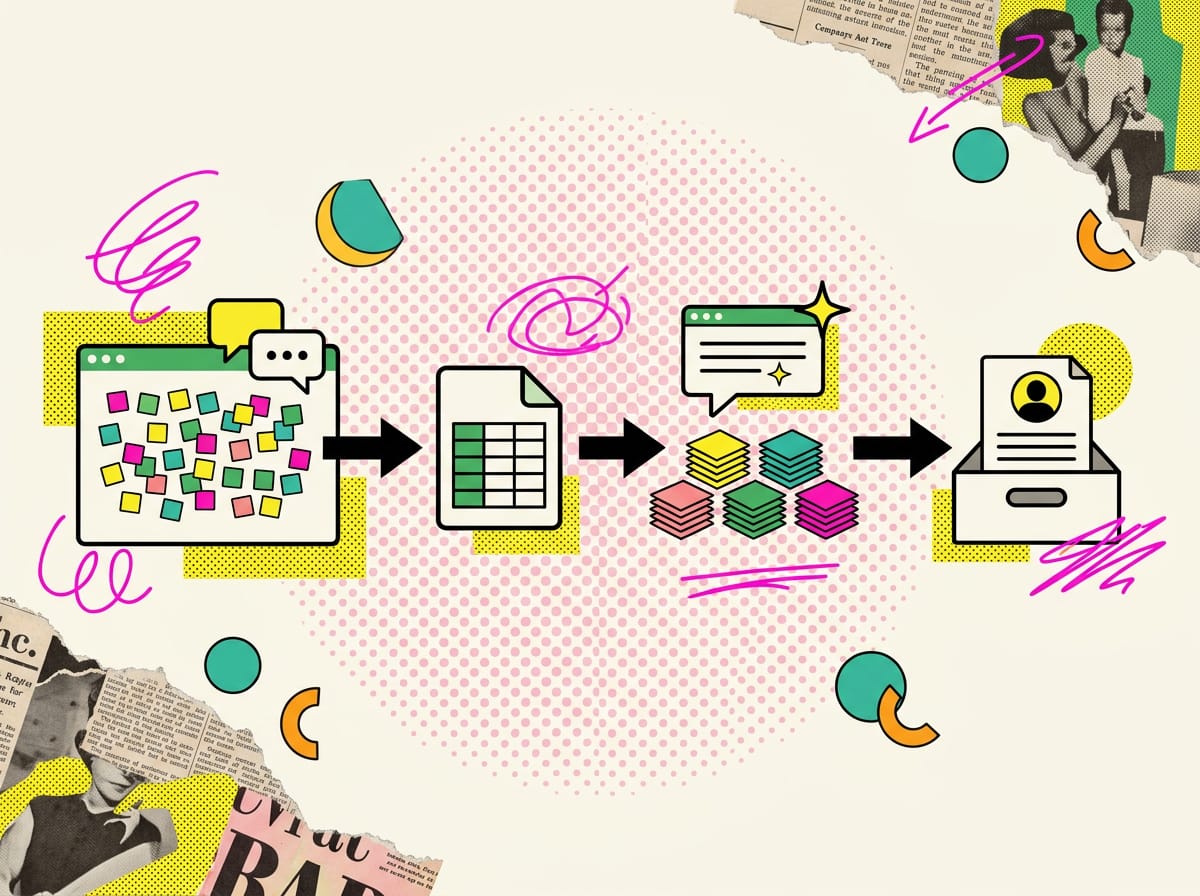
An online whiteboard earns its place while you’re gathering material. Picture a 90-minute remote workshop with two salespeople, your customer service person and the owner. Each of them writes, on digital sticky notes, the objections they’ve actually heard in the past month, one per note. Half an hour in, you’ve got sixty, plenty of duplicates and a few surprises.
- Output format. A shared board
- Language. Your team writes the notes, so it’s in your own language
- Email required? Every colleague you invite needs access to the board
- When to use it. Collecting real objections and questions across a distributed team
- Main limitation. The board stays a pile of notes, and you can’t hand it to anyone
Academic research uses real conversations as raw material too. One study applied digital ethnography on social media to create and refine two buyer personas, and the authors turned it into a 6-step method for practitioners5. The principle scales down fine: gather first, then synthesise.
Using AI. Copy the text from the sticky notes and paste it into Claude or ChatGPT with this prompt.
“Questi sono i post-it di un workshop con vendite e assistenza clienti di una PMI che vende [prodotto]. Raggruppali per tema, conta quante volte compare ogni obiezione e segnalami quelle citate da una sola persona. Non aggiungere obiezioni che non sono nel testo. Restituisci una tabella con tema, frequenza e una frase originale come esempio.”
Then move the summary into something that lasts: Notion, Word or PDF.
4. Notion template (for teams already working in Notion)
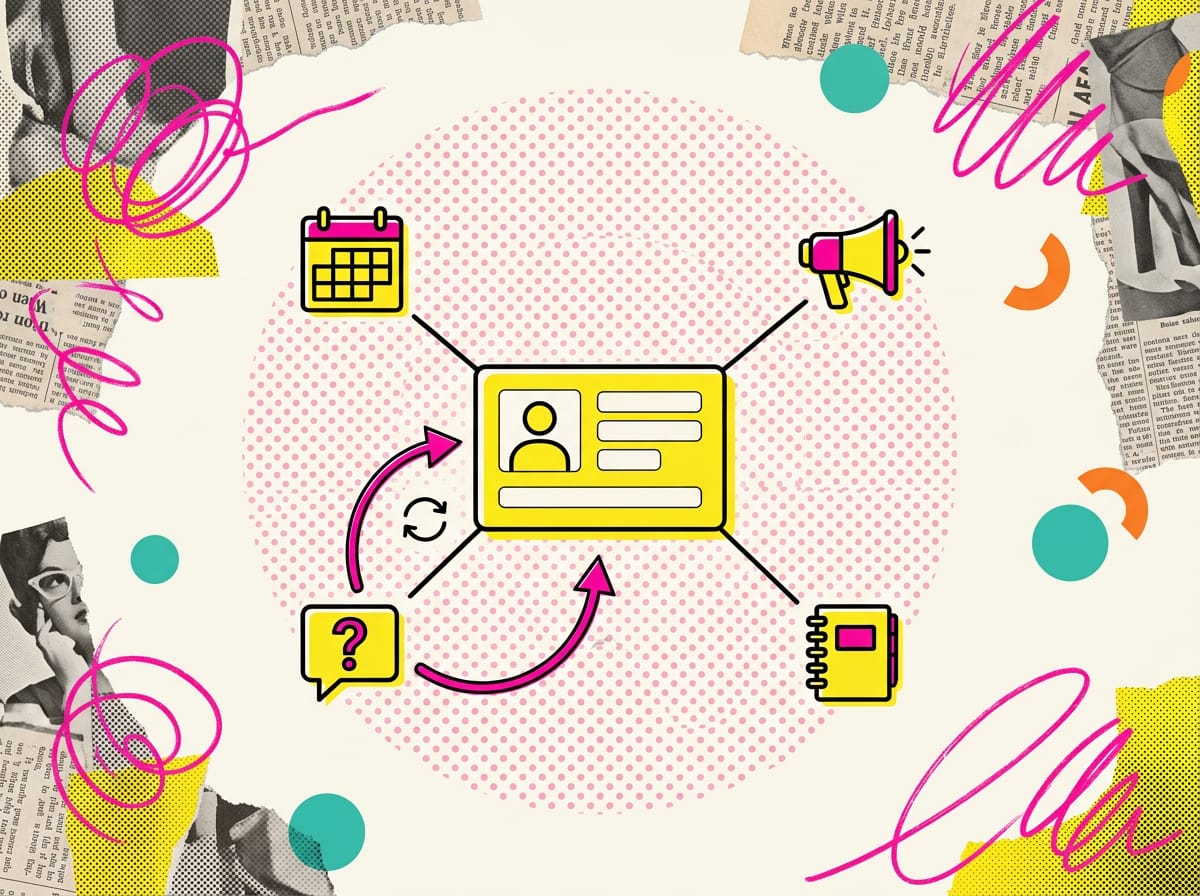
Notion makes sense when the persona needs to stay a living document. You build a personas database and link it to your content calendar, campaigns and sales notes. When you sit down to write an article, the “persona” field takes you straight to the objections that piece has to answer.
- Output format. A Notion page or database you can duplicate into your workspace
- Language. Templates in the official gallery and third-party marketplaces come from all over the world, so check the field language before duplicating one
- Email required? You need a Notion account
- When to use it. Teams that already plan content and tasks there
- Main limitation. Plenty of marketplace templates are paid, so check the price before you hit “duplicate”
Take a company that builds packaging machinery. It links each persona to the questions that came in through the website form over the last quarter. Every three months someone reads the new questions and updates two fields, without rebuilding the whole thing. With Notion AI, right on the page, you can ask: “Compare the questions linked to this persona over the last 90 days with the Objections field and suggest changes, quoting the question behind each one.”
5. Canva template (for marketing/design teams)
Canva is for when the persona is going on the office wall, into a deck or into a new salesperson’s welcome pack. Strong on design, weak on data structure.
- Output format. PDF or image, ready to print
- Language. You’ll be replacing every line of template copy anyway, so start from a blank grid
- Email required? You need an account to edit and download
- When to use it. The final version for distribution, once the content has been validated
- Main limitation. Every update means reworking the design, and you’ll do it less often than you think
What usually works is keeping the working version in Notion or Word and moving the “wall” version into Canva once a year. A filled-in canvas you can read from a metre away holds far less text than people expect.
6. Audience persona template from academic research (Word / PDF)
If you want a neutral template, outside the commercial ecosystem, the literature offers two. The first is an audience persona template designed for technical communicators. It was built by pulling together documentation used inside companies, and it ties audience analysis to how you design your copy3. The second is the Personas for AI toolbox, freely available6. It was made for designing artificial intelligence applications, with a medical example, but the field structure transfers well.
- Output format. A document to copy into Word or print as a PDF
- Language. English
- Email required? These are research publications, so read the terms of use on the source page
- When to use it. When you want a clean structure to adapt, without any software’s logic baked in
- Main limitation. No fields designed for Italian B2B selling
The research is also a useful reminder of a limit. One study lists the criticisms of the method, including the view of several experts that it lacks empirical support1. Treat that as a practical warning: a persona with no data behind it is just a guess with a nice layout.
7. Marketing Hackers template in Italian for SMEs (Word and PDF)
We built this one for Italian SMEs turning over €1-1.5 million, starting from the gaps in the templates above. The fields cover sales channel (rep, reseller, trade fair, word of mouth), who signs the order at the client company, and typical objections such as “we need a written quote”. The downloadable buyer persona template puts the ten fields from the box above on page one and the optional ones on page two.
- Output format. Editable Word file to work in, PDF for the sales network
- Language. Italian
- Email required? It’s stated next to the button, before you click
- When to use it. Teams of one or two people, with sales going through reps or resellers
- Main limitation. It’s built for B2B and needs adapting for B2C
Adele Revella wrote a whole book on buyer personas, focused on understanding what customers expect7. And it’s the customers’ own words that should fill the template.
Using AI. Export the notes from your last 20 deals, won and lost, from your CRM, and give them to Claude or ChatGPT along with the Word template and this request.
“Ti allego un template di buyer persona e le note di 20 trattative di una PMI italiana. Compila solo i campi per cui le note contengono prove e, accanto a ogni risposta, indica il numero della trattativa da cui la ricavi. Lascia vuoti i campi senza prove e scrivi quale domanda dovrei fare a un cliente per riempirli. Riporta le frasi dei clienti esattamente come sono scritte.”
Asking it to cite the deal shows you at a glance which fields rest on evidence and which are filler. The same principle holds up in a more structured workflow, with a template populated from AI output.
Which one to open first
| Situation | Template | Format |
|---|---|---|
| Starting from scratch and want to see an example | HubSpot Make My Persona | online profile |
| Presenting the persona to an agency | Xtensio | designed canvas |
| Collecting objections with a distributed team | Miro / Mural | whiteboard |
| Planning content in Notion | Notion | database |
| Need a version for the wall | Canva | PDF / image |
| Want a neutral structure to adapt | Academic templates | Word / PDF |
| Italian SME, B2B sales, small team | Marketing Hackers | Word + PDF |
In small companies, the setup we see working most often has three steps. Gather objections on a whiteboard, synthesise them in Word or Notion, and hand out a one-page PDF. For more than twenty years the persona method has supported interface design by linking users’ mental models to specific contexts6. A persona used that way, pulled out for every campaign and corrected every quarter, is worth more than any template downloaded and forgotten.
Further reading
Sources
Footnotes
-
A buyer persona definiálása és marketing célú felhasználásának bemutatása a hatékony kommunikáció érdekében. doi.org ↩ ↩2 ↩3 ↩4
-
Buyer persona — Wikipedia. it.wikipedia.org ↩
-
Audience Personas: Audience Analysis Documentation for Rhetorical Technical Communications. programmaticperspectives.cptsc.org ↩ ↩2
-
Developing Persona for Used Car Buyers in Indonesia. ijcsrr.org ↩
-
How to Use the Six-Step Digital Ethnography Framework to Develop Buyer Personas: The Case of Fan Fit. formative.jmir.org ↩
-
Personas for Artificial Intelligence (AI) an Open Source Toolbox. ieeexplore.ieee.org ↩ ↩2
-
Buyer Personas: How to Gain Insight into your Customer’s Expectations, Align your Marketing Strategies, and Win More Business. books.google.co.th ↩
FAQ
What is a buyer persona template?
It's a worksheet with predefined fields that helps you organize what you already know about your customers: who makes the buying decision, what they want to achieve, what holds them back and where they look for information. It organizes research you've already done. Without that research, it's just an empty form.
Should I use a buyer persona template in PDF, Word or Notion?
It depends on where your team works. A PDF is fine if meetings happen on paper and you review the persona once a year. Use Word or Notion when the document needs to be shared and updated often.
How do I choose the right buyer persona template for my business?
Look at three things: where your team works, who will receive the finished persona and how often you'll update it. Design and number of fields come second. Answer those three questions and you can rule out most templates.
What fields should a buyer persona include for a small business?
A few essential fields are enough: the role of the person who decides and the person who signs, the customer's industry and company size, the problem they need solved, the event that triggers the search, the most common objection, the channel they come from, the sources they trust, how they compare suppliers and how long a decision usually takes.
Should the buyer persona format change depending on who receives it?
Yes. Your sales team wants a single page they can keep at hand, a content agency wants a document it can edit, and a business partner or board wants something to put on screen. Who receives the persona matters as much as who fills it in.
Why do so many buyer persona templates go unused?
They often have too many fields and get filled in only halfway, or they're in the wrong format for the team that's supposed to use them. Nobody uses a half-finished template, so start with a few useful fields.