Cinematic Websites for Premium Brands: A 2026 Guide
Cinematic websites close the gap between your brand's perceived value and its site. What they are, when they pay off, what they cost and where AI fits.
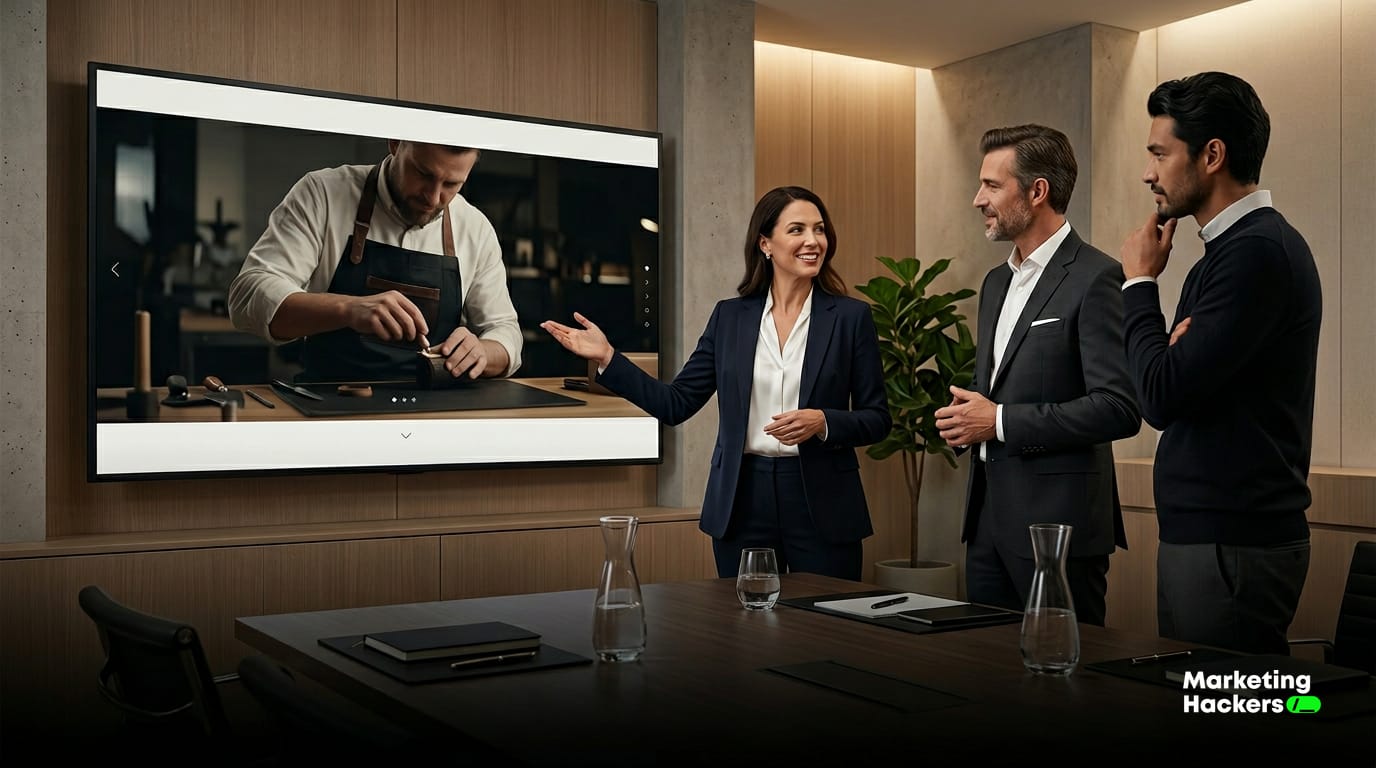
A premium brand on an ordinary website undersells itself. The product promises one thing, the homepage says another, and you pay for that gap in the price you’re able to hold. Premium cinematic websites exist to close it. They’re experience-led sites where scrolling drives a visual story, with video, motion and pacing all working for your positioning. This guide is a map: what these sites actually are, when they make sense for your brand, what drives the cost, how to pick who builds one, and where AI speeds up the process without taking it over. Each section opens with a summary, so you get what you need to make a decision.
What premium cinematic websites are (and what they aren’t)
On a cinematic site, scrolling stages the content instead of just moving it up the screen. Sections arrive on a deliberate beat, video responds as you move, and elements appear in sequence like cuts in a film edit. The goal is to make people feel what the brand is worth before you explain it in words.
Two things often get mistaken for it. A “beautiful site” with a careful layout and good typography is still static, while a cinematic one is guided and timed. A site “packed with effects” piles on transitions without a story, and that breeds confusion instead of desire. UX research has been saying this for years. An eye-tracking study of online retail found that information overload and complicated layouts create cognitive strain and make a site less effective1. Cinematic means a controlled narrative. How many animations you can squeeze in is beside the point.
The technical family includes scrollytelling, where the story unfolds as you scroll, and immersive websites that lean hard into the sensory experience.
When a cinematic site actually pays off for your brand
It pays off when people buy your product partly for how it makes them feel, when your premium margin can carry a positioning investment, and when first impressions sway the decision. If you sell on price or pure utility, a cinematic site is money aimed at the wrong problem.
The first test is how much the first impression weighs. Research on interface credibility is blunt about it. Consumers make up their minds in the first few seconds of interaction, and that impression largely decides whether the site succeeds2. If you sell emotional experiences (a hotel, a fashion collection, a winery), those seconds count for more, because what you’re really selling is an expectation.
The second test is the nature of the product. If there’s something people need to feel before they hear the rational pitch, an immersive format works in your favour. Data on immersive video shows stronger engagement: 360-degree videos get roughly 29% more views than the same content in a standard format3. Immersion does more than look good. It shifts where attention goes.
Use this grid to decide at a glance.
| Worth it if | Not worth it if |
|---|---|
| Your premium margin can carry the investment | You compete on the lowest price |
| The product or experience carries a strong emotional charge | The purchase is purely functional and repeat |
| Desire matters in the buying cycle | The decision is quick and transactional |
| The brand wants to move upmarket | The site only needs to inform or route support tickets |
If at least three rows in the left column describe you, it deserves a serious look.
The technology behind a cinematic site, explained for business
You don’t need to write code. You need to understand what makes an experience feel smooth instead of irritating. Three families of tools do the heavy lifting. Animation engines sync movement to the scroll, so each scene lands at the right moment. Smooth scrolling softens the movement and gives it that weighted, edited feel. High-performance frameworks keep everything light, because an immersive site that stutters kills the very effect it was built to create.
Performance is the part SMEs tend to underestimate. The eye-tracking study cited above ties how easily people find information directly to purchase intent1. A beautiful but slow experience does more harm than good. Smoothness is a conversion factor, so it belongs in the business conversation as much as the technical one. Working together, these cinematic website technologies are what keep the experience fluid.
Read a good example instead of copying it
Browsing a hundred cinematic sites without criteria teaches you nothing. Read them on three dimensions instead. Pacing: do the scenes follow each other with room to breathe, or bury you without a pause? Brand fit: does the experience tell that brand’s story, or is it an interchangeable effect you could bolt onto anyone? Performance: does it scroll smoothly on a phone with an average connection, or does it judder?
When an example works, it usually takes away more than it adds. One strong scene, one clean movement, one message at a time. That’s how to read premium cinematic website examples and brand scrollytelling case studies: look for the narrative decision behind each scene. The effect itself matters far less.
How much a premium cinematic website costs
Price follows the complexity of the story and the production feeding it. Page count barely comes into it. Four items really move a quote. Narrative complexity, meaning how many scenes you need and how layered they are. Video and asset production, since shooting and editing original footage costs more than adapting what you already have. Custom animation, which is bespoke work rather than templates. Performance, because making a heavy site fly is an engineering job.
Be wary of opaque quotes. A single figure with no breakdown usually hides surprises halfway through the project, or a build that cuts corners on performance to stay within budget. A serious quote itemises the work and tells you exactly what you’re paying for. How much a cinematic website costs comes down to the level of complexity and production you choose, and the price ranges can be wide.
How to choose who builds it
Judge a supplier on four signals, whatever their latest portfolio piece looks like. One, portfolio range: can they adapt the cinematic language to different brands, or do they keep repeating the same trick? Two, attention to performance: a good supplier talks to you about speed and mobile as well as the wow factor. Three, a storytelling process: do they have a method for turning your ideas into a sequence of scenes, or do they jump straight to design? Four, transparency on pricing, as covered above.
The most common red flag is a supplier who sells looks and ignores substance. The interface credibility study notes that design communicates trust non-verbally, and that the effect is amplified when the whole site is consistent with the brand’s promise2. An agency that only thinks about the first glance and forgets consistency leaves you with a site that impresses people and tells them nothing. The same four signals apply when you’re choosing a scrollytelling agency in Italy.
Cinematic for your sector
Every premium vertical has its own storytelling needs, and the site has to tell the story of what that market is really buying.
Luxury hotels and hospitality sell the anticipation of a stay, so the narrative works on atmosphere and a sense of place, and luxury hotel websites aim to let guests experience the property before they arrive. Premium fashion sells identity and desire, and websites for premium fashion brands build their pacing around the collection. High-end real estate sells a vision of a life, and luxury real estate websites stage each space like a set. Wine and fine food sell terroir and craft, and websites for wineries and gourmet producers show the hands and the place behind the product. The narrative structure shifts with what the customer is actually paying for.
How AI speeds up building a cinematic site
AI speeds up a sound process here. It can’t stand in for one. Without a narrative direction, AI simply helps you churn out directionless content faster. With your positioning already nailed down, it shortens four steps.
The first is visual direction. You can generate moodboards and reference palettes in a few hours to get your team and your supplier aligned before you spend anything on production. The second is scene copy, the handful of lines that accompany each moment of the scroll: quick to draft, then polished by hand. The third is concept prototyping, so you can compare two or three narrative directions before committing budget. The fourth is micro-copy variants, for testing headlines and buttons without starting from scratch every time.
Here’s a working prompt for the concept stage, to use with a model like Claude or ChatGPT.
“Act as a creative director who specialises in experience-led websites. Propose 3 scroll-driven narrative concepts for the website of [brand name], in the [e.g. luxury hotel] sector, whose premium value is [e.g. its lakefront location and tailored service]. For each concept, list 5 scenes in sequence, one guiding line per scene, the dominant visual tone and the emotion the visitor should feel. No technical jargon: write for the owner of a small business.”
One word of caution on the data. Italy’s media and advertising market is being reshaped by AI, with hundreds of startups mapped in media and advertising alone4, but that’s no reason to hand your creative work to a machine. The part that decides the outcome stays with you: what you want the visitor to feel. AI helps you stage it faster. From concept you move on to production, which is where how to build a scrollytelling site comes in.
FAQ
What is a cinematic website? It’s an experience-led site where scrolling drives a visual story built from video, motion and pacing. Unlike a static site, scenes arrive in sequence so visitors sense the brand’s value before it’s spelled out. It’s mainly for premium brands that sell desire and emotion as well as information.
How much does it cost? Cost depends on narrative complexity, video and asset production, custom animation and performance work. The number of pages has little to do with it, which is why price ranges are wide. Be wary of single-figure quotes with no itemised breakdown, as they often hide cuts to technical quality.
Does it slow the site down and hurt SEO? It can, if it’s done badly. A heavy, slow immersive site damages the experience and conversions, and research links ease of use to purchase intent1. Built properly, with high-performance frameworks and optimisation, it stays light. Performance is part of the project from day one, never a finishing touch.
Do I have to have video? No. Video helps in highly visual sectors, and immersive formats show higher engagement3, but a cinematic site can also work with animation, strong photography and moving type. What matters is a story driven by the scroll, whatever the format.
How long does it take? It depends on the number of scenes and how much production is needed. A project with existing material moves faster than one that needs original shoots. AI shortens the concept and prototyping stages, but refining the narrative and tuning performance still take human work.
The short version
A cinematic site is a positioning tool for brands whose value has to be felt before it’s explained. It makes sense when your margin, an emotionally charged product and the weight of first impressions justify it, and it should be judged on story and performance, never on effect count. AI speeds up concepts, copy and prototyping, but the direction is still your call. If you’re weighing up an experience-led site for your brand, we can help you work out whether it makes sense in your case and build it with a process that starts from the story, with the tools coming second. Get in touch for an assessment of your project.
Further reading
Sources
Footnotes
-
Determinants of choosing an online cosmetics store: an eye-tracking study on the impact of website aesthetics on purchase decisions. um.edu.mt ↩ ↩2 ↩3
-
A Picture is Worth a Thousand Words: Source Credibility Theory Applied to Logo and Website Design for Heightened Credibility and Consumer Trust. scholarsarchive.byu.edu ↩ ↩2
-
User experiences with 360 brand videos: device experiences, presence, and creativity driving brand engagement. link.springer.com ↩ ↩2
-
Internet Media: lo scenario del mercato italiano e i trend in atto nel … osservatori.net ↩
FAQ
What is a cinematic website, and how is it different from a good-looking one?
A cinematic website stages its content through scrolling: timed sections, video that reacts to the user, and elements that appear in sequence. A merely good-looking site stays static. A site stuffed with effects piles them on for their own sake. On a cinematic site every animation serves a controlled narrative.
When is a cinematic website actually worth it for my brand?
It makes sense when people buy your product partly for how it makes them feel, when your premium margin justifies a positioning investment, and when first impressions drive the decision. If you compete on lowest price or the purchase is purely functional, the money is better spent elsewhere.
Why do first impressions matter so much on a premium website?
Visitors form an opinion within the first few seconds, and that first impression largely decides whether the site works. For businesses selling an emotional experience, like hotels, fashion labels or wineries, those seconds matter even more because what you're selling is an expectation.
Do immersive content and video really increase engagement?
Yes. Data shows 360-degree videos get roughly 29% more views than the same content in a standard format. Immersive content isn't decoration: it measurably shifts where users put their attention.
Can too many animations hurt a website?
Yes. An eye-tracking study on online retail found that information overload and cluttered layouts increase cognitive effort and make a site less effective. Cinematic means a controlled narrative, not a higher count of transitions.