Small Business Storytelling: Structure, Examples and Mistakes
Small business storytelling works when you pick the right story, the right hero and a structure (hero's journey or SCQA) that moves buyers to decide.
Trade show, hall 4. The owner of a small refrigeration company is pitching to the buyer for a restaurant chain, and he has twelve slides. Revenue, thirty years in business, certifications, the van fleet. Near the end, mostly to fill a pause, he mentions a Saturday in August when one of his engineers drove out at 2 a.m. to fix a cold room at a restaurant with 400 kilos of fish inside. On Monday the buyer calls back. He wants to know who that engineer was and how long it would take him to reach their area.
He has forgotten all twelve slides. What stuck was the cold room, the time of night and the fish that didn’t go in the bin.
For a small business, persuasive storytelling comes down to choosing. You pick which episode to tell, who the main character is and what order the facts go in, so the listener ends up at a decision. Below you’ll find two structures: the hero’s journey for telling the story and SCQA for getting a decision. Then a three-question test to work out who your hero is, three templates for the About page, the pitch and the case study, five mistakes to fix, and prompts to speed up each step with ChatGPT or Claude. All of it belongs to a wider body of work on the psychology of professional communication, which starts with how your listener decides and only then gets to what you should say.
Why the brain remembers stories and forgets slides
While the owner is reading out certifications, the buyer is doing what experienced buyers do. He weighs every claim, compares it with what competitors have told him and looks for the weak spot. When the cold room story starts, he stops doing that for a couple of minutes and just follows what happens: who, what went wrong, what came next.
Psychologists call this narrative transportation. People absorbed in a story tend to argue back less and accept the messages inside it more readily. A review published in 2025 in the ACADEMIA International Journal for Social Sciences reaches consistent conclusions about consumers. Compared with purely informational appeals, narrative raises empathy, message recall and how authentic the brand feels 1.
There’s a number, too. In 2012 Tom van Laer, Ko de Ruyter and Martin Wetzels pulled together a decade of research on narrative transportation and analysed 287 effects measured across different studies. Their summary: when people get lost in a story, their attitudes and intentions shift in the story’s direction 2. In a B2B deal, nudging intent a few degrees is often enough to close.
The effect holds up with audiences far colder than a buyer. In an experiment with 188 active business angels, researchers at Esade found that the story an entrepreneur tells changes how investors assess the opportunity. It works through two channels: how much the investor identifies with the entrepreneur, and how motivated they judge them to be 3.
For a small business, the practical takeaway is simple. Keep the numbers, and put them inside the story, at the point where the reader expects them.
Quotable passage. A story works because it holds attention on one person, one problem and one choice. The listener follows the sequence and argues back less. Data persuades more when it arrives inside a story, at the moment the listener is already looking for it.
Stories also act on some of the mental shortcuts decision-makers rely on, cognitive biases, which follow rules of their own.
The hero’s journey, business edition
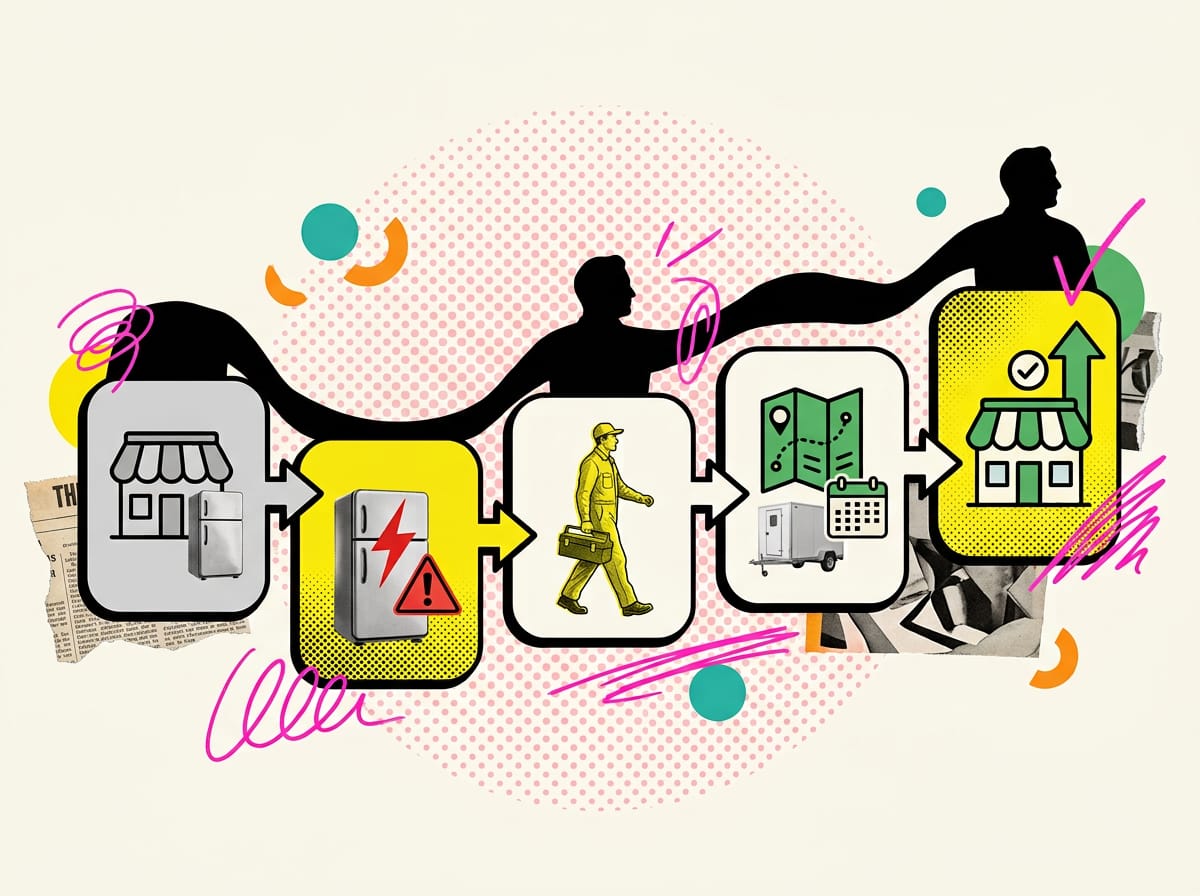
Think of a film you watched recently. Someone is going about their routine, something knocks it off balance, they meet someone who helps, they get through a trial and come back changed. That’s the hero’s journey, one of the oldest and most recognisable story structures there is. The classic version has a dozen stages. A small business needs five.
In business, the decision that matters most is who plays the lead. The hero is the customer. Your company walks on in stage three, as the guide who has seen this problem before and knows how to fix it. In the business angel experiment, persuasion ran through identification 3, and the same applies here. A restaurant buyer sees himself in a restaurant owner whose cold room has failed. He sees himself far less in your engineering department.
| Stage | Question to ask yourself | Illustrative example (refrigeration) |
|---|---|---|
| 1. The customer’s normal | What did their day look like before the problem? | A 60-cover trattoria, kitchen running flat out over the August bank holiday weekend |
| 2. The problem that breaks it | What put money, time or reputation at risk? | 11 p.m. on Saturday, the cold room stops cooling with 400 kg of fish inside |
| 3. Meeting the guide | Why did they call you, and what did you know that they didn’t? | The on-call number stuck to the fridge; an engineer who recognises the fault from the noise described over the phone |
| 4. The plan and the trial | What did you do, how fast, and what got in the way? | On site at 2 a.m., replacement compressor taken from the van, back to safe temperature by 4.30 |
| 5. The customer, changed | What measurable result did they get? | Sunday lunch served, zero stock thrown away, maintenance contract signed in September |
Always check stage 5. Without a measurable result, the story stays a nice anecdote the buyer tells a colleague and then forgets. With one, it becomes proof.
One last practical tip. Fill in the table before you write a word. If a row stays empty, you’re missing something you need to ask the customer or the engineer, and no writing formula will cover for it.
SCQA, the structure that gets the customer to decide
Here’s an introductory email, the kind that lands in inboxes every day.
Dear Purchasing Manager, we are a refrigeration company established in 1994. We have 22 engineers, F-gas certification and coverage across three regions. We offer planned and emergency maintenance. We would welcome the opportunity to meet.
Every sentence is about the company. Not one is about the reader. Here’s the same email, rewritten.
Dear Purchasing Manager, your 14 kitchens run at full capacity from June to September. At peak season, a cold room failure costs you an evening’s takings plus everything stored inside. How do you cut that risk without an in-house engineer at every site? With an overnight on-call contract guaranteeing a visit within 3 hours anywhere in the region. We’d be glad to show you how it went for a business much like yours.
The company information has almost vanished, and the second version sells harder. The only thing that changed is the order.
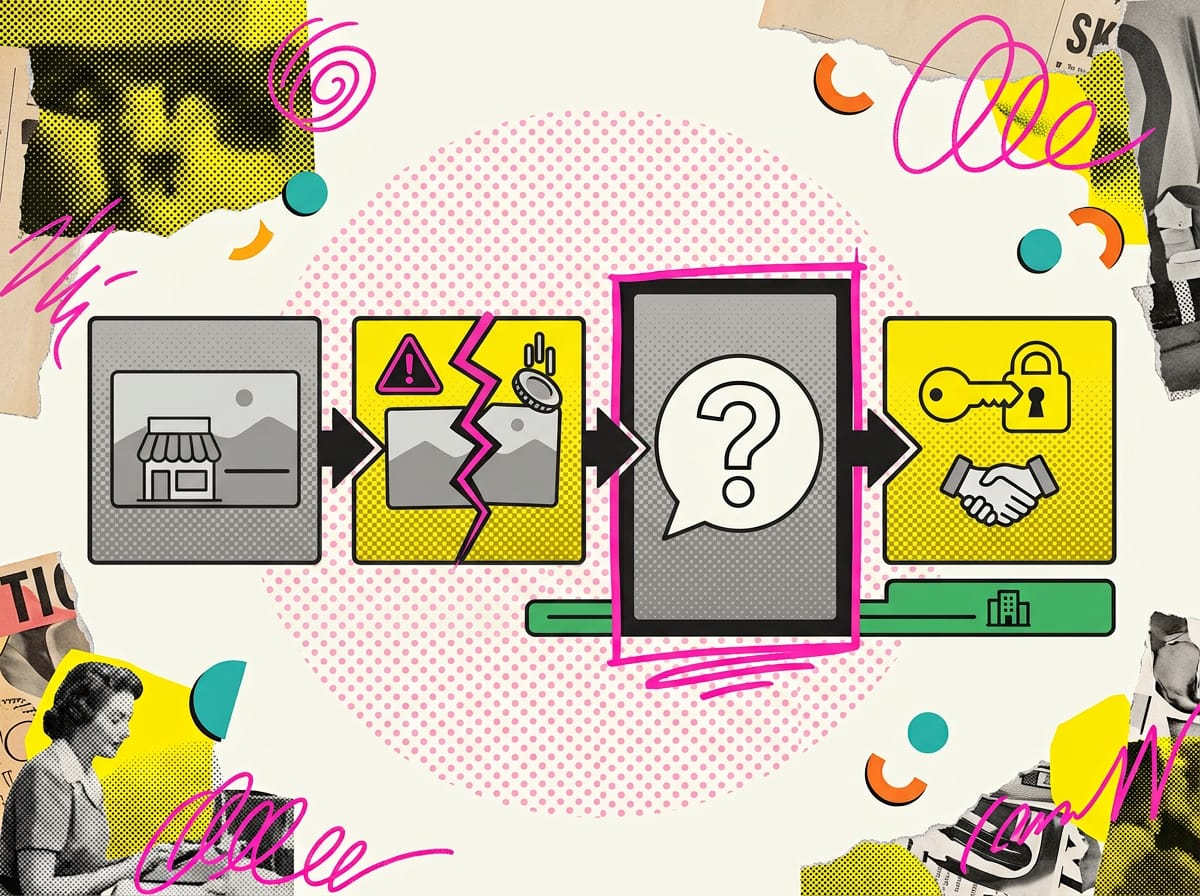
SCQA has four parts. The Situation is what the reader already knows. The Complication is what has changed or what puts them at risk. The Question is what to do now. The Answer is your offer. It works for pitches, sales emails and quotes, because it starts in the customer’s world and reaches your offer at the moment they’re asking for it themselves.
The Question is the hinge. If you struggle to write it, your Complication is weak and the reader feels no need for an answer. Go back and find a concrete cost, risk or deadline.
Where to use it in a small business:
- in the first 60 seconds of a sales call, before any company introduction;
- on the first page of a quote, before the line items and prices;
- in the subject line and first three lines of an email;
- on slides 1 to 3 of a presentation.
The hero’s journey tells what happened to one customer. SCQA gets the next one to decide. They often work as a pair: the SCQA Answer points to a case, and you tell that case in five stages.
Speeding up SCQA with AI
AI writes in seconds, but it only knows what you feed it. Before you open ChatGPT or Claude, gather three facts only you know: the recipient’s industry, what has changed in their market, and the measurable result you got for a similar customer. Without them you’ll get a plausible, generic email that reads exactly like your competitors’.
You are a B2B sales consultant. Write a first-contact email using the SCQA structure (Situation, Complication, Question, Answer).
Recipient: [role and industry, e.g. purchasing manager at a 14-restaurant chain]
Situation they already know: [...]
What has changed or what they're risking: [...]
Our offer: [...]
Concrete proof: [measurable result for a similar customer]
Constraints: 90 words max, no self-congratulatory adjectives, no data other than what I've given you.
Write 3 versions with 3 different subject lines. Then tell me which of the three Complications seems weakest and why.
That last request earns its keep. It forces you to reread the Complication through the customer’s eyes, which is usually where the email wins or loses its reply.
Who’s the hero of your story, you or your customer?
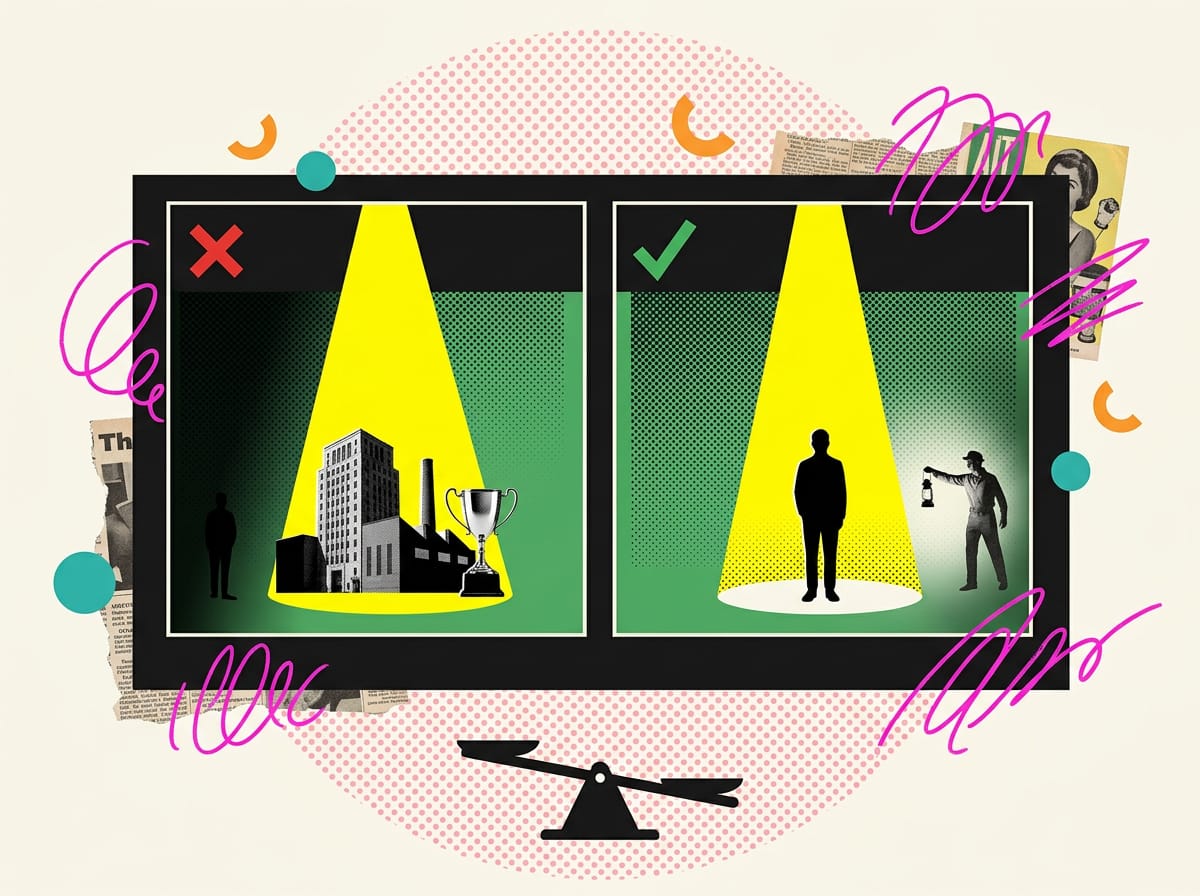
In most sales copy, the customer is the hero and the company is the guide. The customer has the problem, makes the choice and walks away with the result. You bring the method, the experience and the proof. The legitimate exception is the founder’s story, which earns its place on the About page, in recruitment, and whenever customers are buying the person as well as the service.
Research on small firms helps explain why both can coexist. Peter Fluhrer’s study, published in 2025 in the Journal of Brand Management and based on a sample of 217 German SMEs and 107 German start-ups, separates two levels. In strategic storytelling, the brand itself is the story. Tactical storytelling is made of individual stories about the founder, the company’s history, its values, its people and how it makes things. The same study finds a strong link between storytelling and brand positioning, the bridge between how a company sees itself and how customers see it 4.
So the founder’s story has its place. The trouble starts when it takes up every space. When brands use narrative strategies, consumers report more trust and a stronger emotional connection than with purely informational or persuasive appeals 1. If customers recognise themselves in the lead character, the story becomes partly theirs.
The three-question test, to run on any existing copy:
- Is the subject of most sentences “we” or “the customer”?
- Is the problem described the customer’s or yours?
- Does the ending describe a customer result or an award you won?
If two of the three answers point to you, the copy is self-congratulatory. To measure it in two minutes, paste your homepage into Claude with this prompt.
Count how many sentences in this text have the company as their subject (we, our company, our team) and how many have the customer or reader (you, the customer). Give me both numbers.
Then rewrite the 5 most company-centred sentences with the customer as the subject, without adding any new facts.
Text: [paste]
A case told from the customer’s side is also the most credible form of social proof, one of the persuasion principles most widely used in sales.
Three templates for the About page, the pitch and the case study
In a small business, the brand is shaped mostly by the owner’s mindset and skills, with no marketing department of dedicated specialists behind it 4. A repeatable template takes the blank page off the owner’s hands and leaves them the part that counts: the facts.
There’s plenty of room to improve. A group of researchers examined 247 websites of Spanish companies across six sectors and found 104 stories to analyse. Their conclusion: most companies make little use of storytelling, and the quality of the stories they do tell could be much better 5.
About page
Here the founder can take the lead, as long as the story ends with the customer. Five paragraphs, 300 to 400 words in total.
- The starting point. A specific moment with a place and a date, in two or three sentences, instead of “founded in 1994 out of a passion for”.
- The customer problem you saw back then and still see today.
- What you do differently, backed by a verifiable fact (response times, number of systems maintained, an internal procedure).
- The people, with the names and roles of whoever the customer will actually deal with.
- A typical customer result and the next step to take.
The voice has to match the rest of the site. An emotional About page on an otherwise dry, technical site rings false, which is why you need a company tone of voice nailed down before you write. In research by Singh, Kumar and Lal with 250 social media users (Media Education, 2025), brand trust is tied to authentic, well-structured narratives 6.
The 2-minute pitch
It’s SCQA with a case inside, timed.
- 0–20 seconds. The typical customer’s Situation, with a detail from their industry.
- 20–45 seconds. The Complication, with a cost or risk in numbers.
- 45–60 seconds. The Question, said out loud.
- 60–100 seconds. The Answer, with a case squeezed into the five stages.
- 100–120 seconds. A concrete ask, such as a site visit or a 20-minute call.
In a pitch, concrete verbs and physical details do the work. “The cold room was at 12 degrees” sticks. “We resolved a critical issue” slides straight past.
Customer case study
A case study is the hero’s journey in written form. Open with a headline that states the result, then introduce the customer and their context, the problem with a number attached, why they chose you, what you did and how long it took, the measurable result, and a direct quote from the customer. Aim for 400 to 600 words.
The whole thing rests on the interview. Thirty minutes on the phone with the customer, recorded with their consent, then transcribed. Only then does AI come in.
Below is the transcript of an interview with one of our customers. Write a 400-word case study with this structure:
1) what things looked like before;
2) the problem and what it was costing;
3) why they chose us;
4) what we did, with timings;
5) the result, with the numbers the customer gave;
6) one direct quote from them.
The customer is the hero: make them and their business the subject of the sentences.
Use ONLY facts and figures that appear in the transcript. Where a figure is missing, write [MISSING DATA].
Transcript: [paste]
The [MISSING DATA] placeholder is the most useful part of the prompt. It shows you what to ask the customer before publishing, and it stops the AI plugging gaps with made-up numbers.
Five mistakes that wreck small-business storytelling
1. Mistaking a timeline for a story. A list of dates is a chronology. It has no conflict and no lead character.
- Before. “Since 1987 the company has grown, opening a second plant in 2005 and achieving certification in 2018.”
- After. “In 2005 a customer asked us for 48-hour delivery. To manage it, we opened a second plant 40 km from their site.”
2. Vagueness. “High-quality tailored solutions” is a line anyone could sign. Swap every adjective for a fact that proves it.
- Before. “We offer a fast, reliable service.”
- After. “Of 312 emergency call-outs last year, we were on site within 3 hours in 298.” (Use your real numbers.)
3. The too-good-to-be-true ending. Stories that exaggerate reality or clash with the brand’s values lose their power, and a badly built story breeds distrust and makes the brand look inauthentic 1. An experienced buyer spots the exaggeration the first time they hear it.
- Before. “We eliminated the customer’s machine downtime.”
- After. “Downtime dropped from 9 incidents a year to 2. The two that remained were electrical faults outside our contract.”
4. The wrong hero. This is the mistake the three-question test catches. The team, the award or the new machine takes centre stage, and the customer is an extra.
- Before. “Our team overcame a complex technical challenge.”
- After. “The production manager had three weeks to get the line running again. With our plan, he reopened in twelve days.”
5. No ask at the end. The story finishes, the reader nods and closes the page. Every sales story needs to end with one small, specific step: a 20-minute call, a site visit, a spec sheet download. If a price or an avoided cost appears in the story, the order you present it in matters too, which takes you into framing and the anchoring effect.
To fix existing copy in bulk, give ChatGPT or Claude one page at a time with this request: “Find examples of the following five mistakes in this text: timeline instead of story, vagueness, exaggeration, wrong hero, no closing ask. For each one, quote the sentence and suggest a rewrite that uses only facts already in the text, flagging with [MISSING DATA] wherever a number is needed.” Checking the numbers is still your job.
Does storytelling work in B2B?
Yes. Some of the strongest evidence comes from settings that are anything but emotional. In the experiment with 188 business angels, the entrepreneur’s story changed how the investment opportunity was perceived, through identification and perceived motivation 3. A purchasing manager decides through much the same mechanisms.
How long should a company story be?
It depends on the format. As a working benchmark: a pitch runs 2 minutes, an About page 300 to 400 words, a case study 400 to 600, an SCQA email under 90 words. If any of the five stages needs more than a paragraph, you’re probably telling details that interest you more than the reader.
Can I get AI to write my stories?
You can use it to write them faster. The facts, the numbers and the customer’s words still have to come from you, from interviews and from your own business data. A generic or inflated story erodes trust 1, and AI left unconstrained tends to produce exactly that. Put explicit constraints in the prompt, ask for placeholders where data is missing, and read everything through before you publish.
Further reading
- The psychology of communication for small businesses: a practical guide
- Framing and the anchoring effect: how a small business should structure offers and prices
Sources
Footnotes
-
Marketing through Storytelling: The Psychology of Narrative in Brand Communication. academia.edu.pk ↩ ↩2 ↩3 ↩4
-
Effects of Narrative Transportation on Persuasion: a Meta-Analysis. openaccess.city.ac.uk ↩
-
How storytelling helps entrepreneurs gain access to external … merit.url.edu ↩ ↩2 ↩3
-
The role of storytelling in the branding of SMEs - Springer Nature. link.springer.com ↩ ↩2
-
“Once upon a brand”: Storytelling practices by Spanish brands. sciencedirect.com ↩
-
Digital Storytelling and Brand Positioning in the Media Age: Building Consumer Trust through Narrative Authenticity. doi.org ↩
FAQ
Why do customers remember a story but forget the slides?
When people follow a story, they enter a state psychologists call narrative transportation. For a while they stop weighing and comparing every claim, push back less and remember the message better. Revenue figures and certifications get evaluated and compared with your competitors' instead.
Which story structures can a small business use?
There are two that work well together. The hero's journey is for telling your story, for example on your About page. SCQA (Situation, Complication, Question, Answer) is for moving the listener to a decision, as in a pitch or a sales proposal.
Does storytelling really work in B2B?
Yes. A meta-analysis by van Laer and colleagues (2012) covering 287 measured effects found that narrative transportation shifts intentions with a correlation of 0.22, twice its effect on attitudes. The effects are moderate, but in a B2B deal, moving intent a few degrees is often enough to close.
Can a story persuade experienced investors too?
Yes. In an Esade experiment with 188 active business angels, the founder's story changed how investors assessed the opportunity. The effect depends on how much the investor identifies with the founder and how motivated they judge the founder to be, and it gets stronger when the language is vivid.
Do you have to give up numbers in business storytelling?
No. You keep the numbers, but you place them inside the story instead of listing them on their own. A concrete episode, like a technician driving out at night to save a customer's stock, gives meaning to figures such as years in business and response times.
Can you use ChatGPT or Claude to build your company's storytelling?
Yes. AI can speed up every step, from choosing the episode to drafting your About page, pitch or case study. Picking the true story and its concrete details is still the business owner's job.