How to Choose a Scrollytelling Website Agency in Italy
Hiring a scrollytelling agency in Italy? 7 criteria, a 20-minute test and 12 questions to find a studio whose work actually holds up on a smartphone.

The quote lands in your inbox with a portfolio reel attached. On the office monitor everything glides: the product spins, the copy slides in right on cue. Then you pull up the same site on your phone, sitting in the car outside a client’s office, and the first screen stays blank for what feels like forever. Anyone shopping for a scrollytelling agency in Italy runs into this sooner or later. Almost every studio can make something move when you scroll. Far fewer can build a story that holds up on an ordinary smartphone over an ordinary mobile connection, and until the contract is signed, the business owner has no way of telling the two apart.
Below you’ll find seven scored criteria, a 20-minute test you can run yourself, twelve questions for the first meeting and two prompts for comparing proposals with AI. A quick definition so we’re on the same page: a scrollytelling site is one where content appears or changes as the visitor scrolls down the page 1. It’s the foundation of premium cinematic brand websites.
Why a scrollytelling site calls for a different kind of supplier

With a standard brochure site, the agency assembles pages out of a header, some sections, a form and a footer. You judge the work page by page.
With scrollytelling, the agency is designing time. It decides how long a scene lasts, what the visitor sees before the price, when an image steps aside for the copy. That takes three crafts working together: someone writes the story, someone designs the motion, and someone makes it run smoothly on a phone. Researchers at the Hasso Plattner Institute say so outright. Good scrollytelling needs content designers, graphic designers and developers collaborating, and when the designer depends entirely on the developer, the result is misunderstandings and wasted rounds of iteration 2. The team at the University of Bergen reaches the same conclusion, citing a user evaluation which found that authors, designers and developers need to sit on the same team 1.
A scrollytelling agency that covers only one of those crafts either subcontracts the other two or fakes them with an animated template. You can tell from the finished site: the copy clearly arrived last and got wedged into animations that were already built.
The format was born in journalism. The New York Times published Snow Fall in December 2012. The piece won a Pulitzer in 2013 and passed 3.5 million views in its first week, with readers spending around 12 minutes on the page on average 3. Twelve minutes on a single page. That’s the kind of attention an immersive site can earn, and it’s why asking a general web agency to “add a few animations” will take you somewhere else entirely.
The short version. Pick a supplier that can write, design motion and code, or one that tells you plainly who does what and which partners they bring in.
Who builds scrollytelling sites in Italy? The 4 types of supplier
In Italy you’ll come across the general web agency, the creative studio specialising in motion, the freelance creative developer, and the hybrid team that uses AI to speed up concepts, copy and prototypes under human creative direction. Each one suits a different project and carries a different risk.
| Type | Strength | Typical risk | When it makes sense | Relative budget |
|---|---|---|---|---|
| General web agency | Handles site, SEO and maintenance under one contract | Uses templates with scroll effects and calls it scrollytelling | A handful of effects on a corporate site | Low to mid |
| Creative and motion studio | High visual quality, often with industry awards on show | Beautiful but heavy sites, copy treated as filler | Product launch, brand with a strong visual identity | High |
| Freelance creative developer | Full technical control over the animations | Story and copy are on you, continuity rests on one person | You already have an in-house copywriter and designer | Mid |
| Hybrid team with AI | Faster concept and prototype stages, three crafts coordinated | Generic content if the creative direction is weak | SMEs who want the result without managing three suppliers | Mid |
The motion studio is the one most likely to pitch itself as a cinematic web design agency. It works well when your story is mainly visual. If your story runs on numbers, say the impact of a plant or the stages of a supply chain, you’re better off with someone who knows how to stage data. In a study with 98 participants, an interactive data comic was more engaging than plain text carrying the same information, and its readers remembered and understood the data better 4.
The cost of a cinematic website varies a lot from one tier to the next.
In the interest of transparency: Marketing Hackers sells a managed service for premium cinematic sites and falls into the fourth category. Read this guide knowing where it’s coming from, and hold us to the same criteria.
7 criteria for judging a scrollytelling agency
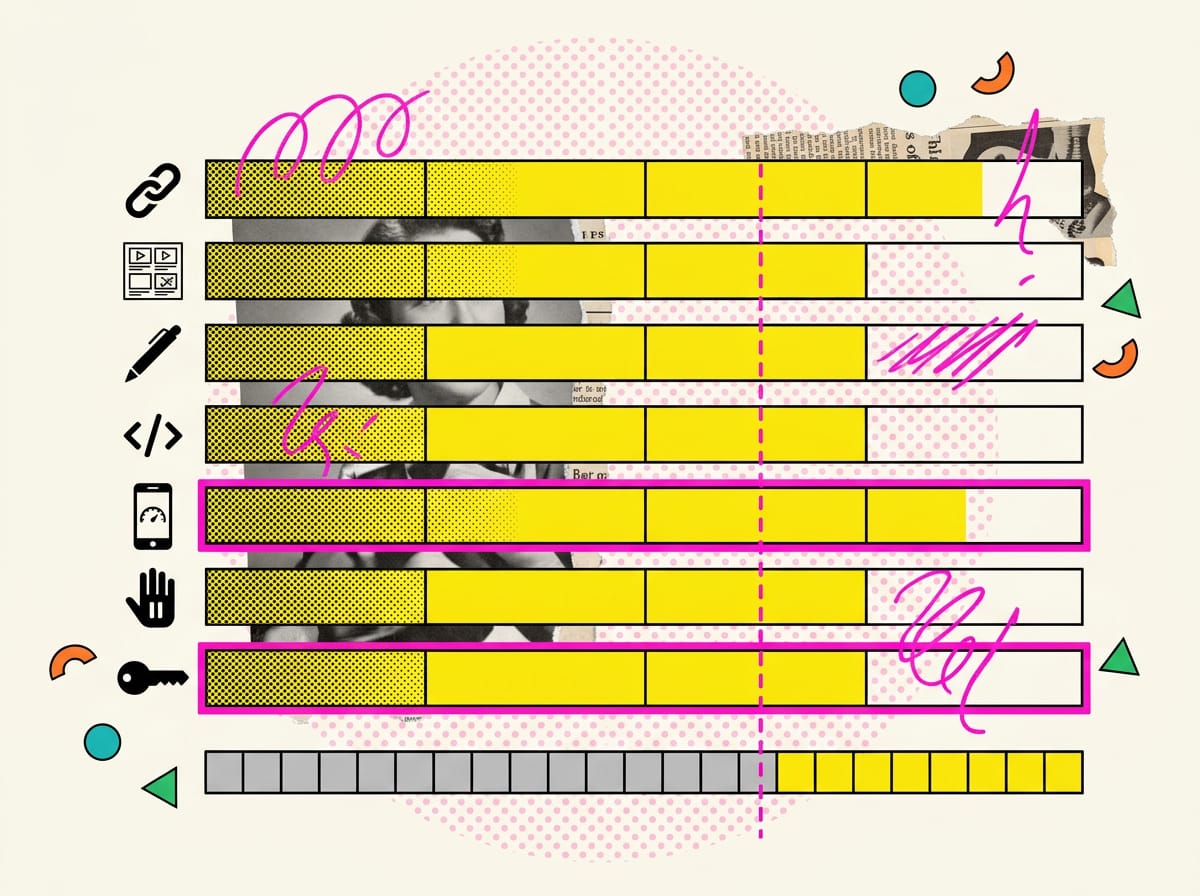
Run every proposal you receive through these seven criteria. The scoring system is at the end of the section.
1. A portfolio with public, working links
A Vimeo reel shows the site at its best, recorded on a powerful machine over fibre broadband. What you need are the URLs of at least three scroll-driven projects that are still live and were built for real clients. If a project has been taken down, ask why. Sometimes the client changed strategy. Sometimes the site had become impossible to maintain.
How to check. Ask for three links and open them yourself, on your own phone, without the agency in the room.
2. Storyboard before code
You plan scrollytelling the way you’d plan a short film. Before a single line of code gets written, there should be a scene-by-scene storyboard, a script with the copy and the length of each scene, and a motion prototype, however rough. The Potsdam group found that when designers can’t test their own vision, the end result often drifts away from it and avoidable revision rounds pile up 2. You pay for every one of those rounds.
How to check. Ask to see the storyboard from a delivered project, with the client’s name blacked out if need be.
3. Who writes the story
Plenty of agencies ask the client for “the content” and simply lay it out. On a scroll-driven site, the copy sets the pace. It decides how many words fit in a scene, where the reader pauses, what they see before they reach the contact form. If nobody at the agency writes, that job lands on you or doesn’t get done at all.
How to check. Ask for the name and role of the person who’ll write the copy, plus a script they’ve already written.
4. Who writes the code
Subcontracting becomes a problem when nobody mentions it. Six months after launch you want to change a scene and find out the freelancer who built it is now busy with other clients. Ask which technologies they’ll use as well: there are plenty of options for immersive sites, and some of them tie your site to a single developer.
How to check. Ask who does the development, whether they’re in-house or external, and who handles fixes after handover.
5. Performance measured on a smartphone
The benchmark that matters is your customers’ average phone on whatever mobile network they happen to be on. High-resolution video and sequences of hundreds of images are heavy. A serious agency will explain how it loads them and will agree to write into the contract, as an acceptance condition, that the mobile version must pass the Core Web Vitals assessment in PageSpeed Insights.
How to check. Run the portfolio test described further down and read the acceptance clause in the draft contract.
6. Controlled motion and accessibility
The most common risk is scrolljacking: the site takes over your scrolling speed and won’t let you skip ahead. Even successful projects have their limits. A scrollytelling platform evaluated by 289 people scored 79.9 on the System Usability Scale, yet its authors still flag the risk of cognitive overload from the sheer amount of information 5. Ask for a version designed for people who switch on reduced motion on their phone. As for the EU’s digital accessibility requirements, which apply only to certain categories of products and services, check with your legal adviser.
How to check. Turn on reduced motion and reopen the portfolio sites.
7. Ownership and independence after launch
The code, the animation source files, the videos, the font and image licences should all belong to you. Ask what you’ll be able to edit yourself, too. The editors and CMSs you’d use for a normal site offer little support for interactive storytelling 1, so on a scrollytelling site even changing a headline can mean calling a developer. Better to know that up front.
How to check. Get the ownership clause in writing and ask for a demo of the editing panel.
The score
Give each criterion a mark from 0 to 3.
| Mark | Meaning |
|---|---|
| 0 | Missing or not stated |
| 1 | Stated verbally |
| 2 | Shown with a concrete example |
| 3 | Shown and written into the contract |
The maximum is 21. Our rule of thumb: below 14, we renegotiate or walk away. A zero on criterion 5 or 7 outweighs any aesthetic score, because those are the two problems you only discover after you’ve paid.
The 20-minute portfolio test, no technical skills needed

Grab two projects from the portfolio, a smartphone and a stopwatch.
- Minutes 0-5, PageSpeed Insights. Go to pagespeed.web.dev, paste in the URL and open the “Mobile” tab. Note whether the Core Web Vitals assessment passed or failed. Repeat with the second project.
- Minutes 5-12, mobile network. Turn off Wi-Fi and open the site. Time how long it takes to show readable text. Scroll all the way down and note any stuttering, scenes that jump, or text laid over images where you can’t read it.
- Minutes 12-17, reduced motion. On an iPhone, go to Settings, Accessibility, Motion and switch on Reduce Motion. On Android, look for “Remove animations” in the accessibility settings (the wording varies a little between manufacturers). Reopen the site. It should still be readable and easy to navigate.
- Minutes 17-20, in a hurry. Pretend you’re a customer who just wants the phone number. Scroll fast, go back up, hunt for the contact details. If it takes you more than a few seconds, it’ll take your customer even longer.
The PageSpeed report is full of acronyms. Copy the text of the report and paste it into Claude or ChatGPT along with the prompt below.
I run a business and I'm choosing an agency to build a scrollytelling
website. I'm not technical. Below is the PageSpeed Insights report
(mobile) for one page from their portfolio.
Explain in plain English:
1. whether the page passes Core Web Vitals and which metric is furthest
   from the threshold;
2. which problems come from animations, video or images;
3. three specific questions I should ask the agency about these problems.
Don't make up any values that aren't in the report. If something is
missing, tell me.

[paste the report here]
Take the three questions you get back to the first meeting, along with the ones in the next section.
12 questions for the first meeting
The right-hand column matters more than the middle one. A single red flag on questions 1, 5 or 9 is enough reason to stop and ask for clarification in writing.
| # | Question | Good answer | Red flag |
|---|---|---|---|
| 1 | Can I open three of your scroll-driven projects today? | Three working links | Videos only, or “they’re all under NDA” |
| 2 | What do you deliver before development starts? | Storyboard, scene script, motion prototype | ”We’ll start with the design and take it from there” |
| 3 | Who writes the copy for the scenes? | Name and role of a copywriter | ”The client provides the content” |
| 4 | Who develops it, and who steps in after launch? | In-house developer or a named regular partner | Vague answer, a different person on every project |
| 5 | What performance threshold do you put in the contract? | Core Web Vitals passed on mobile, checked with PageSpeed | ”It’ll be lightning fast”, with no numbers |
| 6 | What happens when reduced motion is switched on? | An alternative version already designed | They don’t know what you’re talking about |
| 7 | Which phones do you test on? | A list of real devices, mid-range ones included | Only the browser emulator |
| 8 | What can I edit myself? | Demo of the panel and a list of editable fields | ”Just email us for any changes” |
| 9 | Who owns the code, videos and source files? | The client, by contract | A time-limited usage licence, or silence |
| 10 | How many revision rounds are included, and at what stage? | Concentrated on storyboard and prototype | Unlimited revisions once the site is finished |
| 11 | How do you measure whether the story is working? | Scroll events and conversions defined before launch | Visit counts only |
| 12 | Do you use AI in your process, and where? | Specific stages, with human review | They deny it outright, or hand everything to AI |
Question 10 comes down to money. Changing a scene on the storyboard takes an hour. Changing it once the site is built can take days. An agency that front-loads its revisions is protecting your budget.
How to use AI to compare agency proposals
AI speeds up the comparison. The final call stays with you. Researchers at Tongji University catalogued 91 design models and tools for narrative visualisation, and only 9 of them deal with scrollytelling and slideshows 6. The same authors point out that building narrative visualisations takes time, analytical skills and design skills. Automation for this format is still thin on the ground, so any proposal promising “everything generated by AI” deserves a sceptical look.
Our process has four steps.
- Send every agency the 12 questions and ask for written answers alongside the quote.
- Strip out the names and relabel the proposals A, B and C. That takes some of the shine off the better-known brand.
- Upload the documents to a Claude project or to Google NotebookLM, which answers by citing passages from the files you’ve uploaded.
- Use the prompt below and check every citation yourself before trusting the score.
Attached are proposals from three agencies for a scrollytelling website,
anonymised as A, B and C. Score each one against the seven criteria
below on a scale of 0 to 3 (0 missing, 1 stated only, 2 shown with an
example, 3 shown and written into the contract):
1. portfolio with public links
2. storyboard, script and prototype before development
3. who writes the scene copy
4. who develops and who maintains the site
5. mobile performance threshold
6. reduced motion and accessibility
7. ownership of code and assets, ability to edit independently
For every score, quote the exact sentence from the document it's based on.
If the document says nothing, give it 0 and write "not stated".
Finish by listing, for each agency, the three questions to ask before
signing.
The “if it isn’t written down, it scores zero” rule is the one that makes the difference. It forces the model to work from the documents and shows you straight away what the agency promised verbally without ever putting it in writing.
How much should price count?
Look at price after the seven criteria. Two proposals for the same amount can contain very different work. One includes a storyboard, copy and testing on real devices; the other is an animated template with your logo on top. Compare every quote for a premium website line by line. The cost of a cinematic website moves in market tiers, and within the same tier, what you get for the money is what counts.
Does scrollytelling make sense for a B2B SME?
Yes, if you have a story that unfolds in sequence: a production process, a supply chain, a product that needs explaining. Honda moved its magazine The Engine Room to a scrollytelling platform in 2018 and saw average time on site rise by 85% and click-through rate by 47% 3. For a company turning over €1.5 million, a sensible starting point is a single narrative page linked to a conventional site.
Can I start with a single landing page?
That’s often the smartest move. A scroll-driven landing page for one product or campaign lets you measure results before rebuilding the whole site, and shows you how the agency works on a smaller scope.
Can search engines read the text inside the animations?
It depends on how the site is built. Ask for headings and paragraphs to be real text on the page, readable even with animations turned off. The reduced-motion test gives you an early clue. If the text disappears when motion is reduced, ask for an explanation.
Our projects are handled by our Design Team, with names and roles on the table. Run the scorecard on us too, just as rigorously as you would with anyone else.
Fonti
Footnotes
-
ScrollyVis: Interactive Visual Authoring of Guided Dynamic Narratives for Scientific Scrollytelling. ieeexplore.ieee.org ↩ ↩2 ↩3
-
Tool support for collaborative creation of interactive storytelling media. books.google.co.th ↩ ↩2
-
The Concept of “Scrollytelling” in Academic Discourse and Media Practice. logosfera.unn.ru ↩ ↩2
-
Interactive data comics for communicating medical data to the general public: A study of engagement and ease of understanding. ars.els-cdn.com ↩
-
A Web-Based Data Visualization Approach Using Scrollytelling to Communicate Electric Vehicle Emission Reductions in Indonesia. doi.org ↩
-
How Does Automation Shape the Process of Narrative Visualization: A Survey of Tools. ieeexplore.ieee.org ↩
FAQ
What is a scrollytelling website?
It's a website where content appears or changes as the visitor scrolls. Text, images and animations come in on cue and build a story, instead of showing static sections one after another.
Why isn't a general web agency enough for a scrollytelling site?
With scrollytelling, the agency is designing time: how long a scene lasts, what the visitor sees before the price, when an image gives way to text. You need a writer for the story, a designer for the motion and a developer who makes it run smoothly on a phone, all working together. Adding a few animations to a brochure site doesn't get you the same result.
What kinds of providers build scrollytelling websites in Italy?
There are four main types: the general web agency, the creative studio specialising in motion, the freelance creative developer, and the hybrid team that uses AI to speed up concepts, copy and prototypes under human creative direction. Each one suits a different project and carries a different risk.
How can I tell if a scrollytelling agency's portfolio is reliable?
Don't judge by the portfolio video on your office monitor. Open the sites they've built on your smartphone, over a normal mobile connection, and check whether the first screen loads quickly and the animations stay smooth. Plenty of providers can make things move on scroll. Few can build a story that still works on a phone.
What happens if the agency only covers one of the three skills needed?
It usually subcontracts the other two or fakes them with an animated template. You can see it in the result: the copy comes last and gets squeezed into animations that were already built. Pick a provider that covers all three skills, or one that tells you plainly who does what and which partners it works with.
Where does the scrollytelling format come from?
It started in journalism. The best-known example is The New York Times' Snow Fall, published in December 2012: it won the Pulitzer Prize in 2013 and passed 3.5 million page views in its first week, with an average time on page of around 12 minutes.