
Luxury Real Estate Website Design: Selling Villas, Not Listings
How to design luxury real estate websites that make high-end villas desirable and qualify viewing requests, instead of copying listing portals.

Picture an agency that sells fifteen villas a year, each over a million euros, and shows them off in a grid of listings you can filter by price and number of bathrooms. That agency is speaking the wrong language. Someone weighing a three-million-euro house checks who’s offering it, how they talk about the place and how discreet they are. A luxury real estate website has a different job from a listings portal. It has to make people want the property, and it has to vet whoever asks about it, all before anyone sees a floor plan. The principles behind an immersive website work for any brand. Here we apply them to high-end villas, where buyers decide on gut feeling and back it up with paperwork afterwards.
Why a luxury agency’s website shouldn’t look like a portal
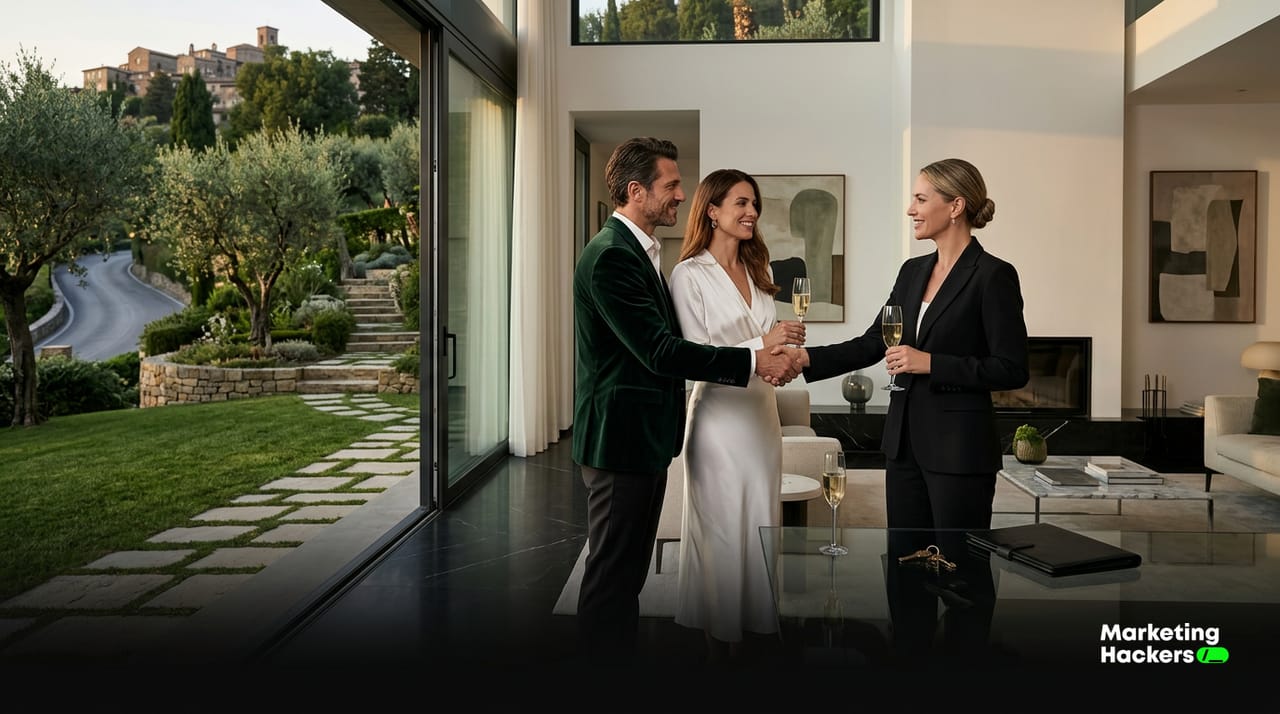
Portals live on being found. Immobiliare.it and LuxuryEstate exist because they pull together thousands of listings and win on search. One study looked at six years of data (2017–2023) from three residential portals to see how much that traffic weighs. Listings drew around 16.7 million visits a month, compared with 13.4 million for the editorial articles on the same sites. The same study found that the tone of the content affected how many people showed up. 1
That tells you two things. First, you won’t beat a portal on search volume, and you shouldn’t be trying to. Second, the way you write matters as much as what you show. When you sell fifteen villas a year, you’re working on trust. Leave the catalogue to the portals. Your own site is where a buyer checks whether you’re the right person to handle a confidential, multi-million-euro deal.
| Listings portal | Your own luxury site | |
|---|---|---|
| What it sells | Visibility, volume of listings | Trust, belonging, local expertise |
| Who owns the contact | The portal (you pay per lead) | You, from first click to first meeting |
| What it says | ”Here’s every house for sale" | "Here’s how we work and who we are” |
| What it measures | Listing clicks, generic enquiries | Lead quality, enquiries about a specific property |
A luxury real estate website tells the story of a handful of properties in documentary-level detail, and it screens anyone who asks for a viewing. Portals generate contacts. Your own site generates better deals.
How people actually buy a luxury villa
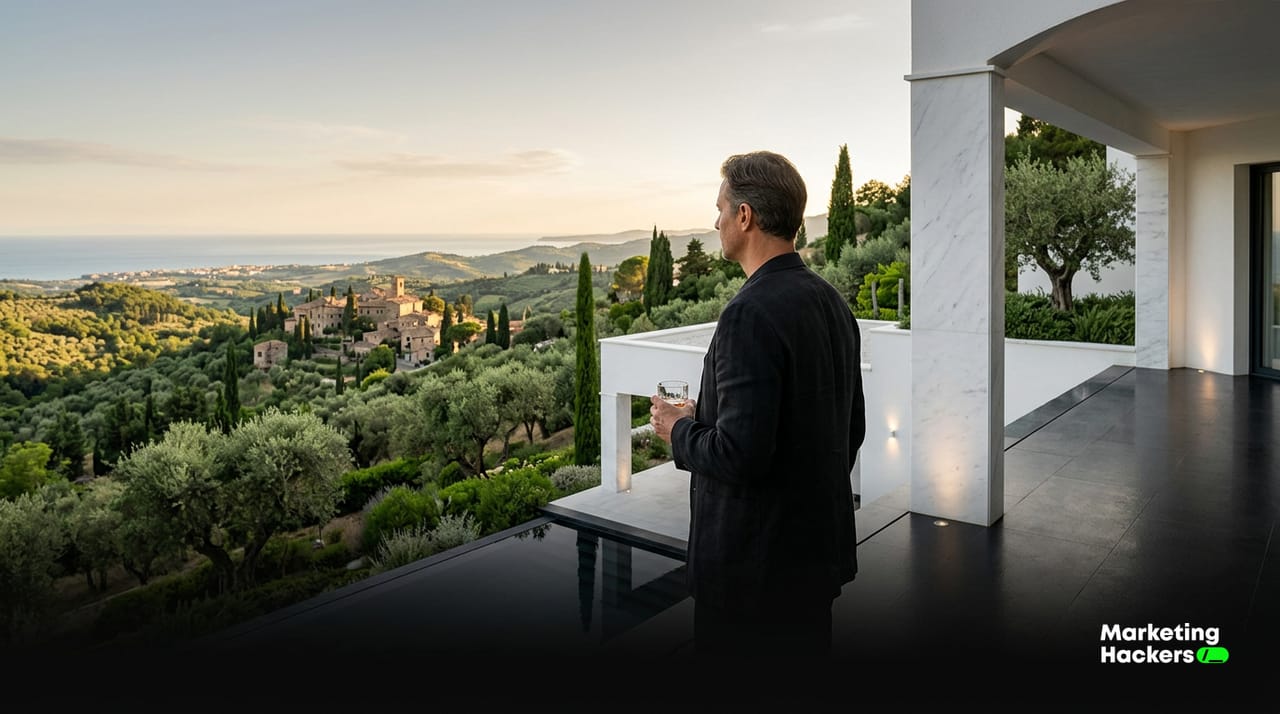
Someone spending three million on a home goes through four stages, and the website has a different job at each one. Treat them like a studio-flat buyer, with pushy calls to action and a nine-field form, and you’ll lose them at the first stage.
| Stage | What they’re asking | What the site needs to show | What you measure |
|---|---|---|---|
| Quiet discovery | ”Who is this agency?” | Who you are, villas you’ve handled, a few chosen references | Direct visits, time on the “about” page |
| Immersion | ”What’s it like to live here?” | Light, views, a typical day, the village around it | Scroll completion, videos watched to the end |
| Due diligence | ”Is everything in order?” | The property’s history, planning restrictions, documents on request | Downloads of private dossiers |
| Private enquiry | ”Who do I talk to?” | A real person to contact, not an endless form | Qualified enquiries, meetings booked |
At the discovery stage, the buyer lands on your site to check you out, often after a tip from an adviser, a family office or a friend. They almost never come from a cold search. That’s why the page introducing the agency and its past deals matters more than the homepage.
At the immersion stage, the buyer wants a feel for the place: the morning light, the cicadas in July, how far it is to the restaurant they’ve been going to for twenty years. The square metres come later. This is where Philip Kotler’s point about positioning, repeated for decades, comes in: people buy the meaning they give a product. A luxury villa means a way of life, and the site has to show that before it starts listing features.
Luxury also flips the usual rule on social proof. Two hundred five-star reviews look suspicious here. What works is three very strong references, anonymised if discretion calls for it, plus one hard number about your work. That could be the average time from mandate to completion, the ratio between asking price and final price, or how many deals you’ve closed with overseas buyers. Use a few pieces of proof, and make each one count.
How to structure a luxury villa website that works
The order of the sections matters more than the design. The sequence below follows the way a buyer thinks, and you can reuse it as a template on every new project.
Open with a single featured property, not a grid. Use a short opening video, eight to ten seconds, showing the entrance, the view and one close-up of a material (the stone, an old floor, the water in the pool). Then comes the scrollytelling for the property. The buyer scrolls and the house reveals itself room by room, as if they were walking through it.
Immersive experiences hold attention in a way still images can’t. An academic review of virtual reality in marketing reports that augmented reality campaigns average 75 seconds of dwell time, against 2.5 seconds for traditional radio and TV ads, and that 71% of shoppers would buy more often from brands offering these experiences. 2 That figure shows a well-built experience keeps the right people around, and you don’t need to load the site with effects to get there.
Be careful with 3D virtual tours, because the research cuts them down to size. A Harvard Business School study of 75,178 homes sold in the Los Angeles area between March 2019 and March 2021 found that virtual tours, used in 22% of listings, raised prices by 1.1% when the quality of photos and descriptions wasn’t taken into account. Once researchers controlled for that quality, the effect on the final price was no longer statistically significant. 3 Sellers who paid for a virtual tour simply put more care into everything else too.
So a tour is mainly a filter. The same research notes that it helps buyers rule out what they don’t want, so they turn up to the viewing already sold. 3 For a luxury villa, that means sparing the owner pointless viewings and protecting their privacy. A tour costs anywhere from about $300 (just under €280 at the current rate of roughly €0.92 to the dollar) to several thousand for a large home shot by a professional. 3 Use one where it helps qualify a buyer who’s far away. Skip it when you really need to get the person through the door.
The structure ends with documents and contact details. Offer a dossier on request (floor plans, planning restrictions, land registry history) and a direct contact with a name, photo and phone number. The tech stack and pricing build on the same foundations as premium cinematic website design, the main guide this vertical grows out of.
A website for one villa as a launch tool
When you launch a major residence, an agency site with a catalogue works against you. A five-million-euro estate ends up in the same grid as an €800,000 apartment and stops looking special. The answer is a single-property microsite: a one-property site on its own domain or subdomain that tells the story of one house.
The scroll sequence of a microsite follows a clear narrative. Start with the location from above, a drone descending towards the property. Then the arrival: the driveway, the gate. Then the interiors, in the order you’d show them if you were taking a buyer round in person. Near the end comes the life around it: the village, the wineries nearby, the sea twenty minutes away. Close with a low-key invitation to request full access.
This format has a clear commercial advantage. The microsite becomes the one link you send to the overseas adviser, the family office or the specific buyer you’ve identified. It’s a clean, elegant URL that says “exclusive” far louder than listing no. 4,812 on a portal. A project like this carries real weight in the budget, like any quote for a luxury real estate site.
Overseas buyers: language, currency and remote viewings
In Italy’s luxury market, a large share of buyers come from abroad, and for them the website is often the only contact before they travel. Premium estate agency web design that ignores this audience cuts out half the demand.
You need three practical things. First, language: an English version that’s properly written, not pasted out of a machine translator. Second, currency: show the price in dollars or pounds where it makes sense, and state the exchange rate. Third, remote viewings: let buyers book a guided video viewing at a time that suits their time zone, with an agent taking them room by room, live. That’s worth far more than a recorded tour, because it puts a person in the room.
This is where AI speeds up a process that stays yours. For translation, use a tool like DeepL for the first draft, then have a language model adapt the tone with a precise prompt instead of publishing the raw output:
You are a native English copywriter specialising in luxury real estate.
Rewrite this description of a Tuscan villa for an affluent US buyer.
Keep the facts unchanged. Make the tone understated and evocative, avoid
empty superlatives, use concrete imagery (light, materials, landscape).
Max 180 words. Italian text: [paste].
A person always rereads the result. AI saves you the first hour, but the final call is still yours.
Handling confidentiality and off-market properties
Many luxury villas sell with no public address and no published price, and sometimes the neighbours never find out the owner is selling. The site has to show without giving the game away.
In practice, that means properties that only appear after an access request, photos that don’t reveal the exact location, “price on request” and a private tier that opens after some basic qualification. That threshold filters for real interest. A serious buyer will happily fill in three fields to see a private dossier, and those three fields already tell you who you’re dealing with.
Here AI handles the qualifying. You can have incoming enquiries analysed with a prompt that sorts them before an agent opens them:
Act as an assistant to a luxury real estate agency. Analyse this
enquiry and classify it: 1) seriousness (high/medium/low) with reasons;
2) signs of a budget consistent with the property requested;
3) questions the agent should prepare for. Enquiry: [paste form].
That way the agent goes into the call knowing where to focus their time, and no valuable lead sits in the queue behind someone who’s just browsing.
A performance checklist for video-heavy sites
Opening videos, scroll animations and virtual tours are heavy, and a slow site kills any sense of luxury before the content even loads. Someone who clicks through from a listing and gets a page that stutters will close it and won’t come back.
Keep an eye on a few practical points. Compress the opening video and serve it in a modern format, with a high-quality still that appears straight away while the video loads. Load images only as they scroll into view. Stay within Google’s official Core Web Vitals thresholds, which still apply to a visually rich site. Always test on mobile before desktop, because a buyer’s first look almost always happens on a phone. The more technical side overlaps with what a cinematic website costs, from stack to timelines.
The same method works for neighbouring verticals, from luxury hotel websites to websites for premium wineries. The subject changes, but the logic holds: tell a few stories in depth and make them load fast. You can see how we direct this format in the work of our design team.
A luxury agency’s website comes down to one question. After seeing it, does the buyer get in touch because they understand who you are, or do they go back to scrolling the portal like everyone else? Build it around how that buyer actually decides, and the quality of your enquiries will tell you whether it’s working.
Fonti
Footnotes
-
Exploring the Power of Content and Visitor Sentiment: A Study of Web Traffic Dynamics in South Africa’s Residential Real Estate Landscape. doi.org ↩
-
Virtual Reality in Marketing: A Framework, Review, and Research Agenda. frontiersin.org ↩
-
Are Virtual Tours Still Worth It in Real Estate? Evidence from … library.hbs.edu ↩ ↩2 ↩3
FAQ
Can a luxury real estate agency stop using property portals?
Portals are still worth keeping for visibility and search volume, which your own site can't match. A luxury website does a different job: it builds trust and qualifies enquiries. You need both. The portal brings in leads, and your own site turns them into better deals.
Why shouldn't a high-end agency website look like a property portal?
A portal works on aggregation and volume. An agency website works on trust and local expertise. Someone looking at a multi-million villa checks who is offering it and how discreet they are. A grid you can filter by price and number of bathrooms is the wrong format for that kind of buyer.
How do luxury villa buyers behave before contacting an agency?
They go through four stages: quiet discovery (who is this agency?), immersion (what is it like to live there?), due diligence (paperwork and compliance) and a private enquiry (who will I be dealing with?). They often reach the site to check the agency out after a referral from an advisor, a family office or word of mouth.
What should a luxury real estate website measure?
Lead quality, not generic clicks on a listing. Look at time spent on the About page, scroll depth and completed videos, downloads of private property dossiers, enquiries about specific properties and viewings booked. The goal is better deals, not more contacts.
Does a long enquiry form help generate leads for luxury villas?
No. If you treat a multi-million buyer like someone renting a studio flat, with pushy calls to action and nine fields to fill in, they'll leave at the first step. A private enquiry needs a human point of contact, not a long form.