Premium Website Quote: What It Should Include (and What It Shouldn't)
Judge a premium website quote by its scope, not the total: scenes, assets, revision rounds and licenses spelled out. Here's what to insist on before you sign.

Two PDFs sit on your desk, both quoting for the same website. The first fits on eight lines and ends with a nice round total. The second runs to four pages and lists twelve scenes, three revision rounds and the licence for every video clip. The first looks like the better deal until you’re halfway through the project and an email lands saying “mobile animations are an extra”. Judge a quote for a premium brand website by the scope it describes first, and only then by the number at the bottom.
This is a checklist to keep open next to the supplier’s document. It covers what has to be there, which lines deserve a phone call, and which ones you should get removed before you sign.
By a premium site we mean one built in scenes, with video, scroll-driven animation and visual direction designed around the brand, like the cinematic premium websites for brands. The price ranges for a cinematic website depend on the line items below, so it pays to understand the items before you look at the figures.
Why a quote for a premium website is different from one for a brochure site
On a brochure site, cost tracks the number of pages and templates. Five pages, a contact form, a blog. The line items are close to standard, and you can compare two offers in a few minutes.
On a premium site, cost tracks scenes, assets and interactions. Hosting, domain and SSL certificate are still in there, but they’re a small slice of the total and rarely cause trouble. The risk hides in vaguely worded creative items. “Advanced animations” or “immersive experience” describe nothing you can check once the work is delivered, and anything you can’t check, you can’t dispute either.
There’s a concrete reason to insist on precision here. A study published in the International Journal of Human–Computer Interaction points out that a website is often the first or only point of contact between a customer and a company, and that decisions take shape in the first few seconds of browsing. The positive effect on trust grows when the site’s design extends and complements the logo.1 Research on the hotel sector reaches a similar conclusion by another route: perceived website quality builds trust, and trust raises purchase intention.2 Those first few seconds are what you’re paying for. The quote should tell you what they’ll be built from.
Then there’s the gap between an estimate and a quote. An estimate is a guide the supplier can revise, so get it in writing which parts are fixed. On premium sites the creative scope is the first thing to drift, because a scene marked “to be defined” could take a few hours or several weeks. Ask for the document to state clearly what’s fixed-price, what’s billed by the hour, and which events reopen the price.
In one line. Read a premium website quote scene by scene and asset by asset. If a creative item isn’t described well enough to test at sign-off, have it rewritten before you sign.
What a quote for a premium website must include
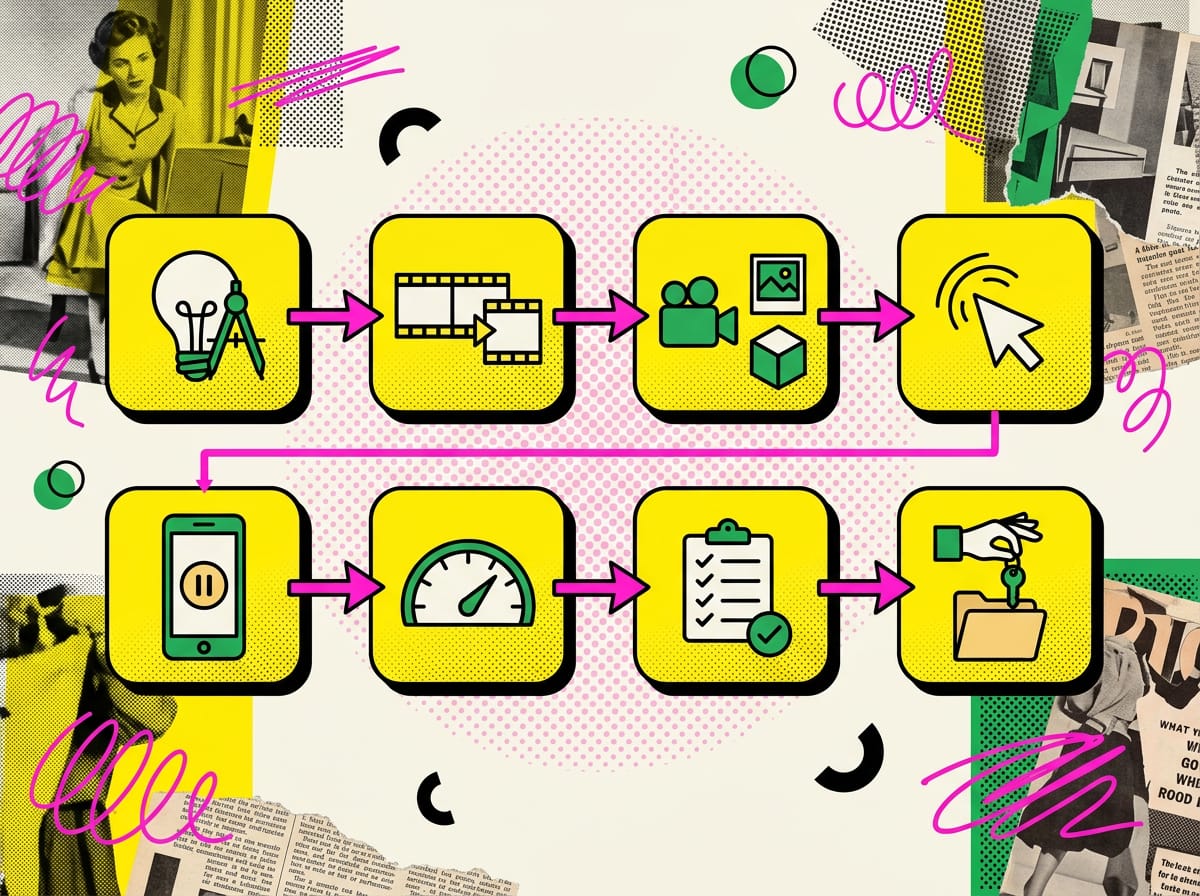
A complete offer for a brand site with visual direction covers at least these eight blocks:
- Discovery and creative direction. Goals, brief, moodboard, number of directions presented, revision rounds per phase.
- Storyboard and scene copy. Number of scenes, who writes the text, what’s left to you.
- Assets. Video, photography, 3D and audio, whether produced or bought, with formats and licences.
- Interaction build. A scene-by-scene list of animations.
- Mobile and reduced motion. What changes on phones and for people who switch animations off.
- Performance, technical SEO and accessibility. Written, measurable thresholds.
- Acceptance testing. Sign-off criteria before the final payment.
- Handover and support. Source files, logins, ownership, post-launch support.
Discovery and creative direction
This is where you find out how much room you have to change your mind. A good offer says how many creative directions you’ll see (one, two, three) and how many revision rounds each phase includes. “Revisions included” with no number sounds generous, and by round three it’s an argument.
Make sure discovery covers your customers, too. A study of small businesses found their websites hold attention worse than those of large companies, partly because designers focus on usability and overlook visitors’ psychological and cognitive needs.3 If discovery means only “competitor analysis and sitemap”, the part that decides whether the site persuades anyone is missing.
Storyboard and scene copy
You design a cinematic site the way you’d plan a short film. The quote should state how many scenes are planned, because six scenes telling the story of woodworking at a furniture maker cost one thing and fourteen cost another. It should also say who writes the copy for each scene. If the text is “supplied by the client”, expect your marketing manager to spend a good while writing tiny lines that have to hold their own on top of video.
Assets: video, photography, 3D, audio
This item inflates or deflates a project more than any other. The document should separate original production from stock, state how many shoot days or clips are planned, who handles post-production, and which formats you’ll receive. Ask outright for vertical and square cuts for social and ads. Shooting them on the same set costs little; going back for them later means a new shoot.
On luxury real estate websites, property footage can outweigh the build, and that’s where a well-written quote shows itself straight away. Every asset needs its licence listed next to it. More on that below, because it’s the part that does the most damage a year down the line.
Custom build and animation
Replace every “custom animations” with a list. For example: in scene 1 the video plays as you scroll, in scene 2 the text appears line by line, in scene 3 the 3D bottle model rotates. With a list like that you can test each scene at sign-off, and trust stops being your only guarantee.
Two lines often go missing. The first is the mobile version. On a phone some scenes need simplifying or rethinking, and the quote should say whether that’s an automatic adaptation or dedicated work. The second is how the site behaves when the system-level reduced-motion setting (prefers-reduced-motion) is on, which people who get motion sickness from animation rely on. Add the list of supported browsers, with versions.
Performance, technical SEO and accessibility as requirements
A video-heavy site that takes too long to show anything throws away all the direction work. Put performance in the quote as measurable requirements. Ask for written thresholds on how fast the main content loads, responsiveness and page stability, and for those thresholds to become acceptance criteria on both mobile and desktop.
Technical SEO needs concrete items: metadata for every page, structured data, a sitemap, and redirects from old URLs if you’re rebuilding an existing site. For accessibility, ask which WCAG conformance level the supplier commits to. If the answer is “we’ll look at it later”, you already know how that ends.
Handover and post-launch support
The offer should list what you get when the work is done: hosting and domain logins in your name, code in a repository you own, design and animation project files, and the video source files. It should also say who worked on the project and in what role. Our Design Team is listed by name and role for the same reason: knowing who’s touching your site is part of the scope.
Who owns the site, the code and the assets once it’s done
A domain registered in your name is the bare minimum. On a premium site, ownership also covers the code, the animation source files, the design files, the full footage (outtakes included, if you want them for social) and the 3D models.
The Graphic Artists Guild Handbook, a standard reference for graphic design and illustration professionals, gives guidance on writing contracts that protect creators’ rights and includes sample contracts.4 For the buyer, the practical point is simple. If the quote doesn’t say who the code and source files go to, ask for it in writing before you sign.
Asset licences deserve their own table in the document. For every font, stock clip, music track and 3D model you need four things:
- who holds the licence (you or the agency);
- how long it runs and whether it needs renewing;
- which channels it covers (website only, social too, paid ads too);
- what happens if you change supplier.
Take a typical case. The licence for the background track on the hero is in the agency’s name, runs for one year and covers web use only. Eighteen months later you use it in a Meta campaign and get a claim. Nobody did anything wrong. One line was missing from the quote.
How do you test a premium site before paying the final invoice?

Acceptance testing is where you check the site matches what was promised, and the quote should set out how it works. Write an acceptance checklist with testable criteria, a testing window (ten working days, say) and a rule that the final payment is due only once the site passes.
A minimum checklist for a premium site covers:
- the agreed browsers and devices, including at least one iPhone and one mid-range Android;
- every storyboard scene present and working as described;
- performance thresholds met on mobile and desktop;
- correct behaviour with reduced motion switched on;
- forms delivering messages to the right inbox and to the CRM;
- analytics and conversion tracking live;
- redirects from old URLs working without errors;
- alt text on images and keyboard navigation.
This is where AI speeds up a tedious job. Once the storyboard is approved, upload it to Claude or ChatGPT and use this prompt.
“You’re a project manager who has to run acceptance testing on a website. I’m attaching the approved storyboard and the ‘build’ section of the quote. For each scene, write one checklist line stating what should happen, which device to check it on, and how to tell whether the test passed or failed. Flag any scenes described too vaguely to be tested.”
You’ll need to review the output, but within minutes you have a draft checklist to attach to the contract.
The three-year cost, line by line
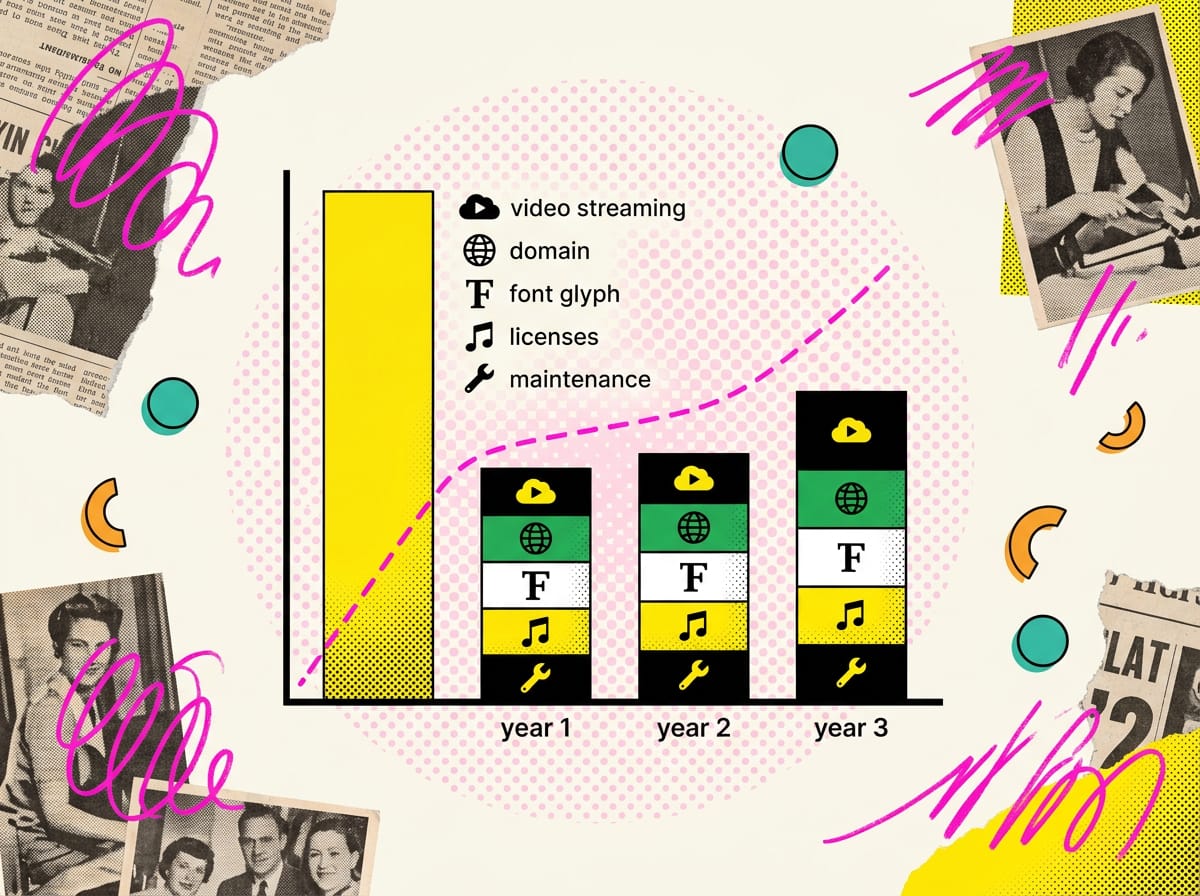
The total on a quote is almost always a one-off figure. A premium site carries higher running costs than a brochure site, because video streaming eats bandwidth, licences expire and animation libraries need updating. Ask the supplier to fill in this table and compare offers on the three-year total.
| Item | One-off | Year 1 | Year 2 | Year 3 |
|---|---|---|---|---|
| Project (design, assets, build) | ||||
| Hosting and video delivery (CDN) | ||||
| Domain | ||||
| Renewable font licences | ||||
| Time-limited stock and music licences | ||||
| Maintenance and technical updates | ||||
| Block of hours for changes | ||||
| Performance monitoring | ||||
| Total |
If a supplier won’t fill it in, treat that as useful information.
What shouldn’t be in a quote for a premium business website
Some lines need removing or rewriting before you sign, because they protect only one side.
“SEO” packages with no deliverables. “SEO optimisation included” tells you nothing. Ask for a list of what’s delivered: metadata, structured data, sitemap, redirects. If no list turns up, the item is worth zero.
Animation hours with no scenes. “40 hours of motion design” shifts the risk onto you. Once the hours run out, every missing scene becomes an extra.
Retainers with lock-in. A monthly fee covering hosting and maintenance is fine. It turns into a problem when the site runs on the agency’s proprietary platform and you can’t export the code. Ask what you’re left holding if you stop paying.
Unexplained set-up fees. Lines like “set-up” or “project activation” with no description are margin in disguise. They can be legitimate, but they need to contain something.
Unlimited revisions. They sound great, but they usually mean nobody ever put a number on the scope, and that kind of scope ends in an argument.
“Content supplied by the client” at the bottom, in small print. Copy, photos and video are the heart of a premium site. If they’re on you, the quote should say so up front, with delivery deadlines.
When choosing between scrollytelling agencies in Italy, how they work matters too. This guide deals with the document already in your hands.
Using AI to read and compare two quotes
The process is still manual at its core. You pull out the line items, compare them, list what’s missing and draft your questions. AI handles the extraction and comparison far faster than doing it by hand.
Before uploading anything, strip out personal details and bank information. Then use Claude or ChatGPT on one offer at a time, or NotebookLM if you want several PDFs in the same project and to query them together.
Prompt 1, extraction.
“I’m attaching an agency’s quote for a premium website with video and animation. Pull every line item into a table with these columns: item, description, quantity (scenes, clips, revisions, hours), one-off cost, recurring cost, and what’s explicitly excluded. If an item has no quantity or is described in generic terms, write ‘NOT DEFINED’. Don’t invent items that aren’t in the document.”
Prompt 2, checking against the checklist.
“Here’s the eight-block checklist a premium website quote must cover. [paste the list of eight blocks] Compare the table you extracted against the checklist. For each block, say whether it’s covered, partly covered or missing. For partly covered blocks, say what’s missing.”
Prompt 3, comparing two offers.
“You’ve extracted the line items from two quotes, A and B. Build a line-by-line comparison table. Highlight items that appear in only one of the two and items with different quantities. Leave the choice to me. Tell me which scope differences explain the price gap and which remain unexplained.”
Prompt 4, questions for the supplier.
“Based on the ‘NOT DEFINED’ items and the missing blocks, write a polite, direct email to the supplier with no more than ten numbered questions. Each question should ask only for a number, a list or a written confirmation.”
That last prompt is the one that saves the most money. The supplier’s answers become an annex to the contract, and a serious agency will be happy to answer, because the same questions protect them too. Reading the contract itself is still a job for a lawyer. For clauses on ownership, termination and penalties, a professional review costs less than a dispute.
Sources
Footnotes
-
A Picture is Worth a Thousand Words: Source Credibility Theory Applied to Logo and Website Design for Heightened Credibility and Consumer Trust. scholarsarchive.byu.edu ↩
-
The Impact of Website Quality and Perceived Trust on Customer Purchase Intention in the Hotel Sector: Website Brand and Perceived Value as Moderators. doi.org ↩
-
Improving the Website Design Process for SMEs: A Design Science Perspective. aisel.aisnet.org ↩
-
Graphic Artists Guild Handbook, 16th Edition: Pricing & Ethical Guidelines. play.google.com ↩
FAQ
Why is a premium website quote different from a standard brochure site quote?
On a standard brochure site, cost is driven mainly by the number of pages and templates, so the line items are fairly standard. On a premium site, cost is driven by scenes, assets and interactions, while hosting, domain and SSL barely move the total.
What's the difference between a website estimate and a website quote?
An estimate is a ballpark the agency can revise. A quote accepted in writing commits both sides to a price and a scope, so it should state what is fixed-price, what is billed hourly and which events reopen the price.
How do I spot a vague line item in a premium website quote?
Phrases like "advanced animations" or "immersive experience" describe nothing you can check once the work is delivered. If a creative line item isn't specific enough to sign off against, have it rewritten before you sign.
What line items should a quote for an art-directed brand website include?
It should cover at least eight blocks, starting with discovery and creative direction (goals, brief, moodboard, proposed directions, revision rounds) and storyboard and copy for each scene. Every block should be described clearly enough to be checked at delivery.
Why insist on precise creative line items in a website quote?
Your website is often the first, or only, touchpoint between a customer and your company, and impressions form in the first few seconds. Research shows that perceived site quality builds trust, and trust drives purchase intent.
Which parts of a premium website quote are most likely to go over budget?
Creative scope slips first, because a scene marked "TBD" can mean half a day or three weeks. Mobile animations are another risk: if they aren't spelled out, they tend to resurface mid-project as an extra.