
How to Calculate CAC: Formula, Worked Example and Excel Template
Learn how to calculate customer acquisition cost the right way: full formula, a worked example from a small business, and a spreadsheet layout to copy.

You know what you spend on marketing every month. What you probably don’t know is what each new customer costs you. This article gives you three things you can use straight away: the formula, a fully worked example from an Italian SME, and a ready-made Excel sheet you can download and fill in. CAC, or customer acquisition cost, is the average amount you spend to turn a stranger into a paying customer. For the full definition and the background, read the CAC formula article. Here we go straight to the method: which numbers to pull, where to find them, and which cell each one goes in.
What is the CAC formula?
To get CAC, add up all your marketing and sales costs for a period and divide by the number of new customers you won in that same period. There is only one basic formula, and it never changes. Small businesses get it wrong in two places: what they put on top and who they count underneath.
CAC = (Costi di marketing + Costi di vendita) / Nuovi clienti acquisiti nel periodo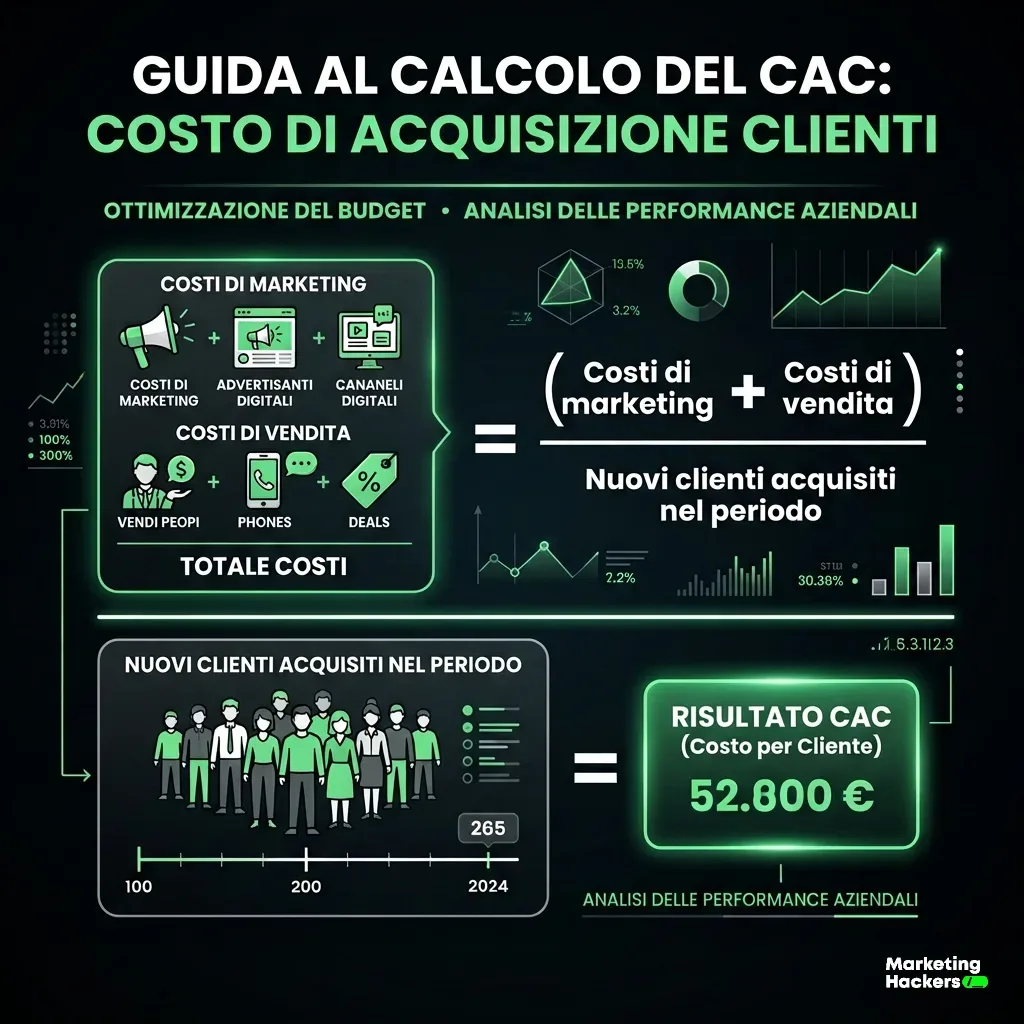
The one rule you can’t break is matching the periods. The top and bottom of the fraction have to cover the same stretch of time. If you take costs from Q1, count the customers you won in Q1. A month, a quarter or a year all work, as long as it’s the same above and below the line.
The formula comes in two versions. The basic version counts only direct ad spend, and it’s fine for a quick estimate. The full version adds staff, tools and consultants, and it shows you the real cost. The sections below build the full version, because it’s the only honest one. And don’t mix up CAC with cost per lead or cost per action. We cover the difference in CAC vs CPA, so we won’t go over it again here.
Which costs go in the numerator?
The numerator holds every cost you incur to win customers, in four buckets: advertising, tools and software, staff, and consultants. The rule of thumb is simple. If a cost exists to bring in new customers, it goes in. In-house staff time is the line almost every small business leaves out, and it’s the one that distorts the result most.
| Cost item | Include it? |
|---|---|
| Ad spend (Google Ads, Meta, LinkedIn) | Yes, in full |
| Tools and software (CRM, automation tools, subscriptions) | Yes, the share used for acquisition |
| Sales and marketing staff | Yes, pro rata to time spent on acquisition |
| Consultants and agencies (SEO, advertising, design) | Yes, in full |
| Cost of producing the product or service | No. That’s cost of goods sold |
| Post-sale customer support | No. That’s retention |
A few grey areas come up in every small business, so settle them now. If the owner also does the selling, their pay goes in, but only pro rata. If they spend 30% of their time closing deals, you count 30% of what they cost. Website and brand costs depend on how you amortise them. A new €8,000 website you’ll use for three years doesn’t all land on one quarter; you spread it out. Welcome discounts and first-purchase coupons go in at full value, because they’re money you pay to win that customer.
HubSpot’s startup example uses exactly these items. It counts the share of the CRM used for sales (50% of a $3,000 quarterly cost, so $1,500, ≈ €1,380 at roughly €0.92 to the dollar) and the founder’s time spent selling, valued by the hours they put in.1 The takeaway is plain: people’s time is an acquisition cost, even when no invoice gets paid.
Which customers go in the denominator?
The denominator counts only new paying customers won in the period. Leads don’t count, quotes sent don’t count, and newsletter sign-ups don’t count either. Someone who left an email address but hasn’t bought anything yet isn’t a customer. Count them and you’ve worked out a cost per lead and labelled it CAC, which is the most common mistake of all.
People mix up leads and paying customers so often that we wrote a separate article on it: CAC vs CPA. For CAC, one rule is enough. No payment, no count.
Two practical cases are left. The first is the reactivated customer who comes back after a long gap. In practice, count them as new only if they return after 12 months or more of silence, because winning them back took fresh marketing effort. Under 12 months it’s retention, and they stay out of the denominator.
The second is long sales cycles, which are normal in B2B. If you spend the money in January and the customer signs in March, putting those costs in the wrong month skews everything. The easy fix is to think in cohorts: group customers by the period when you spent money to win them, and ignore the period when they signed. With an average two-month sales cycle, your Q1 CAC sets January–February costs against customers who closed in March–April. You don’t need to be accurate to the day. You do need to use the same method every time.
Worked example: CAC for a B2B SME with €1.2M revenue
Take an Italian B2B services company turning over €1.2M and work out its CAC for one quarter. With every real cost in the numerator (advertising, tools, pro-rata staff time and consultants), total spend comes to €12,150. With 9 new customers won, CAC is €1,350 per customer. Here’s the marketing P&L, line by line.
| Cost item | Amount (quarter) |
|---|---|
| Google Ads | €4,500 |
| LinkedIn Ads | €1,800 |
| Tools and CRM | €600 |
| 30% of one salesperson’s time | €3,750 |
| SEO consultant | €1,500 |
| Total acquisition costs | €12,150 |
| New customers acquired | 9 |
| CAC | €1,350 |
Now look at what the wrong calculation gives you, the one most companies run. Count only advertising (€4,500 + €1,800 = €6,300), divide by 9 customers, and you get a CAC of €700. That’s barely half the real figure, and it explains a lot. The company thinks each customer costs €700 when they actually cost €1,350, so every pricing or budget call made on the wrong number is the wrong call.
CAC on its own won’t tell you whether you’re doing well. A €1,350 CAC is excellent if each customer is worth €15,000 to you over time, and a disaster if they’re worth €1,000. To read it properly, compare it with what a customer is worth over the whole relationship, which you get from Customer Lifetime Value. To see how CAC fits into a joined-up set of metrics, the pillar article how to calculate CAC brings all the pieces together.
How do you break down CAC by channel?
A blended CAC hides your losing channels inside the average. To find them, calculate CAC for each channel separately: add up each channel’s direct costs, then split shared costs proportionally. Without that breakdown, a channel bringing in customers at €3,000 each stays out of sight, covered by another one bringing them in at €400.
There are two steps. First, separate out each channel’s direct costs: Google Ads spend goes to Google Ads, LinkedIn spend to LinkedIn, the SEO consultant to organic. Then share out the common costs (the salesperson’s pay, the CRM, tools used across the board) using one rule and sticking with it, based either on customers generated per channel or on budget spent. In B2B, sales costs make up a large part of total acquisition cost, so you can’t ignore them or spread them at random.
None of this works without one rule: make the “source” field in your CRM mandatory. Every new customer needs a record of where they came from. Without it you can’t assign them to a channel, and the breakdown falls apart. This article covers the method. The side-by-side comparison of Google Ads, Meta, SEO and email, with typical CAC figures for each, is in the dedicated article in this cluster.
How is the CAC Excel sheet set up?
The sheet has three tabs that keep raw data apart from the result: Tab 1 for cost inputs, Tab 2 for customers won, Tab 3 for the output, which calculates itself. You only update the first two and read your CAC on the third without touching a single formula.
Here’s the layout. In Tab 1 - Costs there’s one row per category (advertising, tools, staff, consultants) and one column per month; staff go in at their pro-rata share, not full cost. In Tab 2 - Customers you log new paying customers by month and by channel. Tab 3 - Output shows three figures that update automatically: total CAC, CAC by channel and the monthly trend.
Using it takes three steps. First, at the end of each month, paste your spending into Tab 1. Second, update the customer count in Tab 2 using the “source” field from your CRM. Third, read Tab 3, where CAC is already split by channel and over time.
This download is free with a Marketing Hackers account (the same one that unlocks full guides and AI tools).
The sheet comes pre-filled with the numbers from this article’s example (€12,150 in costs, 9 customers, €1,350 CAC), so you can see where each item goes before you swap in your own.
The slow part of all this is sorting your expenses into categories, and that’s where AI saves you hours. You still own the process, since you chose the formula and the inclusion rules; AI just speeds up the sorting. Export your expenses from your accounting software and give an AI assistant such as ChatGPT or Claude this prompt:
“Here’s an export of my expenses for the last 3 months [paste list]. Put each item into one of these categories: advertising, tools/software, sales and marketing staff, external consultants, or NOT RELEVANT to CAC. For any ambiguous item, give me the reasoning in one line so I can decide whether to include it.”
A few seconds later your expenses are sorted into the four numerator buckets, ready to paste into Tab 1. You check the borderline items while the AI handles the grunt work.
What are the most common calculation mistakes?
The mistakes that throw CAC off are nearly always the same six, and each one has a clear fix. The most expensive is counting only ad spend, which on its own badly understates CAC, as the example showed. Here’s the list, with what each mistake does and how to fix it.
- Counting only ad spend. Badly understates CAC and leads to bad pricing decisions. Fix: add staff, tools and consultants to the numerator.
- Mismatched periods for costs and customers. Gives you numbers that mean nothing. Fix: use the same time window above and below the line, every time.
- Putting leads in the denominator. You end up with cost per lead and call it CAC. Fix: count paying customers only; the difference is explained in CAC vs CPA.
- Ignoring in-house staff costs. The owner’s and salespeople’s time drops out of the sum. Fix: include it pro rata, based on hours spent on acquisition.
- Not breaking it down by channel. A losing channel stays hidden in the average. Fix: calculate CAC channel by channel, with shared costs allocated.
- Misreading what CAC tells you. You risk cutting a high-CAC channel that brings in very high-value customers. Fix: always read CAC against customer value, never on its own.
On that last point, one figure is worth remembering. A 2026 study of 127 US DTC brands, tracked over 18 months across 5 product categories, found that brands growing mainly through organic channels had a median CAC 41% lower and a lifetime-value-to-cost ratio (LTV:CAC) of 4.2, which is 2.4 times that of brands reliant on paid advertising.2 For a small business, that means a higher CAC on paid channels is fine as long as an organic channel pulls the average down and holds up customer value over time. Without that organic channel, it becomes a problem. Calculating CAC properly, broken down by channel, is how you see that gap in your own numbers rather than in someone else’s study.
Further reading
Sources
Footnotes
-
HubSpot — How to Calculate Customer Acquisition Cost for Startups. hubspot.com ↩
-
Customer Acquisition Cost Optimization: A Comparative Study of Paid Versus Organic Growth Strategies in Direct-to-Consumer Brands. doi.org ↩
FAQ
What is the formula for customer acquisition cost?
Divide your total sales and marketing costs for a period by the number of new customers acquired in that same period. The formula is: CAC = (Marketing costs + Sales costs) / New customers acquired.
Which costs should I include when calculating CAC?
Four types of cost go in: advertising (in full), tools and software (the share used for acquisition), sales and marketing staff (pro-rated by time spent on acquisition) and agency or consulting fees (in full).
Do production costs and customer support count toward CAC?
No. Production costs belong to cost of goods sold, not acquisition. Post-sale customer support is a retention cost, so it stays out of your CAC calculation too.
Should I include the owner's salary in CAC if they also handle sales?
Yes, but only pro-rated. If the owner spends 30% of their time closing new customers, include 30% of their cost, not their entire salary.
How do I handle website and branding costs in CAC?
It depends on how you amortize them. An investment like an €8,000 website you'll use for three years shouldn't be charged to a single quarter: spread it across the period it's actually in use.
Why is internal staff time the most important cost not to forget?
It's the cost almost every small business forgets, and it's the one that skews the result the most. Leaving out the time your team spends on acquisition gives you an artificially low CAC that doesn't reflect reality.