Blog Post Brief Template: 14 Fields to Delegate Without Rewrites
The 14 fields every blog post brief needs, a copy-paste template and a checklist to hand articles to freelancers or juniors without rewriting them.

On Tuesday you send the freelancer a single line: “1,000 words on predictive maintenance.” On Friday you get back a clean, typo-free piece that anyone could have written for any company in your industry. None of your data, none of your customers, none of the failures your techs see on the shop floor. On Sunday night you rewrite it from scratch, and the time you meant to save by delegating disappears into edits.
Nine times out of ten, the problem started earlier, in the article brief. Writers work with what they’re given. If they don’t know who the reader is, what the angle is or what your internal data says, they fill the gaps with whatever ranks on page one of Google.
The brief is one step in a small business’s blogging process. It comes after you pick the topic and before anyone starts writing. Below you’ll find the 14 fields that make a brief complete, how a brief for a freelancer differs from one for a junior hire, the seven mistakes we see most, a template you can copy and a checklist to run before you hit send.
An article brief is the SOP for a single piece

Definition. An article brief is the standard operating procedure for one piece of content. It spells out what to write, who it’s for, which sources to use and how the draft will be signed off. If the writer has to come back with questions before starting, the brief isn’t finished.
Your company blog SOP covers the blog as a whole: who pitches topics, who approves them, when things go live. The brief applies that process to one specific article, with one keyword, one reader and one deadline.
Sign-off criteria are the part almost everyone leaves out. When a brief explains what to write but says nothing about how the draft will be judged, you’re in for endless rounds of edits, because every piece of feedback lands on the writer as a surprise. A qualitative study of nurse managers at three hospitals in Tehran identified three ingredients of delegation that works. The first is a formal framework: a clear description of the task, the goals of delegating it and the limits of what isn’t handed over1. A good brief puts that framework in writing before a single word of the draft exists.
A brief works like a checklist, and checklists do one specific job. Research from the University of Rome Tor Vergata on checklists in aviation and healthcare describes them as memory aids that lighten cognitive load and cut the errors that come from distraction and the limits of human attention. The same research makes clear that checklists leave the user’s expertise, judgment and experience untouched2. Briefs are the same. The copywriter keeps their talent. The brief just makes sure they don’t forget the reader, the sources or the deadline.
What goes in the 14 fields of the brief, and in what order
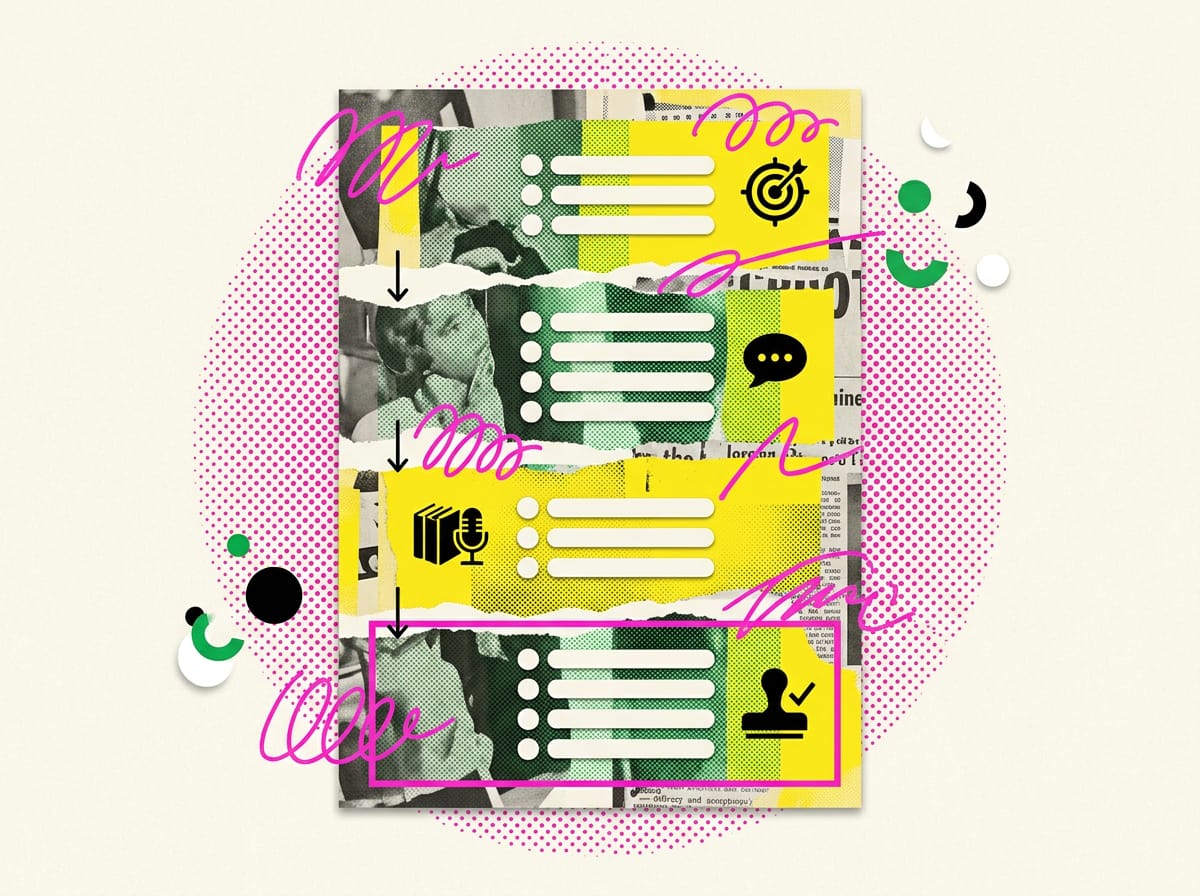
The template below has 14 fields grouped into four blocks. That’s a lot, on purpose. Atul Gawande recommends 5 to 10 items for a checklist2, and the pre-send checklist at the end of this article has nine. A brief, though, is a form you fill in. The blocks keep it readable, and a complete brief for a 2,000-word article fits comfortably on a page and a half.
Why the piece exists
- Business goal and metric. One line on what the article is for and how you’ll measure it, such as quote requests from the page or newsletter sign-ups. Line these metrics up with your company blog KPIs.
- Reader. Their role, how much they already know about the topic and what problem they have when they land on the page.
- Primary keyword and search intent. Next to the keyword, write what the searcher wants to do (understand, compare, buy). The on-page optimization in your blog post SEO checklist is built on this keyword.
What it has to say
- Questions to answer and secondary keywords. The 4-6 real questions your reader asks, pulled from customer enquiries and the SERP.
- Angle and thesis in one sentence. If you can’t write it, the writer won’t manage it either. Good blog topics come with an angle built in; here you spell it out.
- Information gain. What your company knows that the top ten results don’t say. An internal figure, a customer story, a mistake you see every month. This field is what separates an article that’s yours from a summary of the SERP.
- Outline. H2s and H3s, with a rough word count for each section.
What to work with
- Required and banned sources. List which sources are allowed (official bodies, universities, research, books) and which aren’t (agency blogs, competitors, sites with no named author), and say why.
- In-house expert and real examples. Who to interview, for how long, and which cases can be named or must stay anonymous.
- Voice. Two published paragraphs that sound right, two that don’t, and a list of banned words.
How it’s delivered and signed off
- Internal links and CTA. Which pages to link to and what you want the reader to do at the end.
- Format and length. Total word count, tables, callout boxes, images with alt text.
- Rules on the writer’s use of AI. What’s allowed (research, outlining, editing), what must be disclosed, and what’s off-limits (made-up data, quotes without a verified source).
- Sign-off criteria. Deadline, a single named approver, a cap on revision rounds (two is almost always enough) and the conditions under which the draft counts as done.
A weak brief next to a filled-in one
Take a B2B engineering firm that makes gearboxes and writes for procurement managers at its customers. The table shows five critical fields, before and after.
| Field | Weak version | Filled-in version |
|---|---|---|
| Goal | ”Build brand awareness" | "Drive quote requests for custom gearboxes. Measured by clicks on the contact form from the article” |
| Reader | ”Companies in the industry" | "Procurement manager at a packaging machinery maker who can read a spec sheet and has to justify the supplier choice to engineering” |
| Angle | ”Talk about the benefits of our gearboxes" | "List price matters less than machine downtime. The thesis: a pricier gearbox pays for itself if it halves maintenance call-outs” |
| Information gain | (blank) | “The three failures our service team sees most often on competitors’ gearboxes, told by our service manager in a 20-minute interview” |
| Sign-off criteria | ”It needs to be good" | "Only the sales director approves. Two revision rounds max. The draft is accepted if every figure has a source, it includes at least one case from the service team and it respects the banned-words list” |
The right-hand column takes a few extra minutes. Those are the minutes that spare you the Sunday-night rewrite.
How to use AI to fill in the brief
AI speeds up a brief that already has a structure. Without one, it just produces a generic brief faster. You can use Claude or ChatGPT for fields 4, 7 and 10, starting from three inputs: the transcript of your in-house expert interview (most video-call tools will transcribe it for you), the keyword, and three articles on your site that nail the voice.
Here’s the prompt for fields 4, 7 and 10.
You're a managing editor preparing a brief for an external copywriter.
Inputs: [interview transcript], primary keyword [keyword], three articles
from our site that represent the right voice [texts].
1. List 6 questions a [role] asks about [keyword], using the words
   the expert uses in the transcript.
2. Propose an outline with H2s and H3s and an estimated word count per section,
   [N] words in total.
3. Pull 2 paragraphs from the three articles that represent the voice and write
   a list of 10 words or phrases that never appear in our content.
Don't invent data: if something is missing from the inputs, write "NEED TO ASK".
Run the check prompt once the brief is finished.
Read this brief as if you were a copywriter who doesn't know the company.
List the questions you'd ask before writing. For each one, say
which field of the brief should contain the answer.
If the model comes back with more than three questions, the brief goes back for another pass. Fields 1, 5, 6 and 14 stay with you. Goal, thesis, information gain and sign-off criteria come from business decisions, and a language model can only guess at those.
Briefing a freelance copywriter vs a junior in-house writer

Send the same brief to two different people and you’ll get two different articles. Pitch the level of detail to how experienced the person is at this specific task; years in the job tell you very little. A junior who’s brilliant on social may never have written a 2,000-word SEO piece, and a freelancer with fifteen years behind them doesn’t know your customers.
Experience also changes how delegation happens. A study of 211 public employees in Jordan’s Irbid governorate found statistically significant differences in delegation practices between people with under 5 years’ experience and those with more than 163.
| Experienced freelance copywriter | Junior in-house writer | |
|---|---|---|
| Already knows | Structure, SEO basics, pacing | Product, customers, company jargon |
| Missing | Company context, real cases, brand voice | Method, structure, quality standards |
| Fields to expand | 2, 6, 9, 10 | 3, 7, 8, 12, 14 |
| Fields to trim | 7 (a rough outline will do), 12 | 2 and 9 (they already know them) |
| Type of feedback | On substance and thesis, once the draft is in | On structure, including mid-draft |
| Main risk | Well written but generic | Plenty of substance, poorly organized |
Whether to keep writing in-house or outsource it, and what each option costs, is a separate decision.
Tight brief or loose brief
Checklist research distinguishes two ways of using them2. In read-do mode, you read an item and carry it out, one step at a time. In do-confirm mode, you work from memory with some freedom over the order, then check at the end that you’ve covered everything.
Briefs follow the same logic. A junior gets a tight brief to read and execute, with a locked outline and word counts per section. An experienced freelancer gets a loose one. Thesis, reader, information gain and sign-off criteria stay fixed; the writer has a free hand on structure, provided they confirm at the end that every field is covered. The higher the stakes (a page meant to bring in quote requests, a technical topic with safety implications), the more it pays to tighten the brief even for experienced writers.
With juniors, a gradual approach helps too. On a blog, that means tight briefs for the first three articles, then loosening the constraints as the revision rounds drop.
Seven mistakes that sink a delegated article
A one-line brief gets you an article written on autopilot. Researchers at the University at Buffalo interviewed nearly 150 employees at a healthcare organization. When people see delegation as the boss’s way of offloading unwanted work, they rarely push back openly. They put in half the effort, or pretend they forgot or misunderstood the request. The authors estimate this resistance costs US companies around $50 billion a year. Their advice for delegating well: consider the nature of the task, communicate openly and make sure the employee understands your intentions, expectations and needs4. A complete brief puts all of that in writing.
These are the mistakes we see most often in briefs, each with the symptom that shows up in the finished draft.
1. The one-line brief. You get a generic intro, no examples and a word count hit through repetition. Everything is missing, starting with fields 2 and 5. The fix is simple: nothing goes out until all 14 fields are filled in. With AI, the check prompt catches it, because on a one-line brief it returns a long list of questions.
2. Keyword with no intent. You end up with an article explaining what a product is to someone who’s already comparing suppliers. Field 3 is missing. Fix it by adding one sentence on intent and two examples of results already ranking. With AI, ask: “What search intent does this outline serve? Does it match [stated intent]?”
3. No information gain. The article says what the top ten results say, in different words. Field 6 is missing. Before you open the brief, spend twenty minutes interviewing a technician or a salesperson. With AI, paste in the finished draft and ask: “Which claims in this text wouldn’t appear in any generic article on the topic?” If the answer is nothing, the draft goes back.
4. Sources left open. In come quotes from agency blogs, undated statistics and links to competitors. Field 8 is missing. Fix it with an explicit list of allowed and banned sources. With AI, have it extract every citation with its domain, then check by hand only the ones that aren’t on the list.
5. Voice described with adjectives. “Professional but friendly” turns into either flat copy or a wall of exclamation marks. Field 10 is missing, and it needs examples. Two paragraphs that work, two that don’t, plus the banned words, will do it. With AI, ask it to compare the draft against the two reference paragraphs and flag the sentences that sound off.
6. Several approvers with conflicting feedback. Sales wants more product, the owner wants less selling, and round three undoes round two. Field 14 is missing. You need one named approver who gathers everyone else’s input before replying to the writer. Washington State University’s research on time management lists, among the things to settle before delegating, who monitors progress, who reviews the results, who sets deadlines and who steps in with corrections5. With AI, you can merge comments from the different reviewers and have it list the conflicting requests, so you resolve them before passing anything on.
7. No sign-off criteria. The edits never end, because nobody knows when the draft is done. Field 14 again. Write down the conditions for closing it and the two-round cap. With AI, have it check the draft against the criteria, point by point, before you read it yourself.
Brief template to copy into Google Docs or Notion
Copy the block into a Google Doc or a Notion page and save it as a template. In Google Docs, a “Briefs” folder with a read-only master file you duplicate for each article works well.
ARTICLE BRIEF  |  Working title ______  |  Deadline ______

WHY THE PIECE EXISTS
1. Business goal and metric ______
2. Reader (role, what they know, what problem they have) ______
3. Primary keyword and search intent ______

WHAT IT HAS TO SAY
4. Questions to answer / secondary keywords ______
5. Angle and thesis in one sentence ______
6. Information gain (internal data, customer case, mistake you've seen) ______
7. Outline with H2s, H3s and words per section ______

WHAT TO WORK WITH
8. Allowed sources ______  Banned sources ______
9. Expert to interview and usable examples ______
10. Voice: 2 paragraphs yes, 2 paragraphs no, banned words ______

HOW IT'S DELIVERED AND SIGNED OFF
11. Internal links and CTA ______
12. Format, length, tables, boxes, images with alt text ______
13. AI use allowed / to be disclosed / banned ______
14. Single approver ______  Max revision rounds ______
    Sign-off conditions ______
Pre-send checklist for your brief
This is a do-confirm checklist. Fill in the brief however you like, then check these nine items before you send it.
- The thesis fits in one sentence, and someone could disagree with it.
- The reader is a person with a specific role and a specific problem.
- The search intent is written next to the keyword.
- The information gain includes at least one thing only your company knows.
- Banned sources are listed by name.
- The voice is described with sample text, not adjectives.
- The AI rules are written down and the writer knows them.
- There’s one approver and a cap on revision rounds.
- The check prompt returns three questions or fewer.
A checklist makes it visible who did what. In a study of 32 students at a Philippine high school working on group research projects, a task delegation and completion checklist pushed participation to its highest level and left little room for anyone coasting on other people’s work6. Research on mining inspectors in Indonesia, based on 20 interviews, links structured delegation to a 30% rise in decision-making efficiency and a 25% improvement in accountability7. These settings are a long way from a company blog, and the samples are small, yet they point the same way. When tasks and boundaries are written down, the person you delegate to moves faster and owns what they deliver.
Start with the next article on your calendar. Fill in the 14 fields, run the check prompt and count the revision rounds. Then compare that number with the last piece you delegated on a one-line brief.
Sources
Footnotes
-
Nursing managers’ experiences of delegation strategies and practices. pmc.ncbi.nlm.nih.gov ↩
-
Checklist Application in Aviation an Healthcare. akwi.hswlu.ch ↩ ↩2 ↩3
-
The Role of Effective Delegation in Enhancing Administrative … journals.najah.edu ↩
-
Delegating effectively or avoiding responsibility? - University at Buffalo. buffalo.edu ↩
-
Time management skills: A checklist. crln.acrl.org ↩
-
TASK DELEGATION AND COMPLETION CHECKLIST (TDCC) IN SCIENCE RESEARCH TEAM PROJECT. doi.org ↩
-
Delegation of Authority for Improving Organizational Performance in Indonesian Mining Sector. att.aptisi.or.id ↩
FAQ
Why do the articles I outsource to freelancers come back generic?
Usually the brief is the problem. Writers work with what they're given. If the reader, the angle and the company's internal data are missing, they fill the gaps with whatever they find in the top Google results.
What should a blog post brief include?
A complete brief has 14 fields split into four sections, starting with why the piece exists at all. For a 2,000-word article it fits comfortably on a page and a half.
What's the difference between a blog post brief and a blog SOP?
The SOP covers the whole blog process: who pitches topics, who approves them and when posts go live. The brief applies that process to one article, with a specific keyword, reader and deadline.
Why does a content brief need acceptance criteria?
If the brief says what to write but not how the draft will be judged, every edit comes as a surprise and revisions never end. Setting the standards upfront lets you review the result objectively.
Does a detailed brief limit a copywriter's creativity?
No. Like the checklists used in aviation and healthcare, a brief takes load off memory and cuts careless mistakes without touching skill or judgment. The talent stays with the writer. The brief just stops anyone from forgetting the reader, the sources or the deadline.
When should you write an article brief?
The brief is one step in the blogging process. It comes after you pick the topic and before anyone starts writing. Before sending it, run it through a short nine-item checklist.